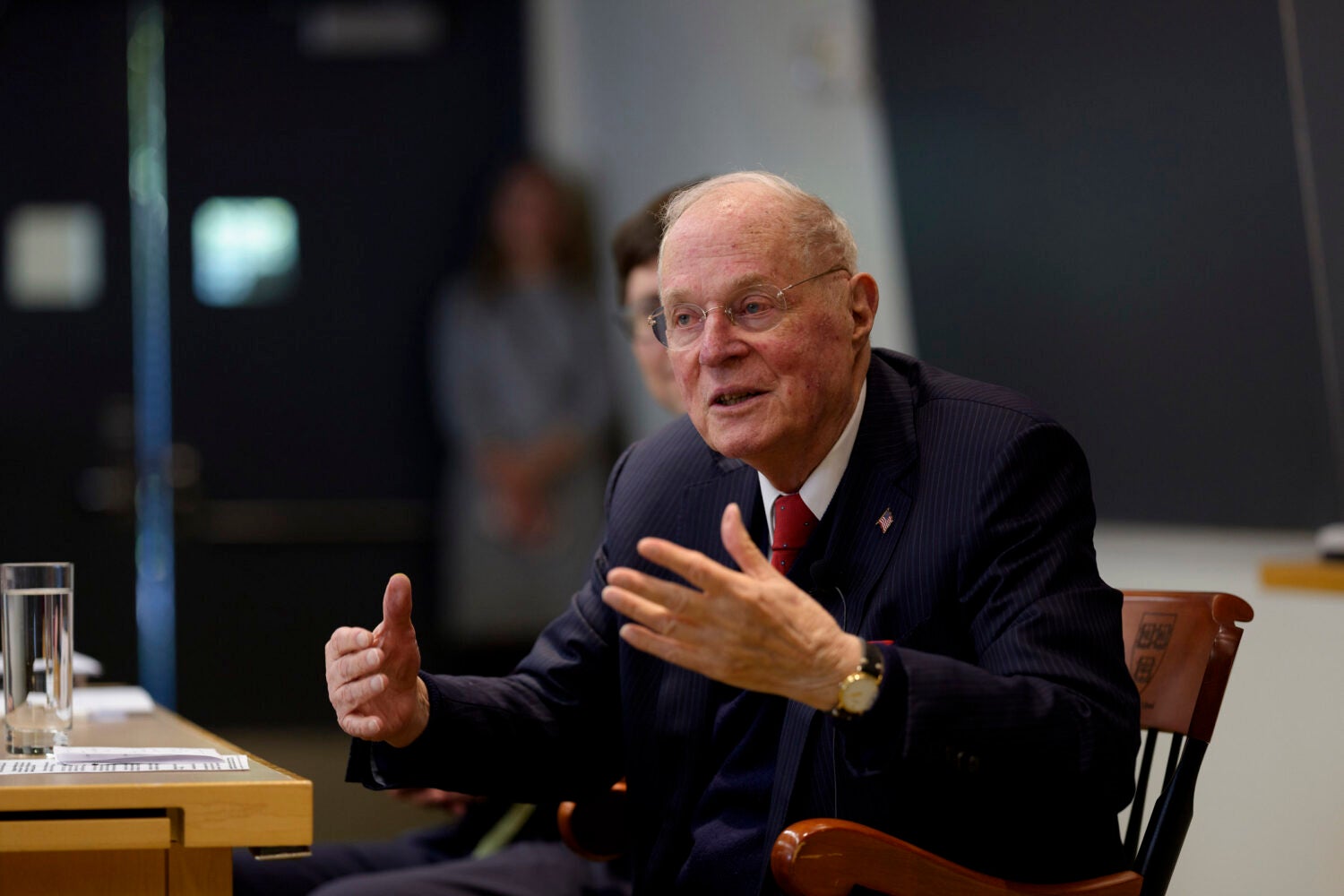
When considering the proper role of a judge, Anthony Kennedy ’61 points to Shakespeare.
The opening lines of “Hamlet,” and the protagonist’s subsequent self-reflection, can be an important guide for those interested in judicial work, the former Supreme Court associate justice said, noting that it’s the “sworn duty” of judges to reflect on and scrutinize their own work.
“Who’s there?” are the famous tragedy’s first words, and the Prince of Denmark spends the “rest of the play … asking himself who he is,” Kennedy told a Harvard crowd during a visit on Oct. 23.
“Judges must always do this. Judges must ask themselves, ‘Who [am I]? What are my motivations? What are my biases? Why am I tempted to do this at first thought?’ And this is the art and the fascination of judging. You find out more about yourself.”
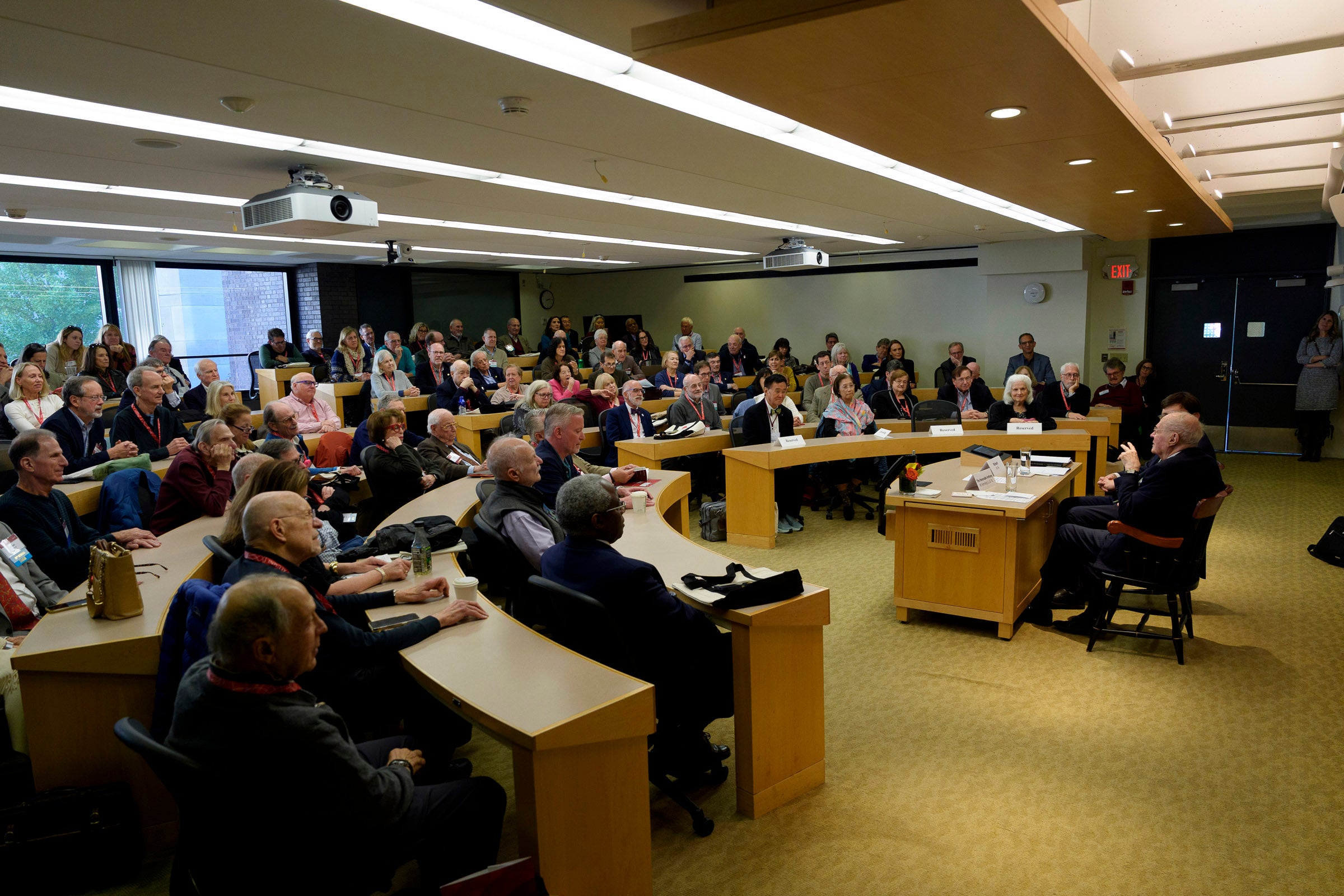
Kennedy, who also has been a legal scholar and lawyer, entertained his rapt listeners, some of whom spilled into an overflow room in Pound Hall to hear the energetic nonagenarian speak for more than an hour about his life and the law.
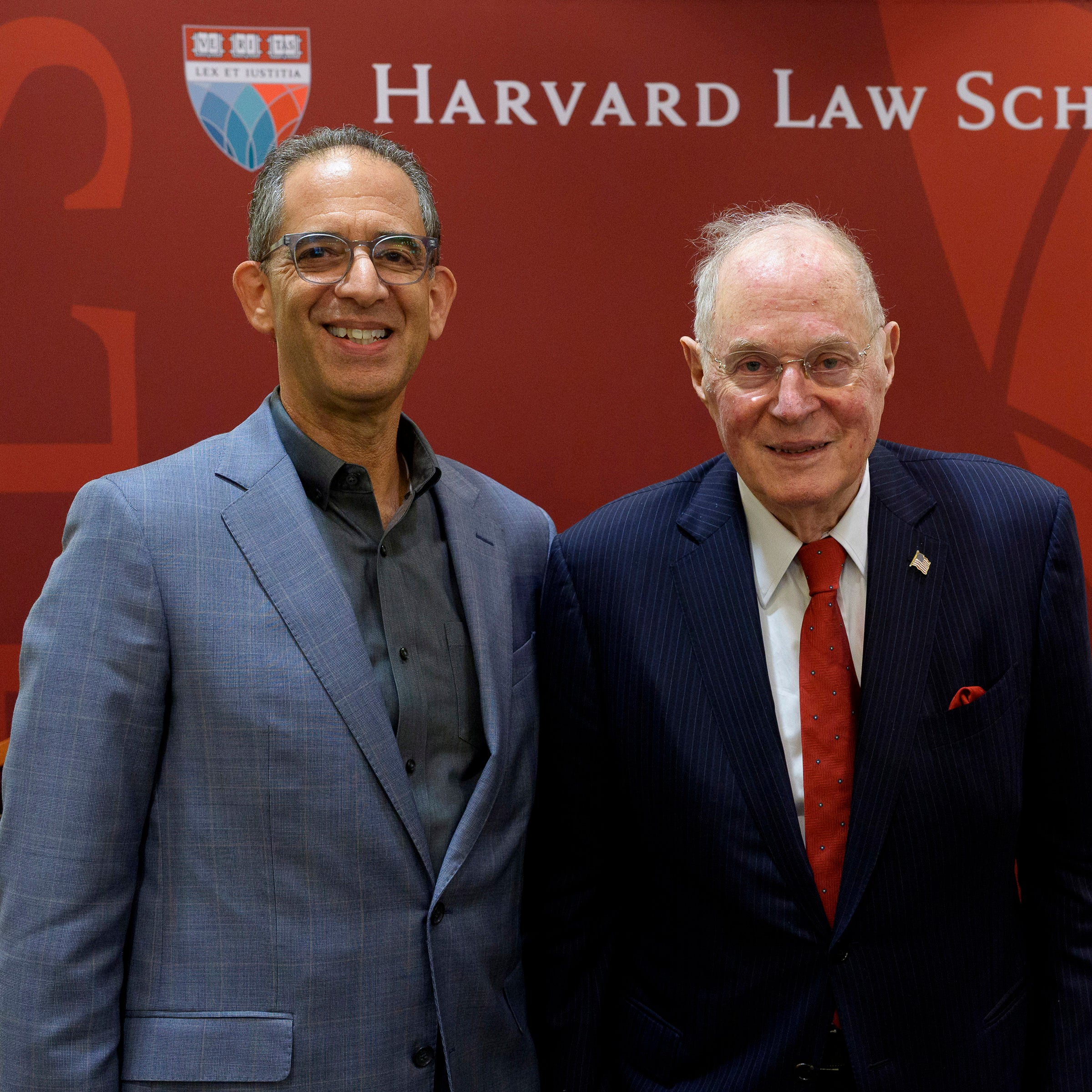
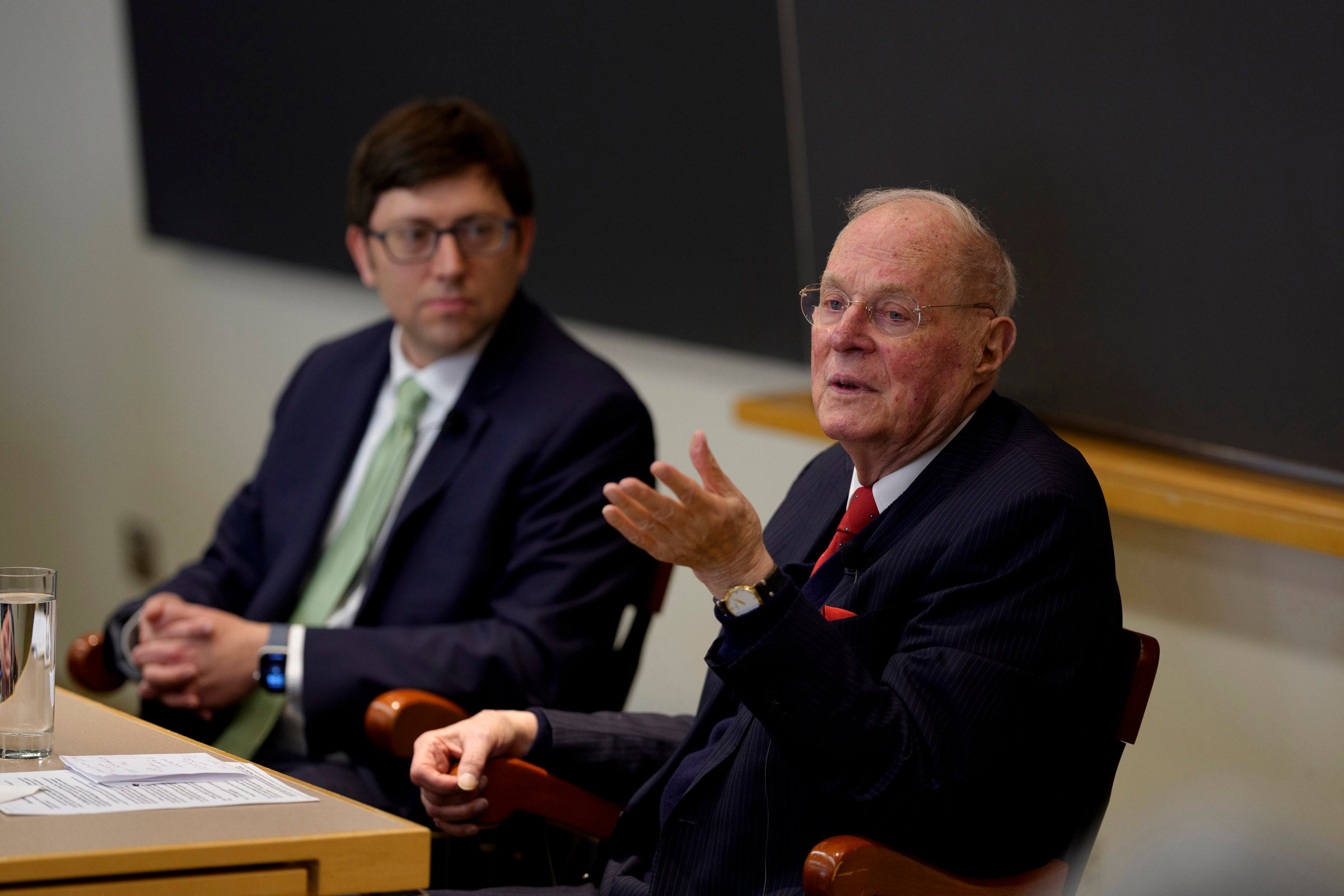
The discussion, part of the school’s fall reunion weekend, was moderated by Harvard Law School Professor Richard M. Re, a former Kennedy clerk, and touched on a range of topics, including Kennedy’s time at Harvard, his recent memoir, his work in the law, and his thoughts on some influential cases he took part in during his tenure on the high court from 1988 until his retirement in 2018.
Looking to the future, reflecting on the past
Discussing the likely consequences of artificial intelligence on judicial work, Kennedy jokingly quipped to Re: “I am 90 years old, and that’s your problem.”
Still, he said he recognized the technology’s immense potential. When some of his children wanted to know how he would have ruled on the recent case involving the administration’s imposition of sweeping tariffs, Kennedy told them, “There’s a statute that’s critical, and I frankly haven’t read the terms of the statute, so I don’t know, but it would be a close and difficult case.” So, his children turned to the internet to ask AI for a simulation of how he might have ruled.
“When the answer came back, I would have told you that I had written that opinion from a style standpoint. It was exactly my style. It’s amazing,” said Kennedy. “And it said it was a close case — I think it came out that I would uphold the tariff, and so that was just incredible. But something even more incredible was it came back in less than two minutes.”
“I couldn’t have done that as your clerk,” quipped Re.
“Two of my former clerks are on the Court,” Kennedy noted. “I said, ‘You didn’t do what I told you to do when you were my clerk; you better do it now,’” Kennedy replied, to laughter from the crowd.
Remarking on the incredible current pace of technological change and likely impacts on the future, Kennedy suggested looking to the U.S. Constitution, which he promptly pulled from his jacket pocket. “It’s incredible that … our Constitution has lasted that … long,” said Kennedy, “and we have to ask ourselves what do we do to make sure that if you put it in [a] time capsule and they pull it out 250 years from now, they’ll know what it means.”
“Judges must ask themselves, ‘Who [am I]? What are my motivations? What are my biases? Why am I tempted to do this at first thought?’ And this is the art and the fascination of judging. You find out more about yourself.”
Reflecting on his Harvard time, Kennedy recalled a range of professors including Austin Wakeman Scott LL.B. ’09, Henry M. Hart LL.M. ’30 S.J.D. ’31 Donald Frank Turner, and Clark Byse, his contracts professor, who was “quite rigorous in class,” said Kennedy, remembering the administrative law expert’s facility with the Socratic method. “In those days, we did not have classes in trial practice. You learned the art of argument and debate from your classroom, and Byse was very good at that.”
He recalled a funny anecdote involving one of the law school’s most renowned legal scholars, an exam, and Red Sox star Ted Williams. Kennedy’s tax law test was just days away, but the famous left fielder was also making one of his last appearances in Boston. Determined not to miss that, Kennedy convinced his classmate to head to Fenway Park with their books in tow. Sitting in the stands trying to study and watch the game, they heard a deep voice behind them say: “You don’t bring the revenue code to the baseball game.” It was their professor, and former Harvard Law dean, Erwin Griswold LL.B. ’28 S.J.D. ’29.
“And he never forgot it,” Kennedy recalled. “He would see me 30 years later in the Supreme Court … [and he would remind me.]”
Democracy, civility, and the rule of law
Kennedy said he opted to write a memoir because he wanted to have some notes for his children and grandchildren to read. More broadly, he hopes that his work, like that of colleagues who have written similar books in recent years, can help people to understand the importance of their judicial efforts both as a way to maintain the rule of law and democratic governance.
“Democracy is not on automatic pilot. You don’t take a DNA test to see if you believe in freedom. Freedom is taught, and democracies and freedom can die. … we have to teach our young people how important democracy is,” said Kennedy.
“We have to say, ‘You have to understand who you are. “You have to understand your destiny. You have to understand your purpose. You have to understand your meaning. You have to understand what America meant to our forefathers and foremothers and see how to preserve it for yourself.”
“Of course many of us are concerned about … the dissipation, the weakening of civility in our society generally, and I don’t want to see that creeping up to the courts because courts tend to reflect social interchange, social linguistics, social values, and if civility is being undermined generally in many institutions, then it is going to be undermined by the Court.”
Like many Americans, Kennedy said he is distressed by the lack of civility he finds in current public discourse.
“Well, of course many of us are concerned about … the dissipation, the weakening of civility in our society generally, and I don’t want to see that creeping up to the courts because courts tend to reflect social interchange, social linguistics, social values, and if civility is being undermined generally in many institutions, then it is going to be undermined by the Court.”
He has watched through the years as those penning judicial opinions have gone from being respectfully disagreed with to being attacked, noting language in more recent rulings that says “‘the judge who wrote the dissent or the majority is wrong again because ….’ This undermines civility, and this is a concern to me, and I’m talking to my colleagues about it.”
“Are you optimistic about our nation, about our constitutional republic?” wondered Re.
“I’m worried in the short term,” Kennedy said. “I’m optimistic in the long term. As I said, [in] the short term this lack of civility is really troubling. Although I think our history, our customs, our mores are strong enough to know that we don’t like a lot of what we hear, and we say that. It’s not just what you do; it’s how you do it.”
Supreme Court decisions that tested his convictions
Asked what he considered one of his most significant decisions, Kennedy pointed to Texas v. Johnson, in which the Court ruled that burning an American flag was a form of symbolic speech protected by the First Amendment. Though Associate Justice William J. Brennan ’31 penned the primary majority opinion, many people connect the ruling with Kennedy in part due to his powerful concurring opinion that outlined the personal struggles the case forced him to confront.
“This was a very difficult issue, and I wrote an opinion saying … it’s poignant but fundamental that the flag protects those who hold it in contempt.”
After the ruling, some senators protested and editors decried it in their publications, Kennedy recalled. But soon, attitudes shifted.
“People began to reflect. They said, ‘You know that that’s my speech … they’re talking about,’ and editorial and public opinion, they began to change. And that indicates to me that the Court and the law, our profession as a whole, has the duty and the honor, and the inspiration and the excitement of teaching the law to our people.”
One listener wondered if there were any decisions he made that he would change today.
Kennedy said his attitude changed around “the constitutionality, the lawfulness,” of sentencing minors to death. In the 1989 case Stanford v. Kentucky, Kennedy voted with the majority that held that executing someone who was 16 or 17 years old at the time of a crime did not violate the Eighth Amendment’s ban on cruel and unusual punishment. Sixteen years later, he authored the opinion in Roper v. Simmons in which he took the opposite view.
In his memoir, Kennedy wrote that “in Stanford, the Court noted that some states had permitted capital punishment for crimes committed by sixteen- and seventeen-year-olds. The Court considered that fact dispositive in deciding that the penalty could be imposed. But the passage of time and the consideration of other cases led me to conclude that the Court in Stanford had put too much emphasis on prevailing practices and too little on the Court’s own interpretation of the evolving standards of decency.”
In the earlier case, “I was concerned that teenagers would know that rule and be encouraged to commit a homicide, knowing they couldn’t get the capital punishment,” said Kennedy. “I later thought that decision was wrong, and I wrote the opinion which reversed [my earlier decision].”
Kennedy also weighed in on prison reform, pointing to other countries such as England that have shorter penalties and lower recidivism rates, and the need to rethink solitary confinement, citing his own experience in the military when he was locked in a cage for hours as part of a prisoner-of-war simulation.
“I think after 60 minutes I began to go nuts.” He suggested that prisons could adopt “circular or semicircular cells where prisoners can talk to each other even though they’re just so dangerous they have to be confined solitarily.”
“Prisoners are real people,” Kennedy said, “and we have to reach out to them more than we do.”
Similar to the flag-burning case, the 2015 gay marriage case Obergefell v. Hodges, in which the petitioner argued for the right of a same-sex couple to marry, challenged Kennedy’s own beliefs. “That was a very difficult case for me: one, just from a religious standpoint; two, from the standpoint of personal attitude.”
The religious dimension to the case was difficult for Kennedy, a devout Catholic whose faith defines marriage as a covenant between a man and a woman, and he admitted he was unaware of what homosexuality was until he was in his mid-twenties.
“So, I learned about it a little late. And as I say, my religious and my cultural values are different. But you have to put that aside. And what really convinced me was that gay couples in the United States have hundreds of thousands of children whom they’ve adopted, and these children [would] have to go through life knowing that if the law had not been struck down, knowing that their parents were unlawfully together, and I thought that was wrong, and that was kind of the turning point.”
In the end, Kennedy penned the majority opinion, sections of which people have told him they now have read at their weddings, even weddings between a man and a woman. Or portions are attached to their kitchen refrigerators.
“It talks about the meaning and the validity and the beauty of marriage,” said Kennedy, “so I passed the refrigerator test.”
Want to stay up to date with Harvard Law Today? Sign up for our weekly newsletter.