In this country, Congress and the courts possess tools that can rein in the executive branch’s broad powers to use economic coercion — in the form of sanctions, export controls, and tariffs — on allies and enemies alike.
But the most effective checks against that power may not come from either constitutionally co-equal branch of government. Instead, they may emerge globally from the countries targeted by coercive measures, which may retaliate in ways the United States does not anticipate, according to Harvard Law School Professor Kristen E. Eichensehr.
“The United States is not the only country that is deploying these tools … and the United States is going to be on the receiving end of some of the very same tools,” said Eichensehr, the Balthrop Cassidy Professor of Law and faculty director of the National Security Law & Policy Initiative, which recently launched at the law school.
Eichensehr pointed to the retaliation the United States has faced from China, which has dramatically restricted exports of rare earth elements used in technologies ranging from memory chips and semiconductors to radar systems and fighter jets.
“I don’t think the U.S. government has really played out the moves there,” Eichensehr said, adding later that “the U.S. government’s assumption across a range of tools tends to be that it has escalation dominance … it’s a little overconfident about that.”
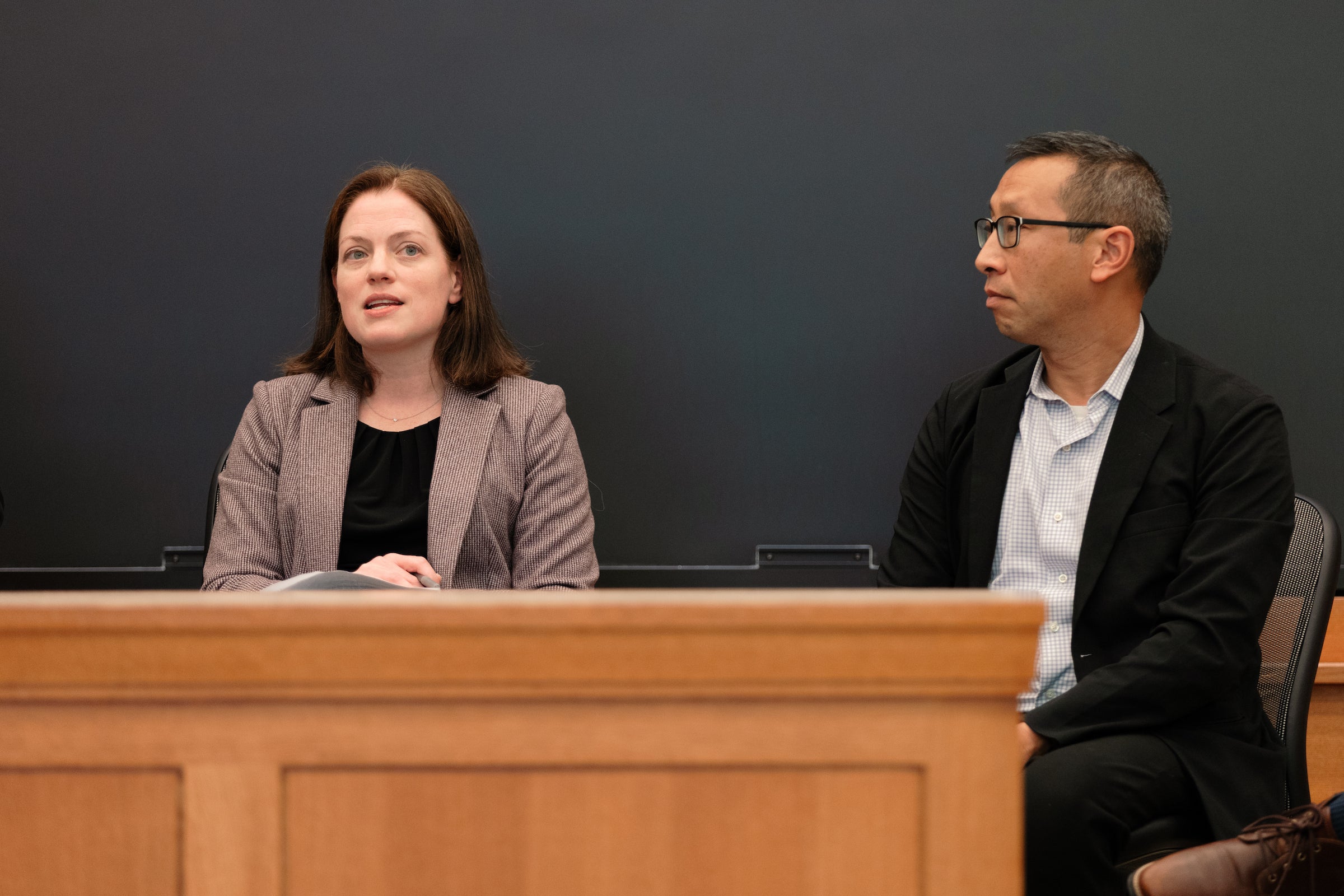
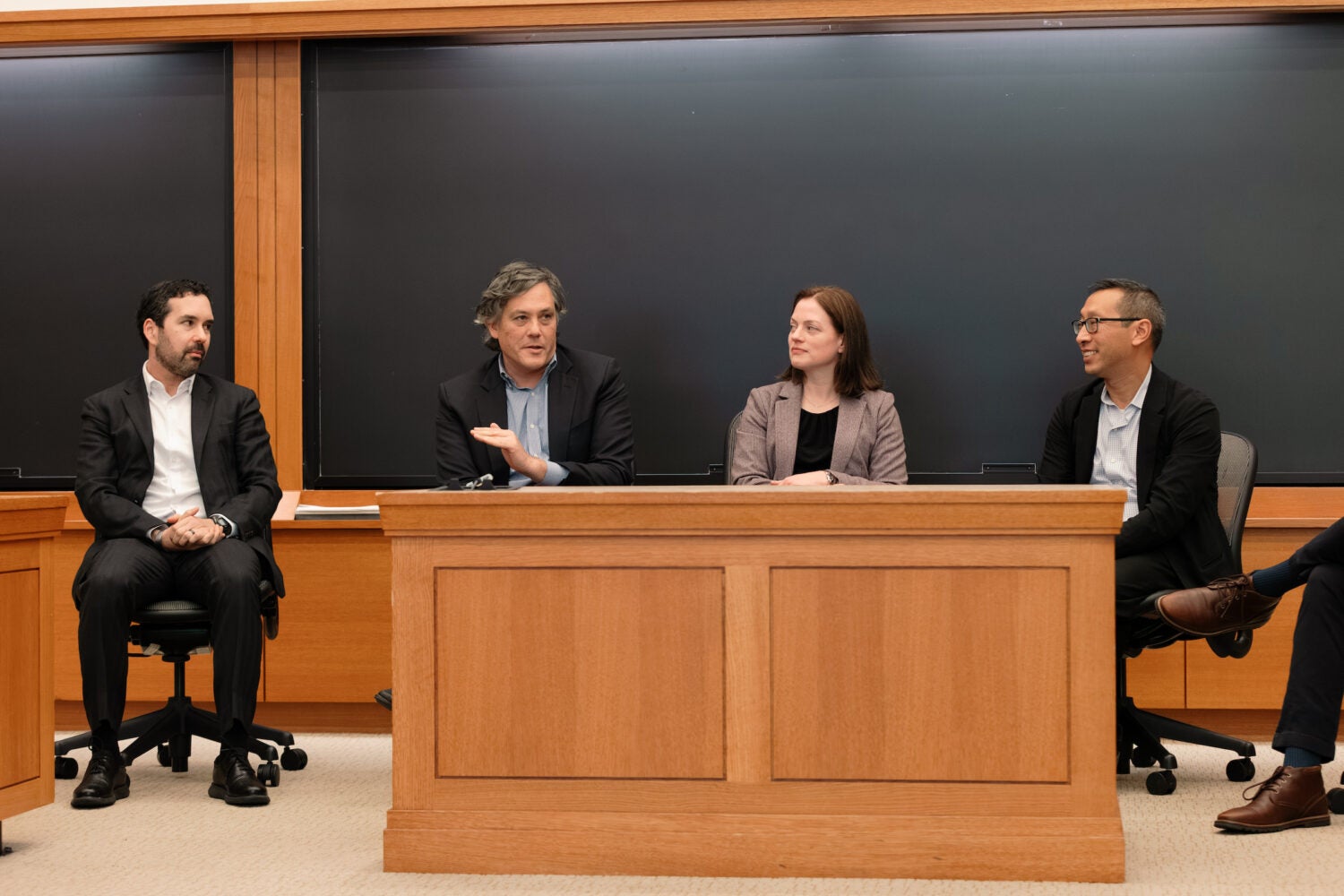
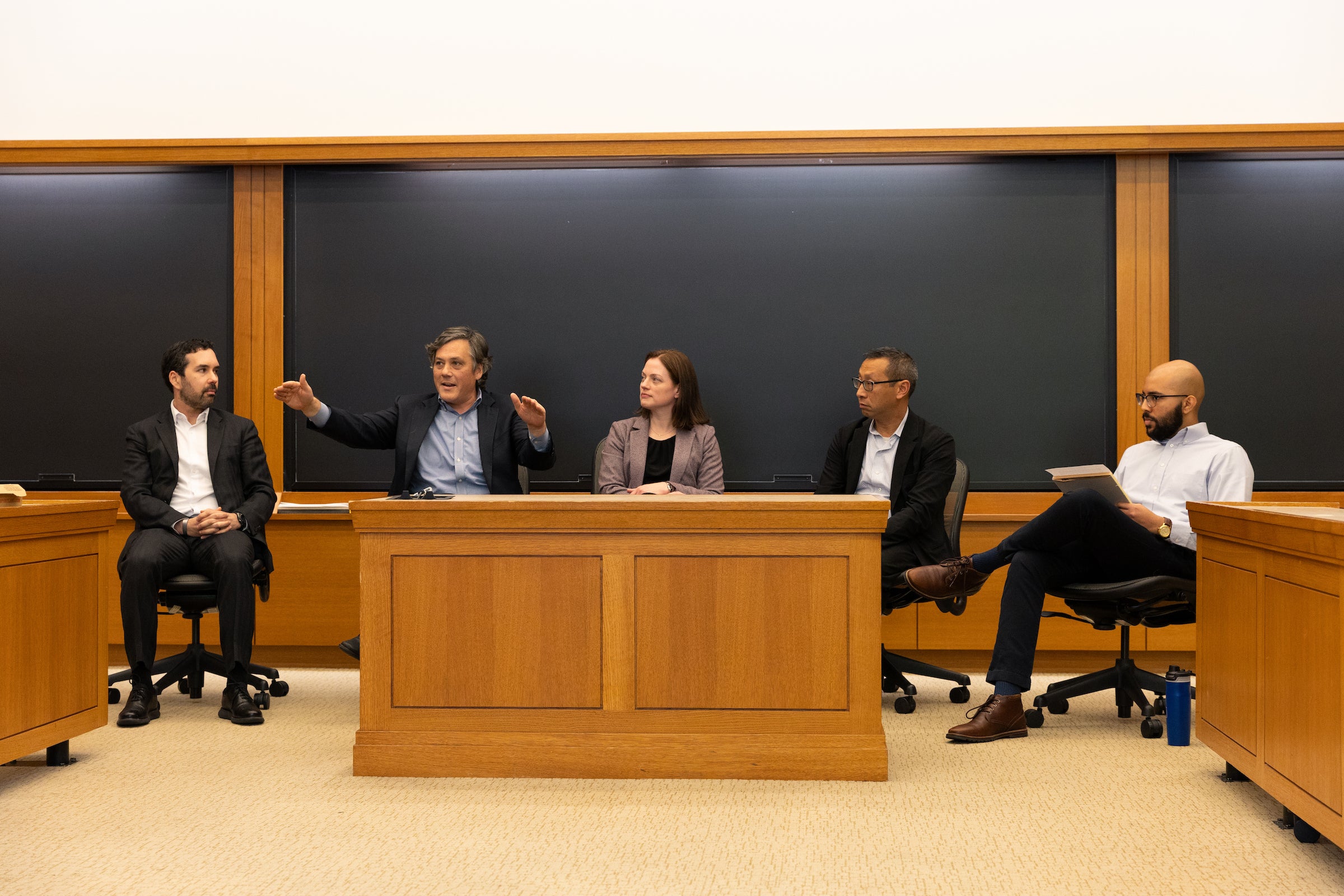
Eichensehr spoke with other economic national security law scholars, including Mark Wu, the Henry L. Stimson Professor at Harvard Law, as part of an Oct. 19 event, “Economic National Security Law: The Future of Sanctions and Illicit Finance,” organized by the Harvard National Security & Law Association (NSLA). Eichensehr and Wu were joined by Alex Zerden, an adjunct professor at Georgetown University’s School of Foreign Service and American University Washington College of Law, and Peter E. Harrell, a visiting scholar at Georgetown’s Institute of International Economic Law. The panel was moderated by Shankara L. Narayanan ’28, who is on the board of the NSLA.
Part of the discussion revolved around the U.S. Supreme Court’s February decision in Learning Resources v. Trump, a case in which the justices ruled 6-3 that President Trump did not have authority under the International Emergency Economic Powers Act to impose tariffs. Despite the ruling, the panelists agreed the president has broad authority to enact unilaterally all sorts of economic sanctions. They also agreed that doing so can backfire.
“The more you use coercive economic tools, the more you create incentives to develop alternatives” to the U.S. financial system, said Zerden, who previously served on the White House National Economic Council and the U.S. Treasury Department’s Office of Terrorism and Financial Intelligence and Financial Crimes Enforcement Network.
The speakers pointed to examples such as Canada’s interest in associate membership with the European Union and the EU’s recent trade agreement with India.
But Wu and Zerden both said it would be hard for middle- and lower-income countries to match the power of the United States or China anytime soon even with new treaties, associations, and alliances.
“In terms of creating legal work for future lawyers, they’re doing quite a lot there, but … are they able to do this and emerge as a third pole?” asked Wu, who was a senior advisor to the U.S. Trade Representative in 2021. “Even if they want to do this, the question is how are they going to pay for it? And can they pay for it at the scale necessary to emerge as a credible alternative to the U.S. and China?”
The panelists agreed that the U.S. and China seem to have maneuvered themselves into a diplomatic stalemate of sorts. Harrell noted that the Trump administration, despite taking many steps supposedly designed to bring down oil prices, has not levied any penalties against Chinese banks that continue to buy oil from Iran and Russia (and Venezuela, before the United States deposed its then-President Nicolás Maduro). Instead, Trump has imposed naval blockades, which Harrell called “a 19th century” form of economic warfare.
“There’s a fascinating diplomatic reality there,” said Harrell, who under the Biden administration led policy processes to impose sanctions and export controls on Russia. “The Trump administration has decided it is diplomatically easier to impose a naval blockade … than to sanction large Chinese banks or other large Chinese companies. … Trump understands that if he imposed sanctions on large Chinese actors, China would feel compelled diplomatically to respond … [and] because they’re diplomatically not calling out China … China has decided they can deal with it.”
During a Q&A session, Wu cautioned that the world is in a new era in which economic tools may not be sufficient to produce any particular desired outcome.
“Our generation might be overly optimistic about the efficacy of this, based on the Cold War … if you persist long enough, over time it will eventually hurt the other side so much so that they run out of options,” he said. “That was really due to a set of historical contingencies about a certain leader in the USSR’s unwillingness to deploy troops.”
Want to stay up to date with Harvard Law Today? Sign up for our weekly newsletter.