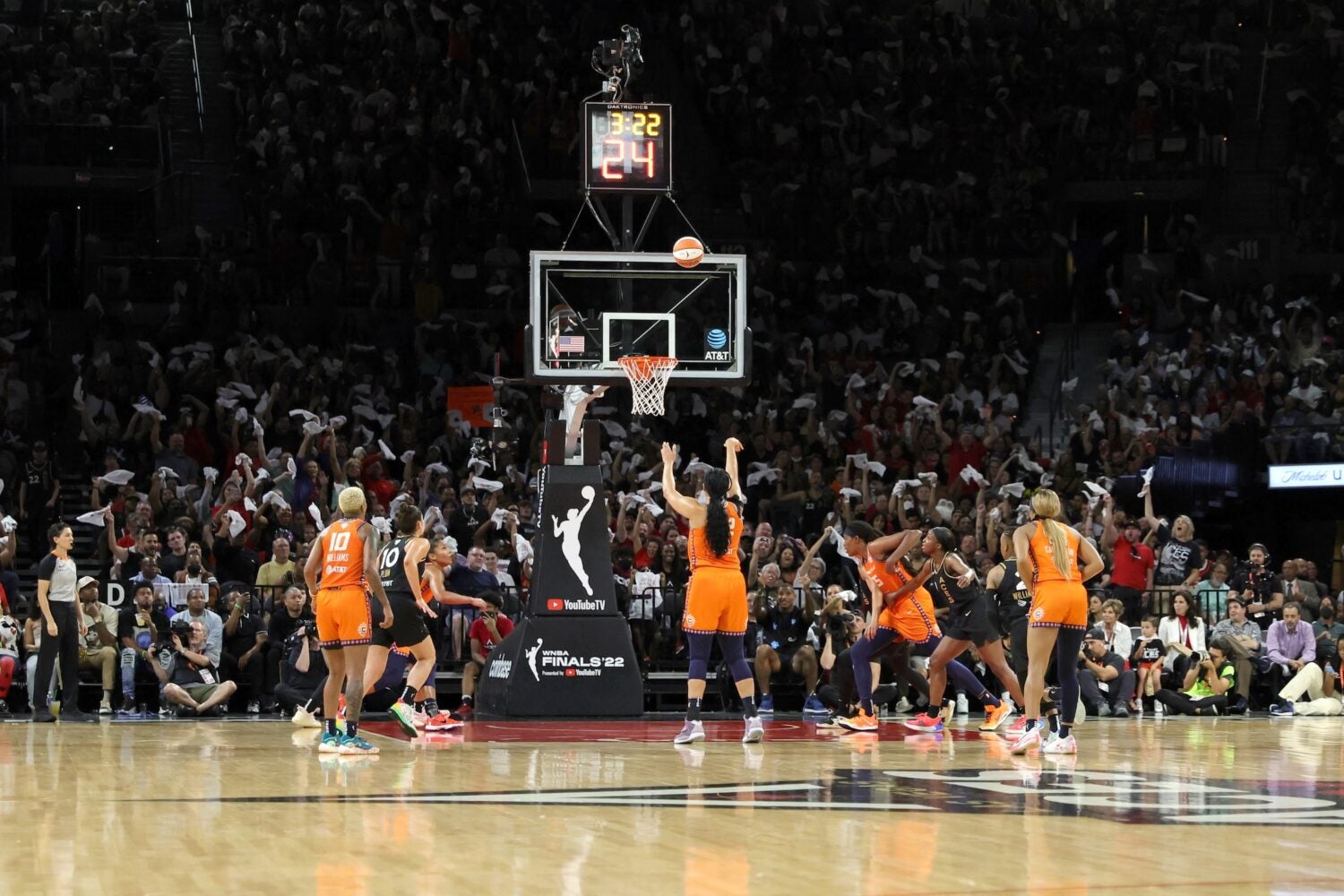
This past March, members of the Women’s National Basketball Players Association (WNBPA) ratified the terms of a landmark seven-year collective bargaining agreement, an outcome that was long in coming, according to one of the principal negotiators.
Erin D. Drake, senior advisor and legal counsel at the WNBPA and a current Harvard Law School Wasserstein fellow, was a member of the union’s negotiating team that helped secure the agreement. Administered by the school’s Office of Public Interest Advising, the Wasserstein Fellows Program brings experienced public interest lawyers to campus to share their expertise and advise students pursuing careers in public service.
At a Sept. 29 talk at Harvard Law School called “Women’s Sports, Practicing Democracy, and Fighting for Workers Voices at the Bargaining Table and Beyond,” Drake discussed the negotiations, the importance of building consensus among players, and the experiences that drew her to this work.
Under the new agreement, the WNBA’s salary cap saw a nearly 400% increase, growing from roughly $1.5 million per team in 2025 to $7 million in 2026. The maximum salary jumped to $1.4 million, nearly the entire cap from the prior season. Minimum salaries, which had been below six figures, have increased to $270,000-$300,000, depending on years of service.
“That is historic in sports agreements and that is historic in labor agreements,” Drake said, and she made it clear that this negotiation was about far more than money.
“It wasn’t just about salary. It was about housing. It was about charter flights. It was about the accommodations players are staying in. It was about family planning benefits. It was about 401(k)s and retirement. It was about retired players,” said Drake.
Drake came to the WNBPA, the first labor union for professional women athletes, to make gains on all these fronts. She worked with a team of labor experts and player representatives to fight for a better contract, stronger protections, and a larger share of the league’s success. “It was huge, but it was 30 years in the making,” she said.
“Women’s sports are vulnerable — not for the reasons that people say. They’re vulnerable because of the lack of investment, the lack of attention, the disregard, and the harm that people continue to face,” Drake said.
Working on behalf of vulnerable populations has been a throughline in Drake’s career.
Although an athlete in her youth, she had not specifically planned for a career in sports law. During a postgraduate clerkship with Judge Diane P. Wood of the U.S. Court of Appeals for the Seventh Circuit, she sought guidance about her professional future.
Judge Wood advised Drake that her decision should be less about zeroing in on one specific role but rather finding work that would support her values.
“What I cared about was making this world safer for women to be free, and for women to be exactly who they are — on court, in a courtroom, wherever they find themselves.”
“She told me to ‘Stop thinking about what job you want,’” Drake recalled. “‘Ask yourself … what do you want to be excellent at? Whatever you decide, use that to find places where you can learn skills that are applicable to that.’”
For Drake, that reframing led to clarity and direction. “I realized what I wanted to be good at was building coalitions for the ideas and people that inspire me.”
At the WNBPA, Drake put that commitment into practice, helping to build trust and consensus among players throughout the negotiations. The agreement was ultimately approved by 100% of the players who voted.
“This was all a practice and a vote of confidence in the process of democracy,” she said.
For Drake, building coalitions and mobilizing collective action are ways she uses her legal training to support a goal that aligns with her values: improving women’s lives.
“What I cared about was making this world safer for women to be free, and for women to be exactly who they are — on court, in a courtroom, wherever they find themselves.”
Want to stay up to date with Harvard Law Today? Sign up for our weekly newsletter.