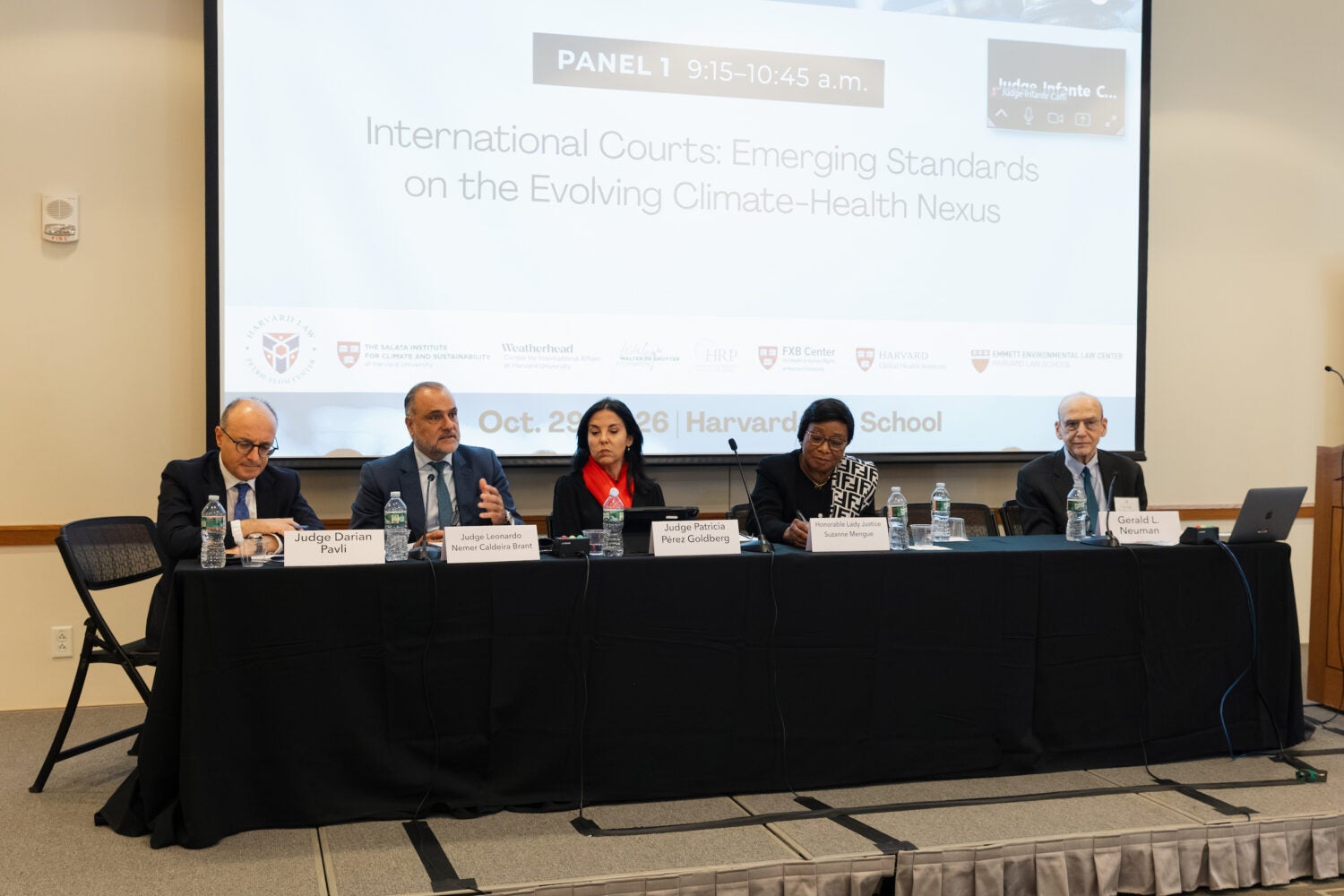
With international and domestic courts continuing to issue advisory opinions and final judgments on how climate change can undermine health, Harvard Law School hosted a dialogue among the advocates who bring such cases and the judges who decide them to seek a deeper understanding of the issues.
The need for such a dialogue is urgent, practitioners said at the Oct. 29 conference called Judicial Dialogues on Health and Climate Change: Emerging Standards, Comparative Trajectories, and Future Directions, sponsored by the Petrie-Flom Center for Health Law Policy, Biotechnology, and Bioethics.
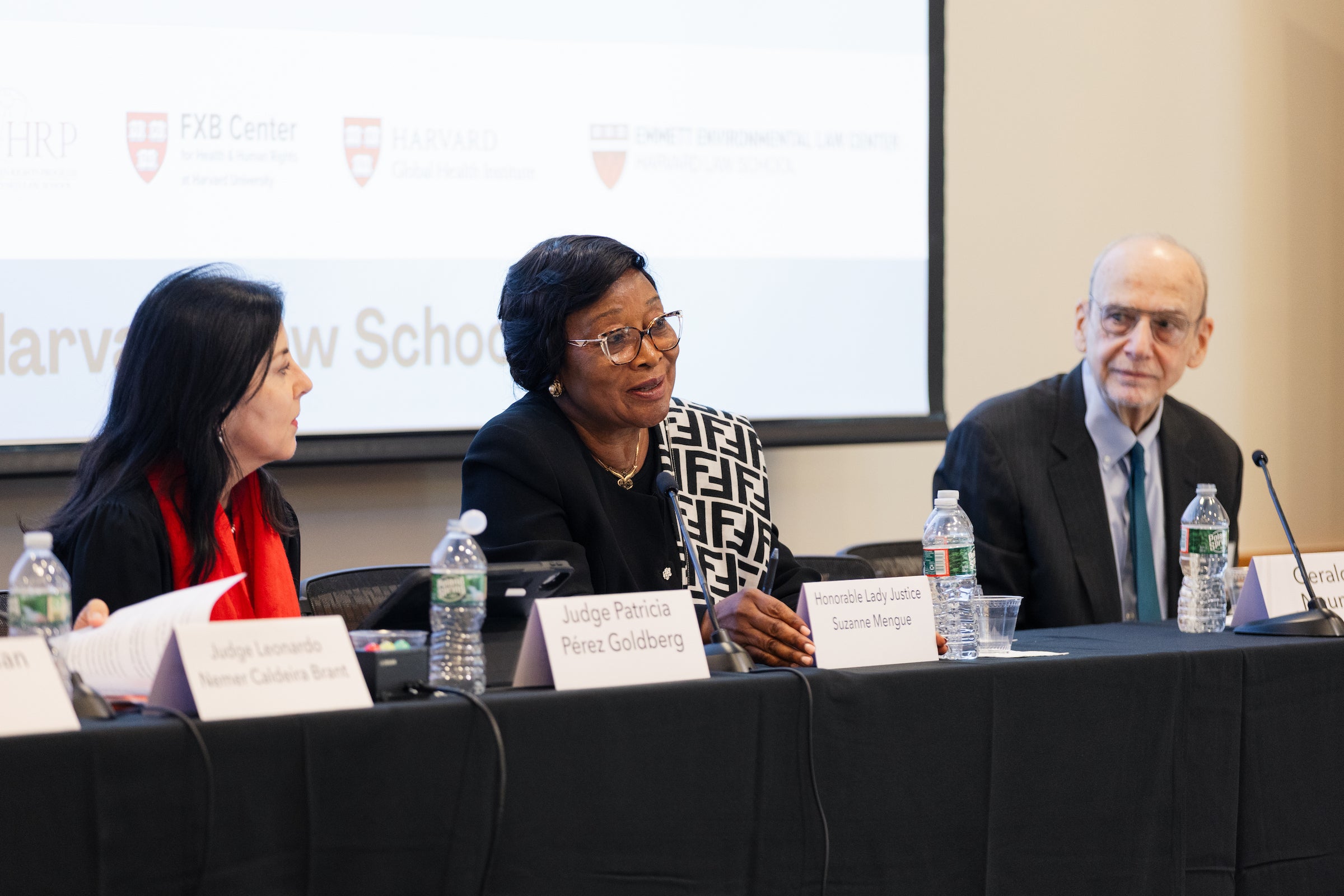
“How do we address harm that crosses borders and jurisdictions?” asked Justice Suzanne Mengue of the African Court on Human and Peoples’ Rights. “Judicial dialogue is no longer optional; it is essential … [we] must speak the same legal language.”
Mengue, whose court is currently considering a request for an advisory opinion on the human rights obligations of African countries in addressing the climate crisis, said that past cases prove the point.
She mentioned a 2023 decision from her court finding that Côte d’Ivoire had violated African Charter on Human and People’s Rights provisions concerning life, health, and a generally satisfactory environment when it failed to prevent a multinational company from dumping more than 500 cubic meters of toxic waste in Abidjan in 2006. It was the African court’s first decision on the right to a healthy environment guaranteed in the charter.
“In Africa, ladies and gentlemen, in Africa, this is not an academic debate,” Mengue said. “It is a matter of survival.”
The event was organized by the Petrie-Flom Center for Health Law Policy, Biotechnology, and Bioethics at Harvard Law School and co-sponsored by, among others, the law school’s Human Rights Program and its Emmett Environmental Law Center.
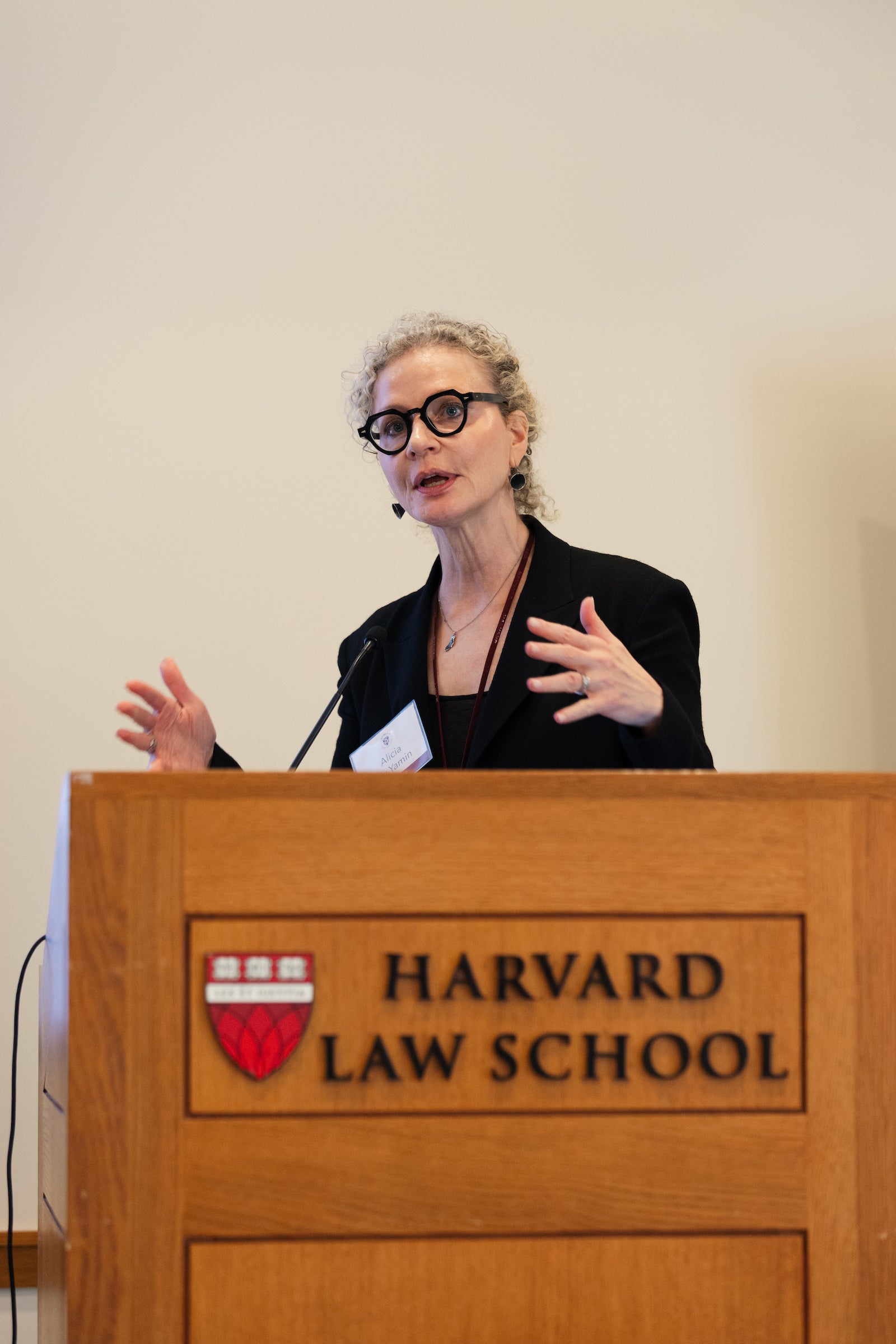
Harvard Law’s Gerald L. Neuman ’80, the J. Sinclair Armstrong Professor of International, Foreign, and Comparative Law and director of the Human Rights Program, welcomed guests on the first day of the event, as did Alicia Ely Yamin ’91, who directs the Petrie-Flom Center’s Global Health and Rights Project. Petrie-Flom Center Faculty Director I. Glenn Cohen ’03, the James A. Attwood and Leslie Williams Professor of Law, appeared by video.
“Today’s event seeks to offer a space to have dialogues about the ways judicial opinions already have in some cases and can in future make the disparate health consequences of climate change legible as legal harms, and how they can tailor appropriate remedies that may offer differential protections,” Yamin said.
The conference convened judges, litigators, and scholars from Africa, Europe, and Latin America for a comparative examination of the evolving relationship among climate change, the right to health, and judicial enforcement.
How international courts are shaping climate law
The first panel, “International Courts: Emerging Standards on the Evolving Climate-Health Nexus,” focused on recent advisory opinions from the International Tribunal for the Law of the Sea, the Inter-American Court of Human Rights, and the International Court of Justice.
Judge Leonardo Nemer Caldeira Brant of the ICJ said his court’s main contribution to the body of law at the nexus of health and climate change in its 2025 advisory opinion was structural. In it, the court stated that “international human rights law, the climate change treaties and other relevant environmental treaties, as well as the relevant obligations under customary international law, inform each other.”
With that finding, “the court integrated human rights into the coherent and comprehensive legal order applicable to climate change,” Brant said.
The panel, which was moderated by Neuman, included Mengue and judges from the International Tribunal for the Law of the Sea, the European Court of Human Rights, and the Inter-American Court of Human Rights.
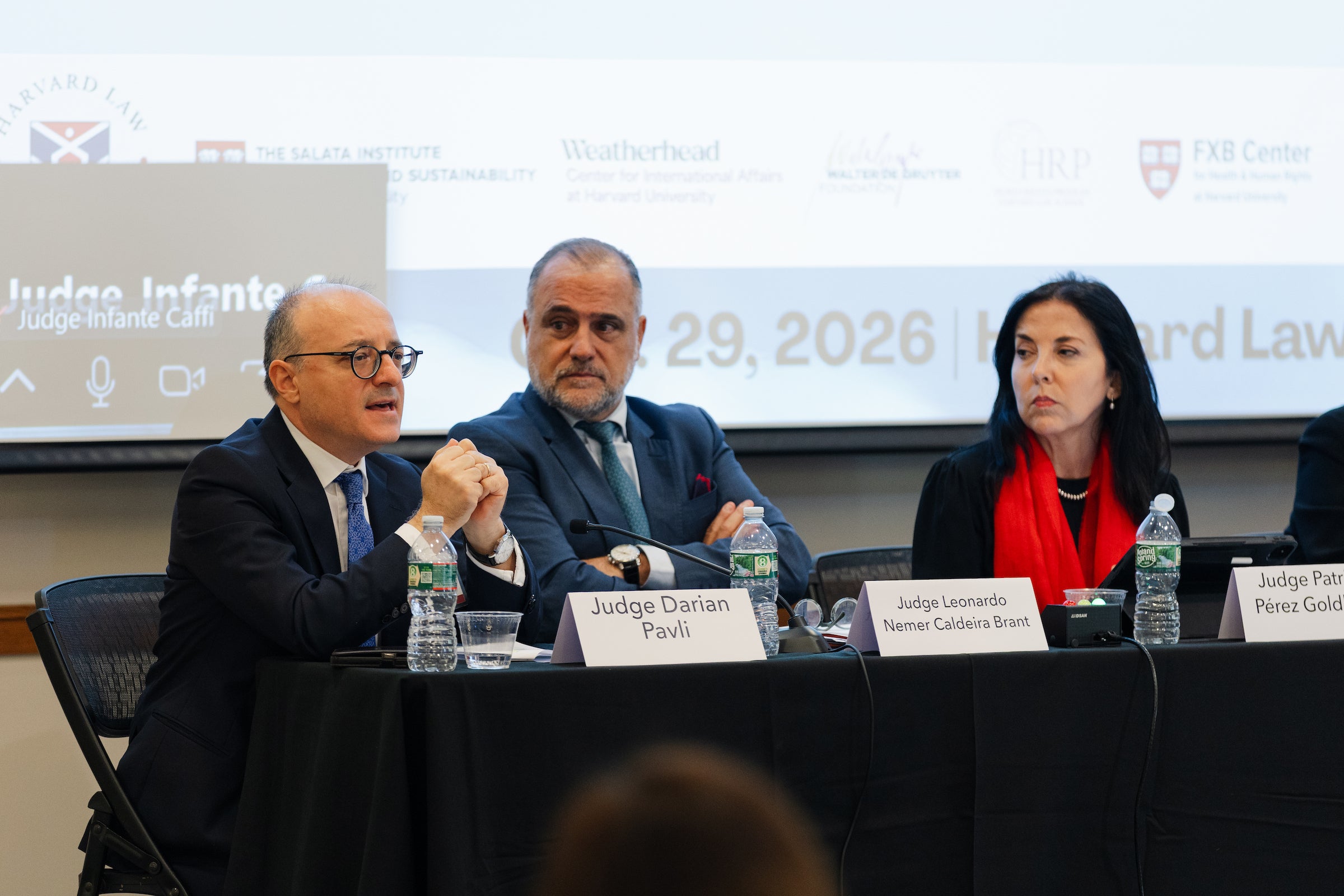
Panelist Darian Pavli, a judge on the ECHR, said his court had faced intense opposition from national governments that urged the court to let them negotiate climate change matters rather than subject them to human rights laws.
Instead, in a landmark 2024 ruling, the court held, among other findings, that Switzerland had violated its citizens’ rights by failing to protect them from the effects of climate change.
“It is rather disingenuous to say that climate change does not affect people’s fundamental rights,” Pavli said. Still, “you can imagine the relief” when other courts issued opinions “going more or less in the same direction.”
From judicial decisions to action
Other sessions featured judges from domestic court systems in Colombia, Germany, Kenya, and Mexico (the latter represented by former Supreme Court Justice Alfredo Gutiérrez Ortiz Mena LL.M. ’98); a visual presentation of the effects of extreme heat in India; a screening of the short film “One Hot Day,” which follows three women in India’s informal economy; a discussion of scholarship and research on climate-health adjudication, which featured Michael Stein ’88, director of the Harvard Law School Project on Disability; strategies for advocates and litigators, with remarks by Harvard Clinical Professor of Law Tyler Giannini; and comments from Dr. Vanessa Kerry, the World Health Organization’s special envoy for health resilience and director of the Global and Climate Health Policy program in the Harvard T.H. Chan School of Public Health.
Yamin said she hoped to expand the health and climate conversation in the future to include information on the kinds of scientific evidence needed to bring such cases and the social movements behind them.
“I have found myself continually thinking about what do these rights mean in practice? And what is the role of courts in turning law on paper into law in action?” she said. “We thought it might be useful to bring diverse actors together in dialogue to discuss these different frameworks and the challenges in moving from judgments and standards to effective public policy in implementation and practice.”
Want to stay up to date with Harvard Law Today? Sign up for our weekly newsletter.