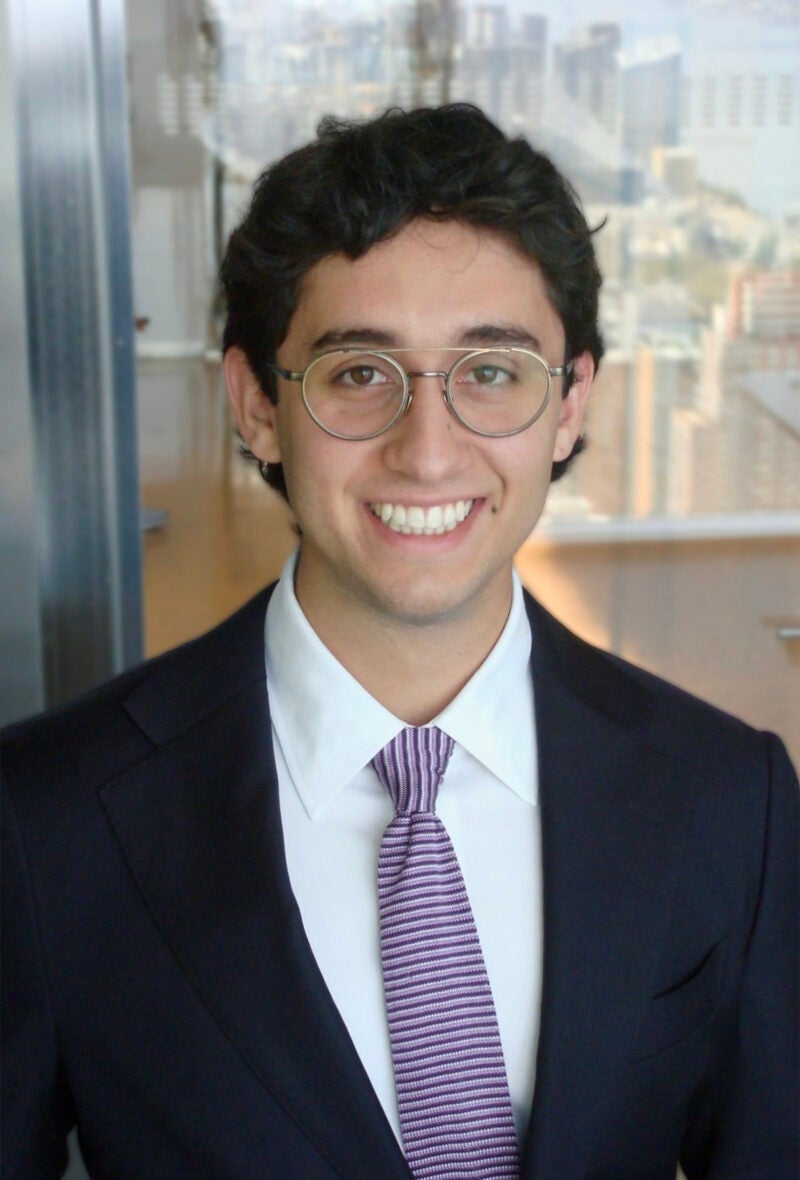
Omid Yeganeh LL.M. ’26, a Canadian born to Iranian parents, spent time in many places growing up — from Montreal, to Paris, to Washington, D.C., and then to the United Kingdom (and a year back in Paris) for law school.
Perhaps seeing the world from so many vantage points helped inspire his interest in international law, a subject he is studying today as a graduate student at Harvard Law School — an experience he says he is enjoying immensely. “It’s amazing how much I’ve enjoyed my time here.”
Two months ago, Yeganeh became the latest Harvard Law student to receive a Rhodes Scholarship — one of the most prestigious academic awards in the world. After he graduates from Harvard, Yeganeh hopes to harness his scholarship to delve even deeper into international law — and international human rights — as a doctoral student at Oxford University, his alma mater.
As a student at Harvard, Yeganeh is taking courses, serving as a researcher and student attorney with the International Human Rights Clinic, and working on a thesis that he hopes might one day culminate in a longer dissertation for his Ph.D. His ultimate goal — one he’s held since his teenage years — is to become a practicing public international lawyer and scholar.
In an interview with Harvard Law Today, Yeganeh shared more about his interests in international law — and what he hopes to achieve as a doctoral student at one of the world’s premier universities.
HLT: In Quebec, where you are from, it’s possible to study law as an undergraduate, as is the case in the U.K., where you went to law school. How did you know you wanted to study law as a teenager?
Yeganeh: Honestly, I wasn’t entirely sure what I was getting myself into. If you’d asked my 17-year-old self what I found interesting about the law, I’d have said that it was a good way to do something that’s both interesting and meaningful. Interesting, because the questions that lawyers ask are not so different from the questions I had been exposed to in philosophy, sociology, and political science classrooms. Meaningful, in the sense that law felt like a good way to make a difference — to make the world a better place.
HLT: How did you come to see international law — and international human rights law, in particular — as your central focus?
Yeganeh: A lot of what motivated me to get a legal education eventually also drew me to international law. I thought, even before starting in Oxford, that it would be something I’d enjoy — probably because of the scale and complexity of the issues involved — so once I got to law school, I took every international law class I could. Obviously, I was not disappointed!
I’ve since been lucky to work on a few cases before international courts and tribunals. Aside from cementing my desire to pursue a career in international law, those experiences gave me exposure to some of the incredible people involved in the international legal profession — at Harvard and elsewhere — and I’ve been consistently amazed by their endless kindness, generosity, and general brilliance. To work side-by-side with some of these people on issues that are both intellectually challenging and morally pressing is more than anyone could ask for, really.
HLT: What drew you to Harvard Law to pursue your LL.M. degree?
Yeganeh: One major driver was the opportunity to think about international law in a new place, and from a different perspective. International law is naturally a discipline that lends itself to an international education. I was also attracted to the flexibility of the LL.M. — Harvard felt like a place where I might be able to do many different things, and where I would enjoy ownership over my course of study. I was also very excited to participate in programs like the International Human Rights Clinic, and to work with faculty whose scholarship I admired.
HLT: What have you focused on during your time at Harvard?
Yeganeh: I’ve spent most of my time in specialized seminars in international law, and working on a master’s thesis that I hope might supply the seeds for doctoral research. I’ve enjoyed it a lot — and of course I have my peers and faculty to thank for that. Above anything else, it’s the people at Harvard who have made my time here so special.
Another one of the highlights of my time at HLS has been my involvement with the International Human Rights Clinic. Aside from all the amazing work it does, the Clinic brings together an incredible community of dedicated lawyers, students, and staff, and I’m very proud to be contributing to their mission.
HLT: So, what happens next, now that you’ve been awarded a Rhodes Scholarship? Will you go directly from Harvard to Oxford to continue your doctoral studies?
Yeganeh: My plan now is to return to Oxford for doctoral studies once I complete the LL.M. here. I haven’t fully decided on a research question, but I think I might write about inchoate or incomplete violations of international law. I’m interested in understanding what happens between the time when a state starts trying to violate international law and the time when it succeeds, or better still, when it fails. I’m looking to unpack that interstitial space, and to figure out how international law does and should respond to it.
HLT: Do you have a sense of what you might want to do after completing your Ph.D.?
Yeganeh: I’d like to combine practice and academia, although I’m not yet sure how, or in what proportions. My hope is that keeping a foot in each world might make me better at both. Luckily for me, it’s not uncommon for international lawyers to pursue both avenues. Ultimately, of course, the goal is to do my part, however small, in delivering on the promise that drew me to international law in the first place.
Want to stay up to date with Harvard Law Today? Sign up for our weekly newsletter.