Constitutionalism is always something of a balancing act, according to a new book by Harvard Law School Professor Emeritus Mark Tushnet and University of Sheffield Professor Bojan Bugarič. Depending on its use, the same constitution can create democratic government and constrain it, can safeguard against authoritarianism and empower it.
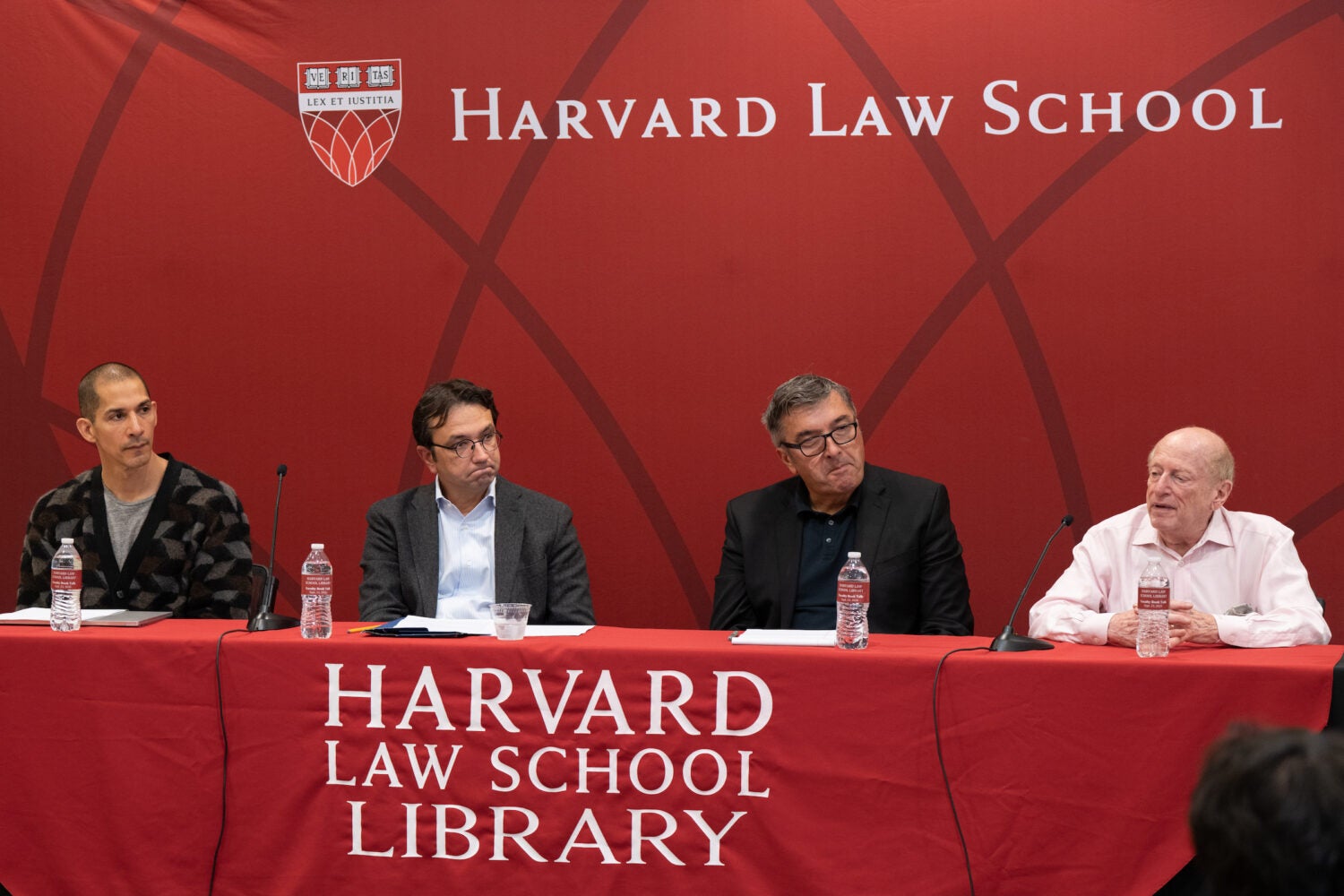
The authors of “Constitutionalism and Its Discontents” explored this paradox in a book talk on Sept. 23 at an event sponsored by the Harvard Law School Library. Harvard Law Professor Ryan D. Doerfler ’13 and Visiting Professor Vlad Perju S.J.D. ’07 joined in a wide-ranging talk on the arguments for and against constitutionalism.
When constitutional constraints become a risky bet
In his opening remarks, Tushnet explained the back-and-forth nature of constitutional government. If you win an election and take power, he said, you have an agenda that you want to carry out. “You’re able to implement some parts of it, but other parts run up against what the Constitution says you can do … and you’re unhappy with that.” But, he noted, you’ll also realize that the party you disagree with will eventually take power and will run up against the same constraints.

“And so you make a bet that overall, with this sort of back-and-forth exercise of power, you’re going to be satisfied with what you can get out of the policymaking system,” he said. “Your bet is that when your opponents are in power, they’ll do stuff you won’t like, but it won’t be so terrible that you’ll find yourself in deep disagreement, to the point where you want to say no and get out of the system.”
This bet, he said, doesn’t pay off all of the time. But it’s more likely to happen under what Tushnet calls a “thin” constitution, one that is mainly concerned with the procedures of democratic government rather than with entrenching substantive policies or principles. The alternative, he said, is “continuing political activism around modification of the constitution, so that whatever your agenda is you can implement it. So the argument against constitutionalism, as such, is that the bet is a risky one. If it pays off, it pays off only under some reasonably specific conditions. The alternative is continuing political contestation about constitutional fundamentals.”
Bugarič turned to recent European history for a case where he said more activist or “thicker” constitutionalism proved unsuccessful. In 2008-09, the European Union responded to that period’s financial crisis by constitutionalizing its efforts to remedy the debt. “The end result of that attempt, which confirms our critique, was that it had a very bad, negative effect on the solving of that crisis. Many countries ended up in severe economic depression.”
The broader picture, he said, goes back to Supreme Court Justice Oliver Wendell Holmes’ [LL.B. 1866] dissent in Lochner vs. New York (1905), which gave its name to the “Lochner era,” a period in which the Supreme Court invoked a constitutional liberty of contract to invalidate some state economic and labor regulations. Holmes argued that economic concepts do not belong in the Constitution. Said Bugarič, “Democratically, it’s simply not fair, if we know that we fundamentally disagree. … What justifies that we elevate one doctrine and exempt all other doctrine, and fix it on the constitutional level?” Further, he said, the European crisis showed that “It’s impossible to know how to create such rules that would fundamentally live up to the facts.”

Can constitutionalism protect against democratic decline?
Tushnet then addressed the broader issue, examined in the book, of how institutions can best respond to democratic decline, citing an example of disappearing jobs and the spiritual crisis that has accompanied that development. Such problems, he said, have not yet been solved institutionally, by a more empowered Supreme Court, nor politically, by center-left parties that proposed “Green New Deal” policies that were not widely adopted. “In some circumstances, almost everything will work; in some circumstances, almost nothing will.”
Even an argument against constitutionalism will have its limits, noted Perju. “Why not no constitution at all? Because even if a political order without a constitution were conceivable, that is not our context. We have to take the world as it is. … The crucial point is that there’s always a context. Even the actions of an absolute monarch, [French philosopher] Jean Bodin shows and Mark and Bojan remind us, are limited by him being embedded in a web of actors and interests.”
The case against an empowered judiciary
Doerfler, the Howard J. and Katherine W. Aibel Professor of Law, referred to a 2022 piece that he and Yale Professor Samuel Moyn ’01 wrote in the New York Times, headlined “The Constitution is Broken and Should Not Be Reclaimed.” The piece argues that liberals in particular need to “reclaim America from constitutionalism,” noting that a conservative Supreme Court has used “malleable resources like commitments to due process and equal protection” to invalidate progressive causes such as abortion rights, child labor laws, and affirmative action.
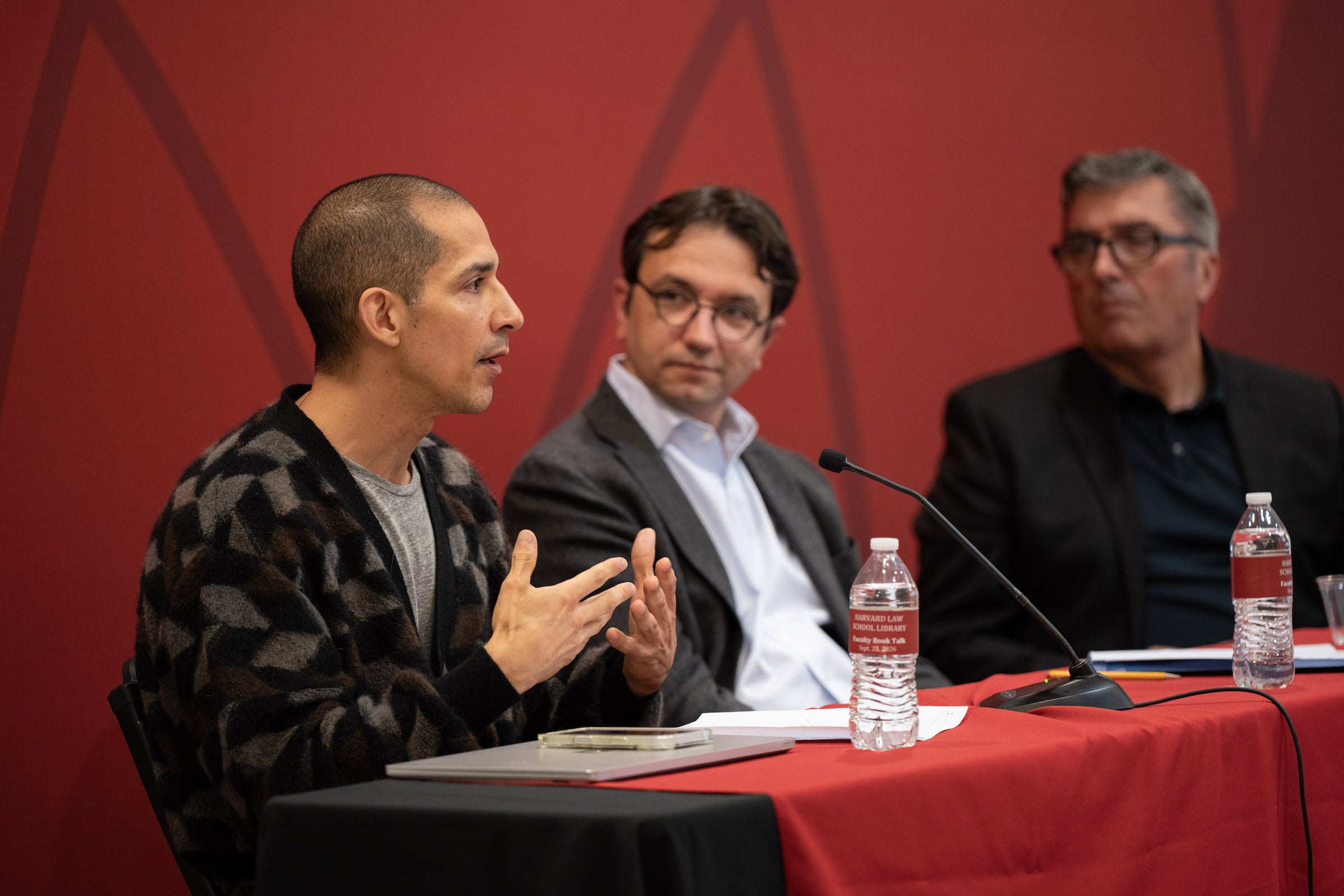
He cited reactions to that article. Readers tended to associate the Constitution with popular elements such as rights provisions, equal protection, and the First Amendment. On the other hand, nobody was defending procedural aspects such as malapportionment and the Electoral College. He suggested that a “thick, enforceable Constitution” resulted in a more empowered judiciary, which can further authoritarianism. “The reason I’m skeptical of empowered courts is that the courts are elites, selected by other elites, and insulated from democratic pressure. My gut [instinct] is that, systematically, this kind of governance structure leads to the sort of politics that we saw play out from the ’70s forward.”
He referenced a statement by Tushnet that if he were a judge, he would rule in a way that would advance the cause of socialism, adding that “I would probably do the same, which is why neither of us will ever be judges.” Referencing the upcoming midterm elections, Tushnet quipped, “But our time is coming.”
Want to stay up to date with Harvard Law Today? Sign up for our weekly newsletter.