Last year, the U.S. Department of Education’s Office for Civil Rights under President Donald Trump issued investigations or warnings to at least 60 American higher education institutions, including Harvard, for allegedly failing to address antisemitic discrimination on campus in violation of Title VI of the Civil Rights Act.
But according to Benjamin Eidelson, a professor of law at Harvard, many of the government’s accusations simply do not fit within the ambit of that provision of the law.
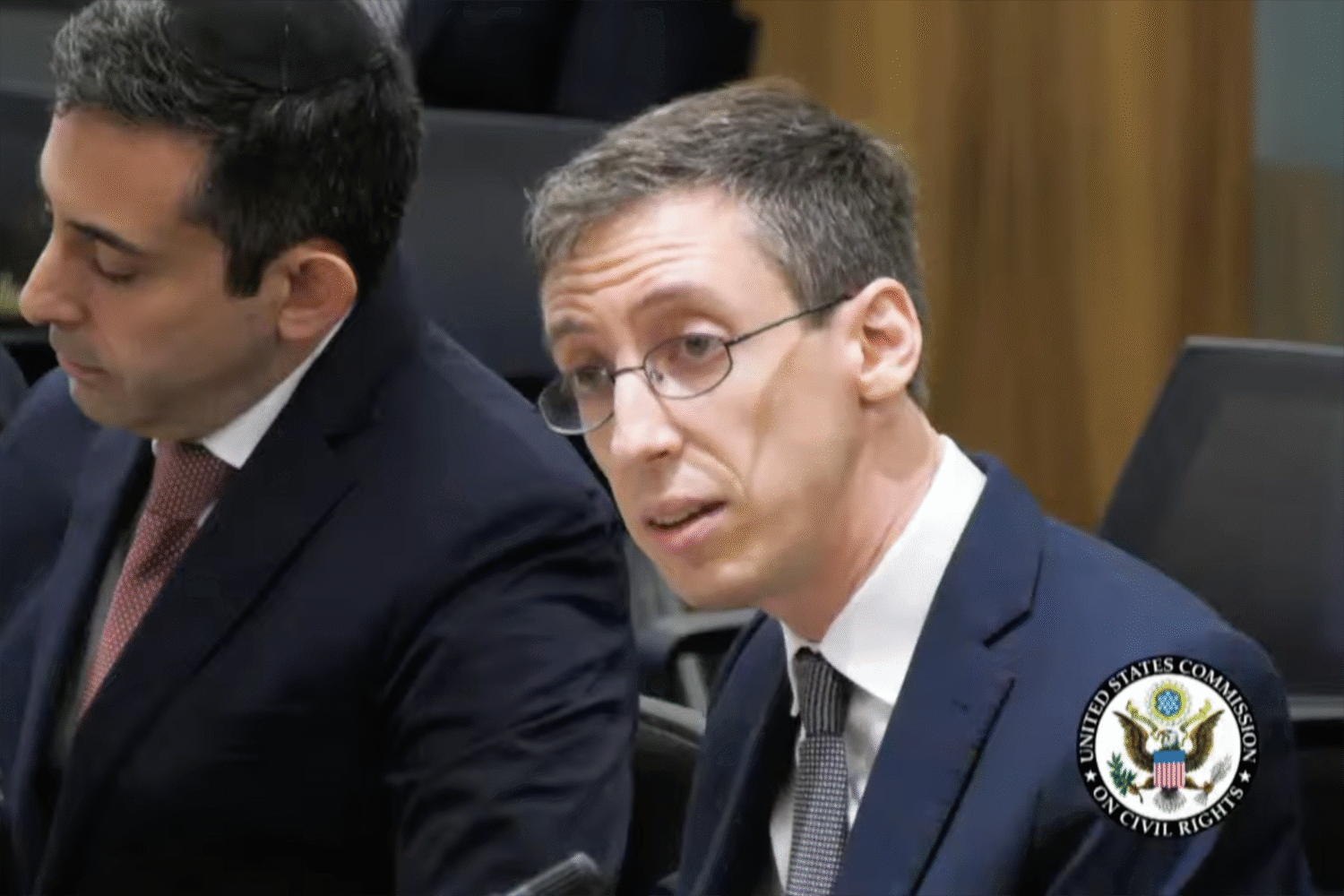
On February 19, Eidelson testified before the U.S. Commission on Civil Rights, outlining his view of Title VI and its role in debates about free speech and campus activism. Title VI, part of a larger civil rights law, prohibits discrimination on the basis of race, color, or national origin in any program that receives federal financial assistance.
Eidelson’s testimony comes as part of a robust debate at Harvard Law School and elsewhere about the appropriate balance between free speech and protection from harassment and discrimination on America’s college campuses.
Eidelson began his opening statement by clarifying that Title VI protects people only from discrimination based on one or more of the three characteristics named in the statute: race, color, or national origin.
“Without that special connection to a protected characteristic, claims about … misconduct are in the domain of campus rules, pedagogy, potentially other laws about all sorts of things — but not federal civil rights law under Title VI,” he told the commissioners.
In other words, Eidelson said, it is a specific and limited legal provision. “The critical point is that Title VI is an antidiscrimination statute. It is not a general anti-hostility statute.”
“The critical point is that Title VI is an antidiscrimination statute. It is not a general anti-hostility statute.”
Eidelson noted that Jewish people are protected under the law, but in ways that differ from many current campus controversies.
“In the 1920s, when Harvard started scrutinizing applications to look at the photos and try and reduce the number of Jews — that clearly would have violated Title VI,” he said. “Similarly, if that kind of racial antisemitism plays out through peer harassment, the university can be in violation of Title VI if it doesn’t try to do anything about that.”
But the Trump administration’s recent enforcement actions against universities are premised not only on hostility toward such protected characteristics, but also on hostility toward Israel or Zionism, Eidelson contended.
“No views about Zionism or Israel are inherent in anyone’s ancestry,” he said, citing a recent study showing that young Jewish people in the Boston area were more likely to identify as anti-Zionist than the opposite.
“What that reflects is that Jews, like other people, understand ‘Zionism’ as a label for a set of political and religious and cultural commitments that they might embrace, but that they might not embrace,” Eidelson said.
He also pushed against arguments that anti-Israel protests create an unlawful “hostile environment” for Jewish or Israeli students. Eidelson expressed “real sympathy for those feelings of estrangement and alienation, on all sides of this conflict.” Elaborating on this point in his written testimony, Eidelson acknowledged that, for many, “Israel’s right to exist as a distinctly Jewish state” is “a personal and communal conviction of profound importance.” But, he insisted at the hearing, “not everything that’s bad is a violation of Title VI.”
As an example of what he saw as overreach, Eidelson pointed to the Trump administration’s treatment of certain “study in” protests, where students had labeled their laptops with slogans condemning Israel or calling for divestment, as unlawful harassment. “The most fundamental issue with [that] is that, again, it doesn’t have the required connection to a protected characteristic,” Eidelson explained.
Even if problematic on some other grounds (for example, a violation of a university’s rules on library use), this conduct is not a Title VI violation, he said, because it is “not about Jewish people or Israeli people.” Rather, according to Eidelson, “the protesters have their view about how to carve up the Middle East in a fair way. Some of my co-panelists might hate it; I might or might not agree with it; but nobody gets to just rule it out of bounds as expression that demeans fellow students for having Jewish ancestry.” And the same principle, he noted, protects pro-Israel expression that some Palestinian students find offensive as well.
Eidelson closed his remarks by recognizing that there are also harder cases, ones in which students use language that is “more ambiguous or provocative.” But “for the most part,” he concluded, the law permits a university to tolerate even rhetoric that is highly offensive.
Eidelson’s arguments last month drew from his written testimony and reflect perspectives that he and his coauthor, Deborah Hellman, published in November in a Harvard Law Review Forum article, “Antisemitism, Anti-Zionism, and Title VI: A Guide for the Perplexed.”
Their essay inspired a response, also published in the Harvard Law Review Forum, by Stephen Sachs, the Antonin Scalia Professor of Law at Harvard, who disagreed with Eidelson and Hellman’s characterization of both anti-Zionist activity and the scope of Title VI.
But Eidelson and Sachs likely agree on one important thing, which Eidelson highlighted in response to one of the commissioners’ questions.
“Sometimes people say ‘Zionism,’ but they mean Jew,” Eidelson said. “They say, ‘no Zionists are welcome here,’ but the reason they’re saying it is they want to get the Jews out. … That is discrimination against Jews. There’s no disagreement that that would be a Title VI problem.”
The difference, for Eidelson, is that equating those two things requires proof. “What I think they need to prevail on that argument is an explanation of why there should be a presumption that when somebody says something about Zionism, they’re motivated actually by hatred towards Jews.”
“And that,” he added, “is what the courts have rejected.”
Want to stay up to date with Harvard Law Today? Sign up for our weekly newsletter.