
“All great stories, in my experience, start with something like me deciding, ‘Does this smell weird?’”
Keen olfactory senses notwithstanding, Harvard College alumnus Pablo Torre has recently found himself in rare air as one of the most prominent investigatory journalists covering sports.
His podcast “Pablo Torre Finds Out,” which boasts 235,000 YouTube subscribers, received three 2026 Emmy nominations and last summer was named one of Time Magazine’s 100 Best Podcasts of All Time.
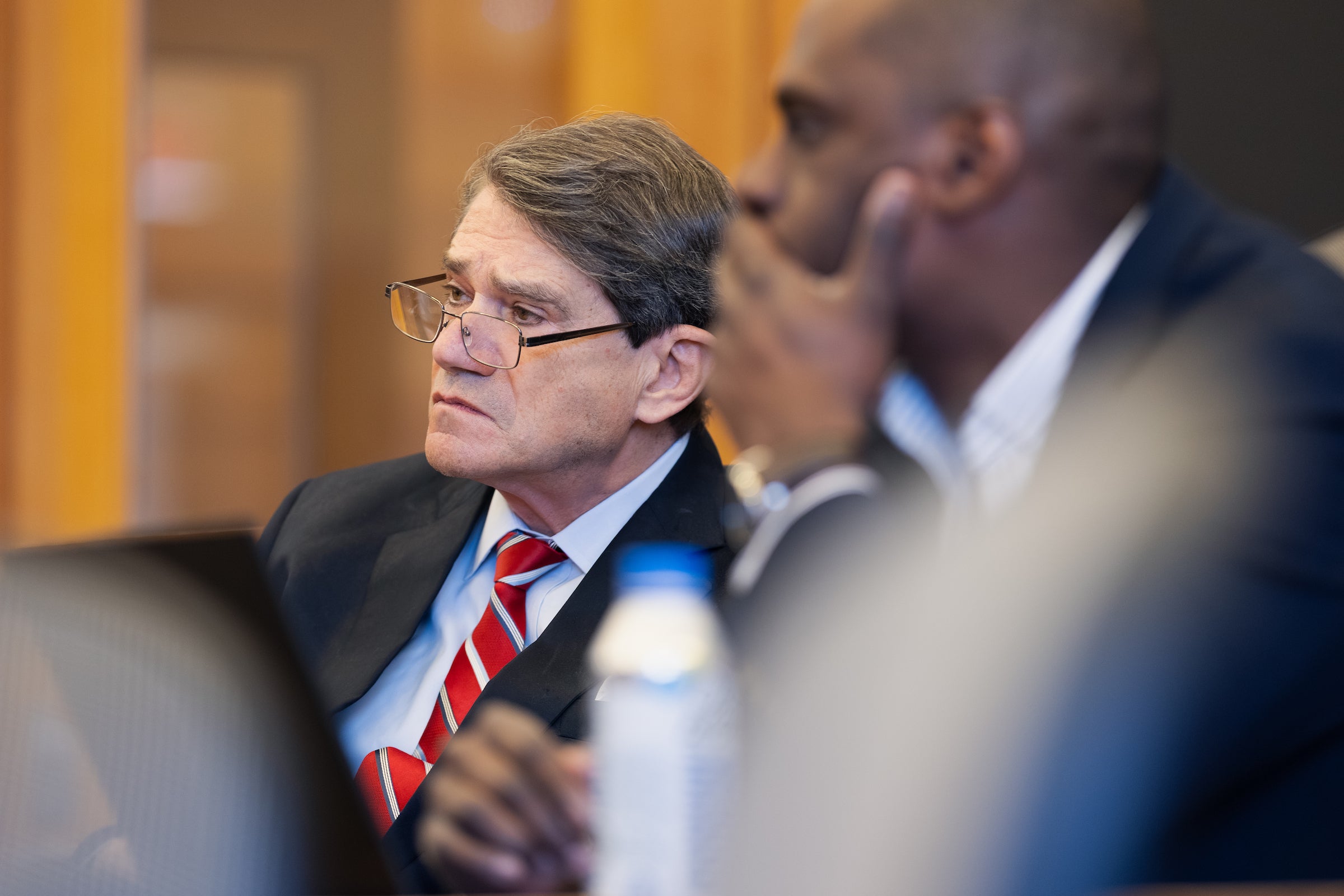
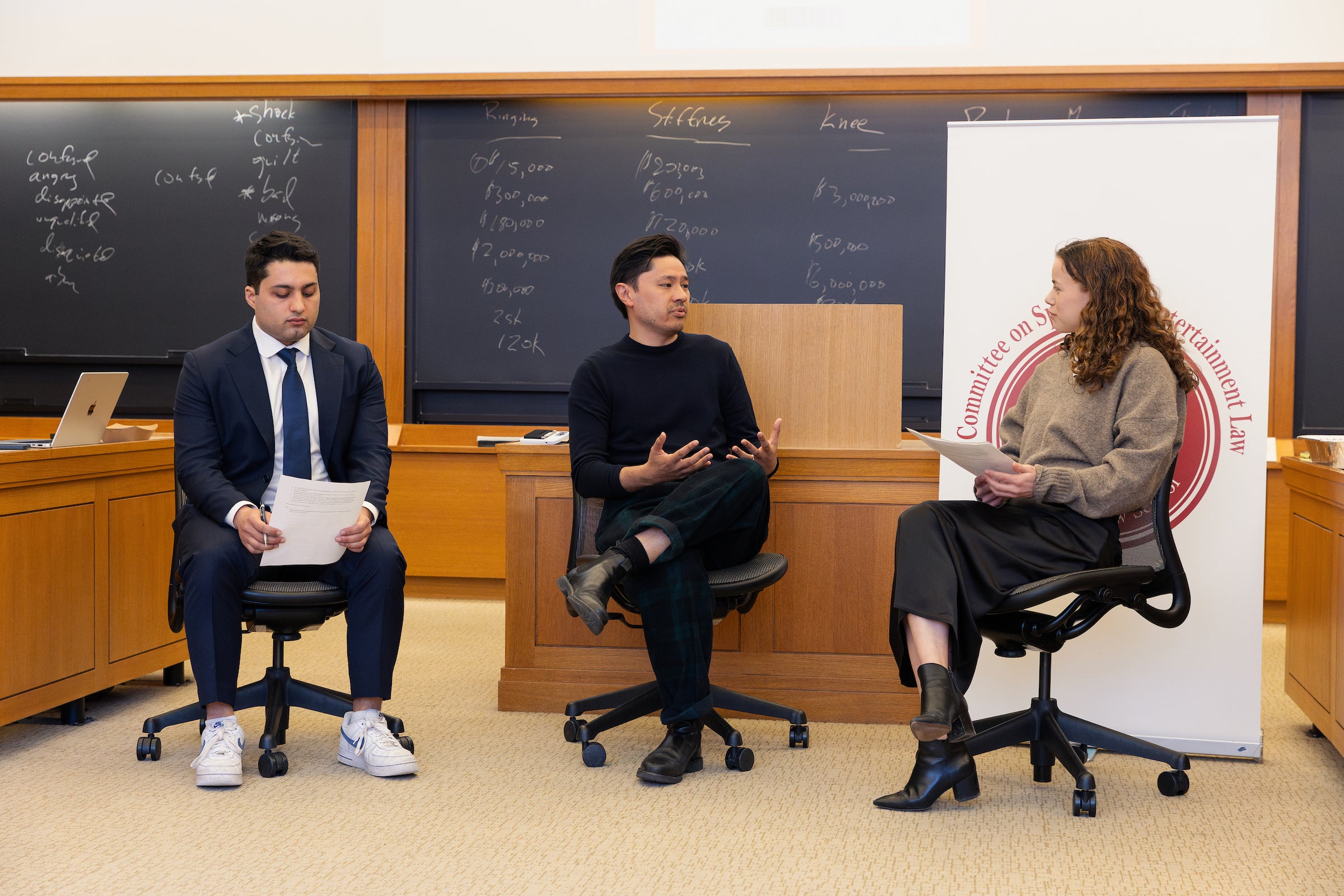
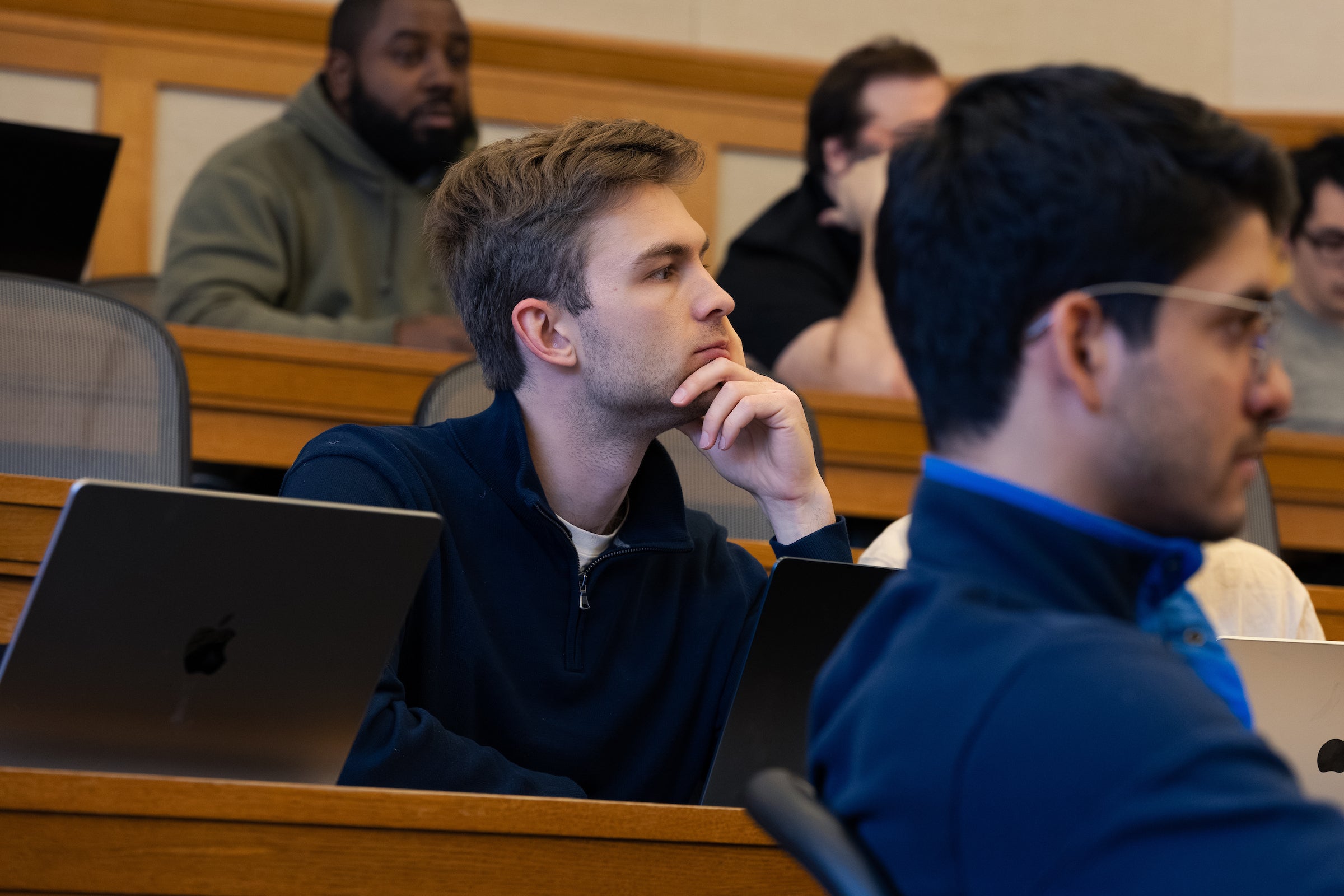
At the 2026 Sports Law Symposium hosted by the Journal of Sports and Entertainment Law and the Committee on Sports and Entertainment Law, Torre spoke candidly with students about the various editorial, legal, and ethical considerations he encounters in the field.
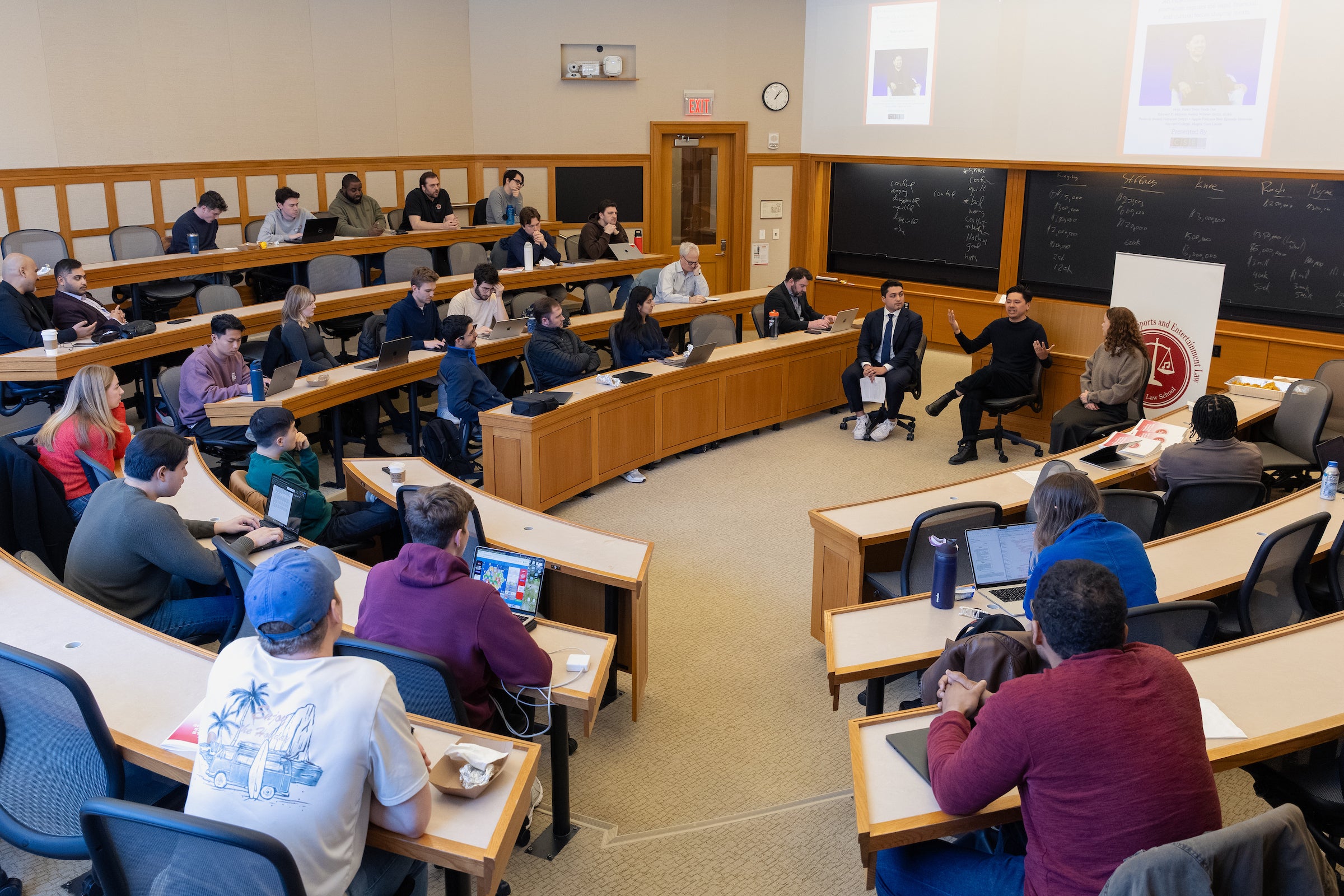
Torre first addressed the recent news that his podcast had parted with former sponsor DraftKings. According to Torre, his motivation for the “conscious uncoupling” with the online sportsbook company stemmed from both a desire to avoid potential conflicts of interest and general misalignment with his show’s image.
“I also don’t think they totally understood what the ambition of the show is and how to even sell and market it,” he said. “We’re doing shows that are essentially deep-dive investigative episodes, as well as episodes where we will taste test the best athlete-branded weed strains. I don’t think DraftKings necessarily knew what to do with us from a marketing and ad sales perspective.”
He also gave students a behind-the-scenes account of a major national story he broke last fall about how the Los Angeles Clippers allegedly skirted the NBA salary cap by paying star forward Kawhi Leonard extra money through a sham endorsement deal.
According to Torre’s reporting, after re-signing with the Clippers in August 2021, Leonard received a four-year, $28 million endorsement deal with Aspiration, a now-defunct carbon offset company, in April 2022.
“[Ballmer] invested, at first, $50 million into Aspiration. Simultaneously in this timeline, we have reported that Aspiration signed Kawhi Leonard to a deal that is a no-show job for which he has done, and had to do, contractually, literally nothing. This was simultaneous to his extension that he signed with the Clippers,” said Torre.
Torre shared how he began monitoring the company’s connection to basketball after someone suggested he look into “a huge sponsor of the Clippers” called Aspiration. His initial search found nothing immediately newsworthy, but he kept the company on his radar.
“Then, there was a bankruptcy filing and Aspiration’s third-ranked creditor was an LLC called ‘KL2 Aspire LLC,’” said Torre. “I fancy myself an investigative journalist, but it doesn’t take Edward R. Murrow to connect ‘KL2’ to Kawhi Leonard [who wears] No. 2. And ‘Aspire’ — so, a vehicle seemingly devoted to Aspiration. Then you see that they’re owed $7 million and you’re like, ‘Well, what was this deal that no one had ever reported?’”
The fact that a major endorsement deal with a star NBA player had not been announced was a major red flag to Torre, so he began talking with former Aspiration employees. The fact-finding process ultimately yielded “over 3,000 pages of documents and nine sources, two of which went on tape under voice modulation,” and a federal whistleblower claim regarding the same allegations.
Regarding his approach to reporting touchy stories with potential legal exposure, Torre readily acknowledged that commenting about prominent athletes and powerful organizations presents unique challenges.
“Steve Ballmer, at last check, has $140 billion. So, the question is ‘How does that math work?’ when I have one lawyer,” said Torre. “One of my great, naive heirlooms that I inherited as someone who grew up in the United States of America is that the truth is a great defense against someone with infinite amounts of money. But now we are testing that all of the time.”

“One of my great, naive heirlooms that I inherited as someone who grew up in the United States of America is that the truth is a great defense against someone with infinite amounts of money. But now we are testing that all of the time.”
While explaining his investigatory work, Torre also described the dilemmas that media lawyers encounter while advising journalists as they research, develop sources, and report their findings.
“The thing about being a media lawyer is, are you there to enforce risk aversion or are you there to find a way to report something that is also defensible in a court of law? And once we’ve passed the threshold of basic documentary evidence, the question becomes: How is [an attorney] involved in the process?”
According to Torre, breaking investigatory stories can involve robust, hands-on attorney collaboration, including listening in on recording sessions and reviewing documentary evidence. He explained how key considerations emphasized by his legal advisor throughout the reporting process help inform his team’s approach.
“Despite building in room for extemporaneous commentary and analysis, which is a feature of the show, we make sure that he is aware of what we’re trying to drive at so he can pressure test us,” he said. “It’s intensive, and also, we are deeply undermanned when it comes to how we do it. But this is why the rule of law is fun.”
While the alleged arrangement among the Clippers, Ballmer, and Leonard may have broken league rules by circumventing the salary cap, it did not, on its own, break any criminal or civil laws. In the wake of Torre’s reporting, however, 11 former investors suing Aspiration for fraud have now added Ballmer’s name to the list of defendants.
The NBA has hired an outside firm to conduct an investigation, but Torre expressed skepticism about the league’s motivation to find evidence of wrongdoing.
“An outside investigation like that is an investigation in which a company hires a law firm to investigate themselves,” he said. “Fundamentally, there’s a very funny conflict of interest … I think that the mechanism through which they are trying to mete out what resembles justice, they are not incentivized to do that. They are not incentivized to publicize things that are not already known.”
The Clippers story, which has more than 500,000 YouTube views, hit a nerve with basketball fans and the public. Yet, to Torre, the scope of its popularity has come as a surprise. He discussed the futility of predicting what audiences will care about and, in hindsight, what the story’s success says about the purity of athletic competition.
“The big learning I’ve had about this story was the public really cares. That’s very refreshing to me, and it’s telling about sports,” he said. “On paper, this story was a story about carbon credits, salary cap circumvention, a guy who came from tech — it didn’t have the recipe for [being] a viral hit.”
“The big learning I’ve had about this story was the public really cares. That’s very refreshing to me, and it’s telling about sports.”
According to Torre, in the Aspiration investor suit that added Ballmer as a defendant, Ballmer’s attorneys have sought to minimize Torre’s reporting as lowbrow, tabloid journalism. Torre disputed that while acknowledging the challenge of balancing journalistic integrity with the realities of marketing a contemporary sports show.
“How does a journalist make an impact? In this era more than ever, especially as an independent journalist, you have to create some cycle of attention,” he said. “It leads to retention editing. It leads to these thumbnails and a certain conformity of esthetic and editorial vision. My whole thing is I just want to tell people stories that they don’t know in ways that surprise them.”
“I am constrained mostly by the fact that if I do it the ‘clickbait-y’ way, not only am I betraying my own sort of principles — editorial and ethical — I’m also making a bad business for myself,” he added. “So, I’m not here to say that I am at all this monk of journalism. It’s the opposite. It’s that the desert of reporting has become so arid that I get to be the guy who makes it feel like there’s a real flood … of integrity.”
When asked about the story he is most proud of, Torre cited a recent episode where he interviewed a death row inmate named Charles Don Flores. Flores was accused of acting as an accessory to a murder during a robbery and was convicted of murder 26 years ago under the law of parties, a Texas statute that allows accessories to be held responsible for felonies later committed by others. According to Torre, the prosecution presented evidence at Flores’ trial that police obtained through the controversial practice of forensic hypnosis.
Flores also happens to be a Dallas Cowboys fan. “His appeal is not being heard by the state. So, I interviewed him and talked to him, got to know him, and told his story three dimensionally. I got to know him as not just a guy with a story that’s crazy, but as an avatar for a sports fan, a football fan in Texas,” said Torre.
“Getting to do a little PTI [Pardon The Interruption, an ESPN show that Torre often guest hosts] with a guy who was sentenced to death as a function of humanizing him, I’m really glad we did that, and I hope to continue to cover his story and stories like it.”
Want to stay up to date with Harvard Law Today? Sign up for our weekly newsletter.