When Shani King ’99 and N. Jeremi Duru ’99 were classmates and friends at Harvard Law School, they often talked about collaborating on a project someday. They probably wouldn’t have guessed it would be a children’s book.
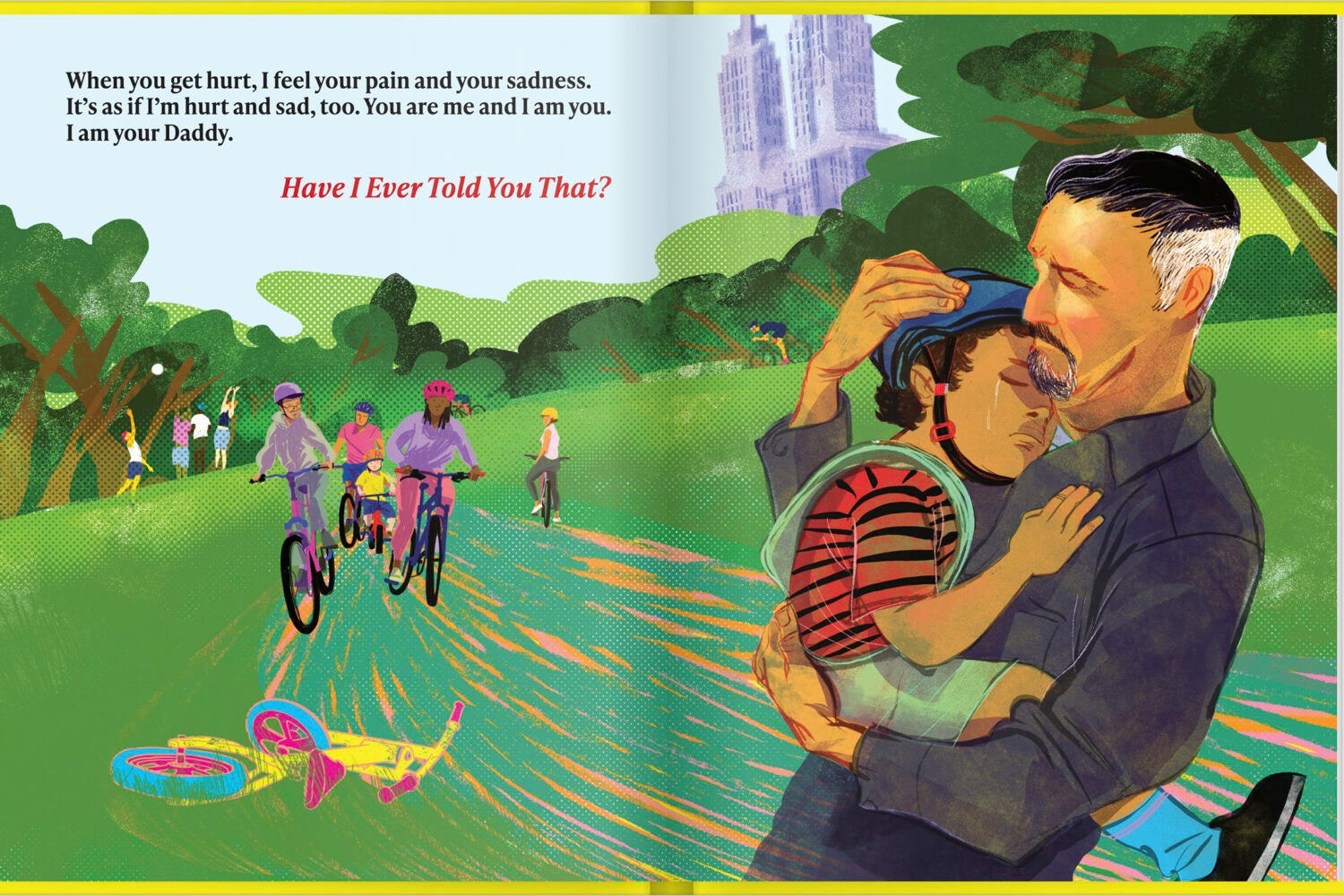
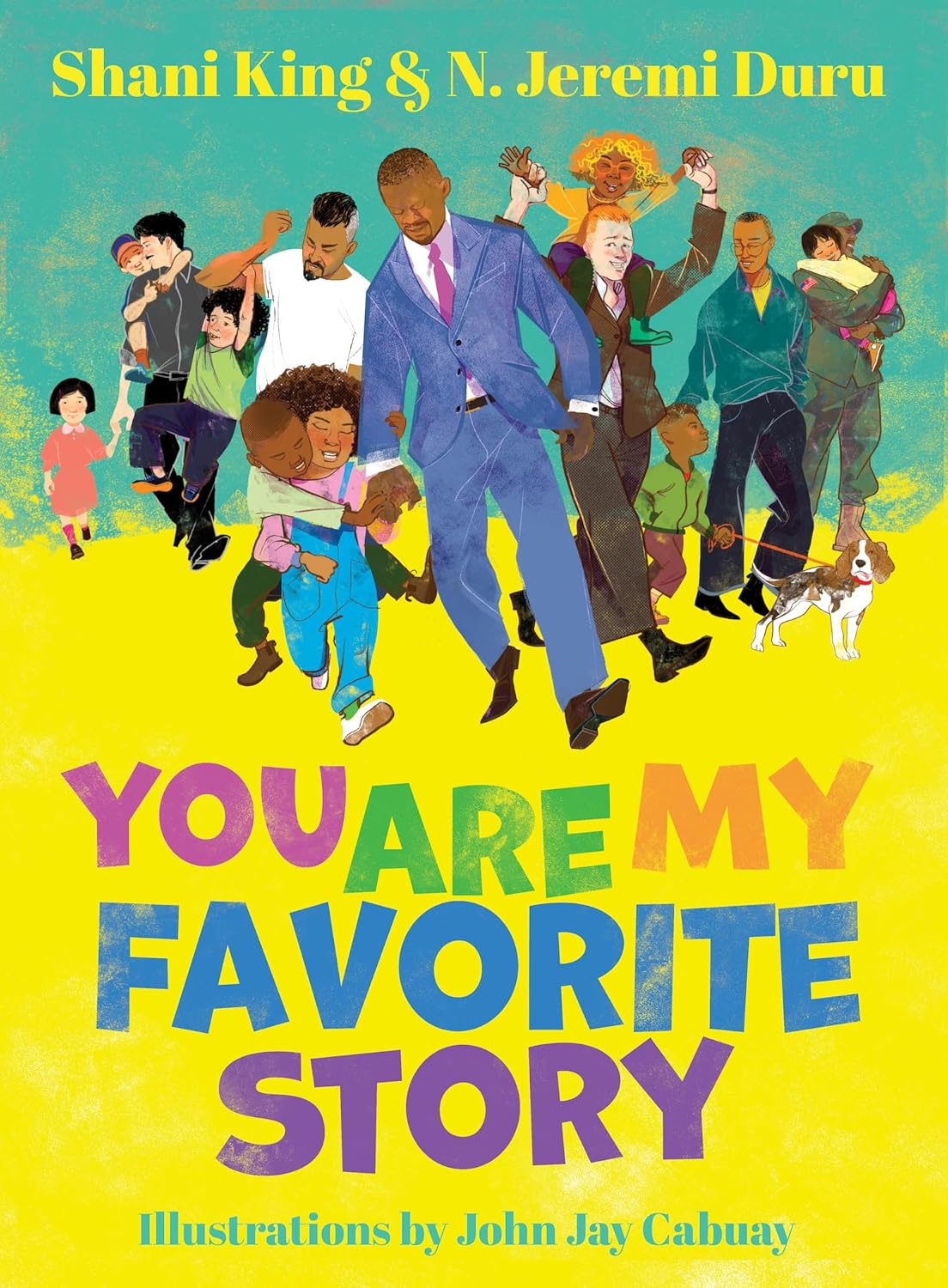
Today, the longtime friends and legal scholars are the authors of “You Are My Favorite Story,” written from the perspective of a father to his children. The book, illustrated by John Jay Cabuay and published by Fair Share Publishing, spotlights the pride, love, and hope of fatherhood — and the deep bonds between dads and their kids.
The book’s origin story starts with King, a vice dean, professor of law, and Martha L. Minow Scholar at Rutgers Law School, who specializes in children’s rights, family law, and immigration law. King had authored several other children’s books when he began working on a personal poem to his children.
As he considered the possibility of turning the labor of love into a book, he thought of his friend Duru, now a professor of law at American University Washington College of Law, with whom he had had many conversations about the thrills of fatherhood.
“I reached out to Jeremi to see if he wanted to collaborate. It just seemed to make sense,” King says. “And, as they say, the rest is history.”
The pair say their goal when writing “You Are My Favorite Story” was, first and foremost, to express their love and admiration for their families. But equally important to King and Duru was the chance to help people — and fathers, in particular — learn how to share their own feelings with their children.
“For fathers who struggle to speak in this way with their children, I hope that in reading the book to their children, they can begin to feel more comfortable in being expressively loving,” Duru says.
A children’s book may not seem directly connected to King and Duru’s legal scholarship, but for King, it fits perfectly with his belief that the expressive value of law, and of words themselves, matters. “What you say, how you say it, and when you say it matter. Words matter.”
In an interview with Harvard Law Today, King and Duru shared more about their friendship, collaboration, and the surprising links between the book and their legal work.


Harvard Law Today: You were students at Harvard Law School together and have been friends ever since. When did you first meet?
Shani King: We actually met at Brown University. Jeremi knew virtually everyone at Brown, and I don’t actually remember how we first met, but that is where our friendship started. We had concentric circles of friends, I think. I played football, so many of my friends were football players, and Duru (as I call him) hung out with the intellectual crowd, but we were all friends.
Then, when we knew we were both going to Harvard for law school and starting at the same time — he did a year at the Harvard Kennedy School, and I worked at a therapeutic day school for kids in Jamaica Plain — we decided to room together, along with one of his childhood friends, Nathan Brown, who was also starting at Harvard at the same time.
HLT: How has your friendship evolved as you both have gone on to your careers in the academy, advocacy, and beyond?
King: It’s funny you ask that in that way, because I think in some fundamental ways it hasn’t evolved at all, and in other ways it has.
It hasn’t evolved in the sense that Duru is as solid a person as they come, and our friendship has always been able to pick up right where it left off, whether weeks, months, or even years have passed. It’s one of those friendships that doesn’t really need watering. We just pick up wherever we left off and are able to reconnect.
If it has evolved, it’s because our lives have become richer as we’ve established families, practiced law, joined the academy, and now become children’s authors. I wouldn’t say our friendship is stronger, because it has always been strong, but as our lives have become fuller, I’ve come to appreciate our friendship even more. It’s really wonderful to have a good friend like Duru to be on this journey with.
N. Jeremi Duru: Back at HLS, Shani and I talked a lot about collaborating in some way at some point in our careers. We’d talked about opening a law practice with a public interest focus. Later, once we’d both become law professors, we’d talked about working together on a law review article or book at the intersection of sports law and family law. But we were always both really busy and were never able to move forward with any ideas. We’d remained friends, though, and saw each other when we were in each other’s cities, and once we’d both had kids, we’d talk about family and fatherhood and how much we were enjoying it.
HLT: What inspired you to write this new book together?
King: “Have I Ever Told You?” is something that I’ve asked my kids for years. It allows me to get away with telling them that I love them, that I believe in them, and that I love being their dad every day.
For years I’ve been saying things like, “You are brave. Have I ever told you that?” To that they invariably respond, “Yes, many times!” or, more accurately, “Yes, too many times!”
On a random day years ago, I wrote a love letter to them and posted it online. That letter eventually became my first book, “Have I Ever Told You?” Years later, I wrote another love letter to them, but this one was from the perspective of a dad. Instead of posting it, because I had written children’s books by that time, I reached out to my good friend — a friend and father for whom I have the deepest admiration and respect — to see if he wanted to collaborate. It just seemed to make sense.
And, as they say, the rest is history.
Duru: Shani emailed me out of the blue one day and asked me to take a look at and share with him my thoughts on a short piece of writing he’d done. It was essentially a poem he’d written that involved a father speaking to his child. It was beautiful, and when I’d finished reading it, in the next paragraph after the poem, he asked me if I wanted to collaborate with him on turning this poem into a book. I was deeply honored that he was interested in my feedback and even more honored that he would consider collaborating with me on it. I told him of course I’d love to join him in the project. We were both busy, so it took some time, but over the course of the next few years, we evolved that poem into “You Are My Favorite Story.”
HLT: Professor King, you have authored several children’s books. How is this one with Professor Duru different?
King: This is the first children’s book in which it is not only my voice, but the voice of a collaborator as well. That’s why it was so important to collaborate with a dad whom I respect so deeply.
It is quite a special enterprise when you collaborate on something so personal and so deeply felt. It is powerful in a very different way. Instead of just my personal voice, it is our voice, which I think amplifies the message.
But not just ours, of course. Our illustrator, Jon Jay Cabuay, and our publisher, Nathan Bond, also have their voices reflected in this manuscript. In some ways, it went from “Have I Ever Told You?” to “Have We Ever Told You?” There is something powerful in that for me.
“It’s okay to be scared, it’s okay to love, it’s okay to cry, and it’s okay to tell your children that you love them.”
Shani King
HLT: What do each of you hope children (and their parents) take away from this new book?
King: For me personally, I have to answer a question that I don’t think you’re asking first. I’m going to answer with respect to my children.
I can never say enough how deeply I believe in Soraya and Matias. For me, this is still a very personal love letter to my children, and it is of paramount importance that they understand they have a dad who loves them and believes in them unconditionally.
In terms of children more generally, my hope is that every single child to whom this book is read can also come to believe that they are loved unconditionally. And for parents, I hope the book serves as one tool they can use to communicate that it’s okay to be scared, it’s okay to love, it’s okay to cry, and it’s okay to tell your children that you love them — all day and every day.
HLT: What about you, Professor Duru?
Duru: There are a few things I hope children and parents will take away from this book. Maybe the biggest is that the most important thing a parent can do for their child is be there for them. Certainty in the big moments, but also in the more mundane moments, the day-to-day moments. Just be there — be a constant presence your child can rely on. I truly believe this is a parent’s most important job. I also hope the book serves as a vehicle fathers can use to express their love to their children. I grew up being told I was loved, and as I have raised my children, I tell them I love them all the time, but it is not as easy for some fathers to be expressive in that way. I hope this book sends the message that it is healthy and feels really good to tell your children how much they mean to you and that you love them. And for fathers who struggle to speak in this way with their children, I hope that in reading the book to their children, they can begin to feel more comfortable in being expressively loving.
“I hope the book serves as a vehicle fathers can use to express their love to their children.”
N. Jeremi Duru
HLT: How did your backgrounds as legal scholars influence the themes, lessons, or values in the book?
King: I think in a few ways.
First, even as adults, we need people to believe in us if we are to reach our full potential. I’ve been fortunate to have that at various points throughout my life, and Harvard Law School was certainly no exception — thank you, Martha Minow.
Second, the expressive value of the law matters. What you say, how you say it, and when you say it matter. Words matter. My thinking and scholarship along those lines track some of the themes in this book.
And third, I think this book is fundamentally about fatherhood, being a dad, and what that means. In that sense, it is related to — but independent of — my identity as a legal scholar. Because if you strip all of that away, I still have what I consider my most important identity, and the themes, lessons, and values reflected in this book grow out of that.
Duru: My work is in sports law, and the bulk of it deals with trying to root out discrimination and inhumanity in the sports world, so it can often feel a bit heavy. Working on “You Are My Favorite Story” with Shani has been kind of like an oasis in the middle of writing projects that focus on less joyful subject matter. “You Are My Favorite Story” is pure joy to me. In my view, the book is about the most important things in life.
Want to stay up to date with Harvard Law Today? Sign up for our weekly newsletter.