
It’s been more than 30 years since Howell Jackson taught his first federal budget policy class at Harvard. It’s a popular January offering that deconstructs the federal government’s yearly fiscal financial planning process and attracts students from across the University. With federal spending controversies increasing in the news, student interest has skyrocketed.
In terms of fiscal capacity, the federal government is increasingly challenged by the rising costs of defense spending, health care costs, and Social Security payments, leading to ballooning deficits and near record levels of federal debt. With recurring government shutdowns and the surge of litigation over spending decisions, lawyers and policymakers are facing a raft of novel questions about the spending power of Congress, the scope of executive discretion, and the capacity of the judiciary to resolve these disputes. The law of federal spending is more contested today than at any time since the Congressional Budget and Impoundment Control Act of 1974 that ushered in the modern era of federal budgeting. These issues are at the core of Jackson’s syllabus.
In his office on a recent afternoon, fresh from a three-hour class, Jackson, Harvard Law School’s James S. Reid Jr. Professor of Law, grabbed a quick bite and explained the genesis of his winter term offering. Before arriving on campus as a junior faculty member in 1989, he had worked in Washington, watching as the effects of then-President Ronald Reagan’s suite of economic policies and tax cuts reversed decades of fiscal stability and led Congress to adopt increasingly intricate laws and practices to constrain spending.
Amid that shifting fiscal landscape, Jackson said he “observed as a lawyer how the ability of clients to get money from the federal government depended a lot on how they asked for it and what the rules were.” Federal budget policy hadn’t been on the curriculum when he was a student at Harvard Law, but Jackson saw its promise and its import and pitched to then-Dean James Vorenberg a course on the subject. He’s been teaching on and off for the past 35 years. And it’s a mountain of material to cover in two weeks.
During a recent class, Jackson touched on myriad topics, including the Federal Credit Reform Act of 1990 that allows special budgetary treatment for federal loans made to non-federal borrowers; the role of the Office of Management and Budget and the Government Accountability Office in the federal budgeting process; how President Obama widened spending grants for the No Child Left Behind Act; the efforts of the Biden administration to justify its student loan forgiveness program based on the Heroes Act; whether the comptroller general can sue President Donald Trump for illegal impoundments of a grant or other spending; and the concept of fiscal federalism, the amount of spending that takes place at the state or local level.
The class, which is taught over two weeks in early January to facilitate cross-university enrollment, also includes a series of Zoom luncheon discussions with other experts on federal budget policy. In one session, two leading legal scholars on the subject — Professors Zach Price ’03 of University of California Law San Francisco, and Eloise Pasachoff ’04 of Georgetown Law — debated academic work on the limits of executive spending powers and ways in which Congress might seek to safeguard its power of the purse by imposing new limits on executive authority.
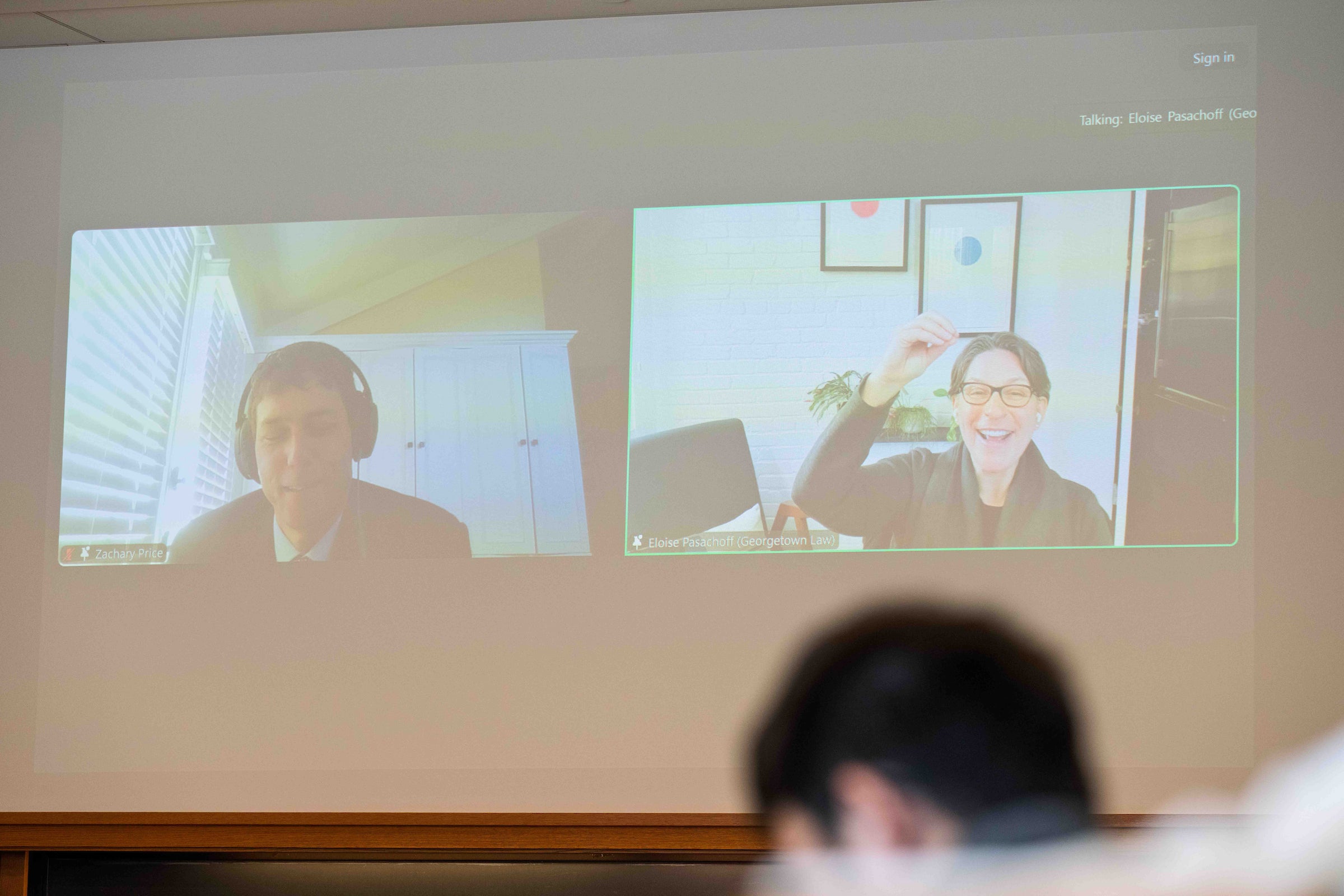

In the discussion that followed, Professor Jackson acknowledged that such responses were possible but they would move the United States even further away from budgetary practices in other leading economies: “If you look at other countries around the world today,” he said, “other legislatures do not exert nearly as much and as granular control over public spending as the U.S. Congress does over spending. While more legislated guardrails are possible, they do come at a cost of efficiency and flexibility.” That’s the kind of tension Jackson wants his students to grapple with. He also wants them to weigh different budgetary approaches going forward, something that he says is informed by an examination of both history and the many different academic perspectives.
“I’m trying to give them an interdisciplinary view of the budget and spending and all the different academic lenses,” said Jackson, noting that some of those lenses are economic, some are political, some are legal, and some are even psychological in nature, such as those involving the budget and public opinion.
In an effort to expand perspectives even further, Jackson has incorporated guest speakers who engage in budget policy on a daily basis, balancing his Socratic discussions with comments from those doing the work in the field. The outside experts help connect classroom debates with actual legal cases and offer students insights into future career paths. This semester’s speakers included John Righter, deputy staff directory of the Senate Appropriations Committee; Natasha Sarin, a Treasury official during the Biden administration; Travis Sharpe, a senior fellow and director of defense budget studies at the Center for Strategic and Budgetary Assessments; and Chris Towner, policy director for the nonprofit nonpartisan Committee on a Responsible Federal Budget.
For Jackson, part of the fun of teaching the class is engaging students “who have had interesting experiences working on public spending in many different contexts.”
“I’m trying to give [my students] an interdisciplinary view of the budget and spending and all the different academic lenses.”
This year’s cohort was no different. Enrollees hailed from the Harvard Kennedy School, the Harvard Graduate School of Education, Harvard Medical School, and the Harvard T.H. Chan School of Public Health, with the majority of students from the Law School’s J.D. and LL.M. programs.
They worked on Capitol Hill, with foreign governments, in national service, and more. For Jackson, the course holds such broad appeal because federal funding touches on everything, from student loans and cancer research to taxes and entitlements.
Benjamin Schiller ’27 agrees.
Schiller spent the past several years in the offices of U.S. Sens. Elizabeth Warren of Massachusetts and Patty Murray of Washington doing budget and appropriations work. When a former colleague and his Republican counterpart who worked for Sen. Susan Collins, and who is also a current third-year at the law school, suggested he take Jackson’s class, Schiller didn’t hesitate.
He reached out to Jackson before arriving on campus to offer help, crafting an in depth memo for the course about how the budget process has unfolded in Washington over the last two years and helping to get Righter to speak to the class.
In Washington, Schiller said he “learned the mechanics of how the budget and the appropriations process work.” He took Jackson’s class to understand the why. “I knew how the process worked in practice, but I wanted to understand the statutory and constitutional framework behind it. That’s not really something you learn when you’re on the ground.”

Like Jackson, Schiller understands the reach of the federal budget and appropriations processes. “It’s something that has really a profound effect on nearly everything, it’s where the money flows,” said Schiller. “And so I think it’s important for really everyone to understand. But in particular, I think anyone who wants a career in government service in the future, or any kind of government-adjacent legal work, should at least understand the basics of these processes.”
Gracie Keenan admits she was “hesitant at first,” about taking Jackson’s class due to its technical and complex nature but quickly realized after reading the syllabus “it would be really fascinating and very relevant right now to understand everything going on.”
Keenan, who is pursuing a master’s in education policy and analysis at Harvard, worked on education policy in Florida. As a paralegal, she also worked on cases appearing before the U.S. Court of Federal Claims, an experience that piqued her interest in the inner workings of the federal government.
Keenan said Jackson’s class gave her important insight into how political interests can shape the federal budget. “Just the sheer amount of money that seems to be thought about not in the most productive way, but because of political relationships, that was really, really surprising,”
The course also helped inspire her to pursue a legal degree.
“Taking this class with Professor Jackson was amazing … I thought it was a really smart way to run a class and have people engaged, and I know that’s how law school classes go. I loved it so much,” said Keenan. “So hopefully I am going to go on to law school after this and either do something with government and or education.”
Want to stay up to date with Harvard Law Today? Sign up for our weekly newsletter.