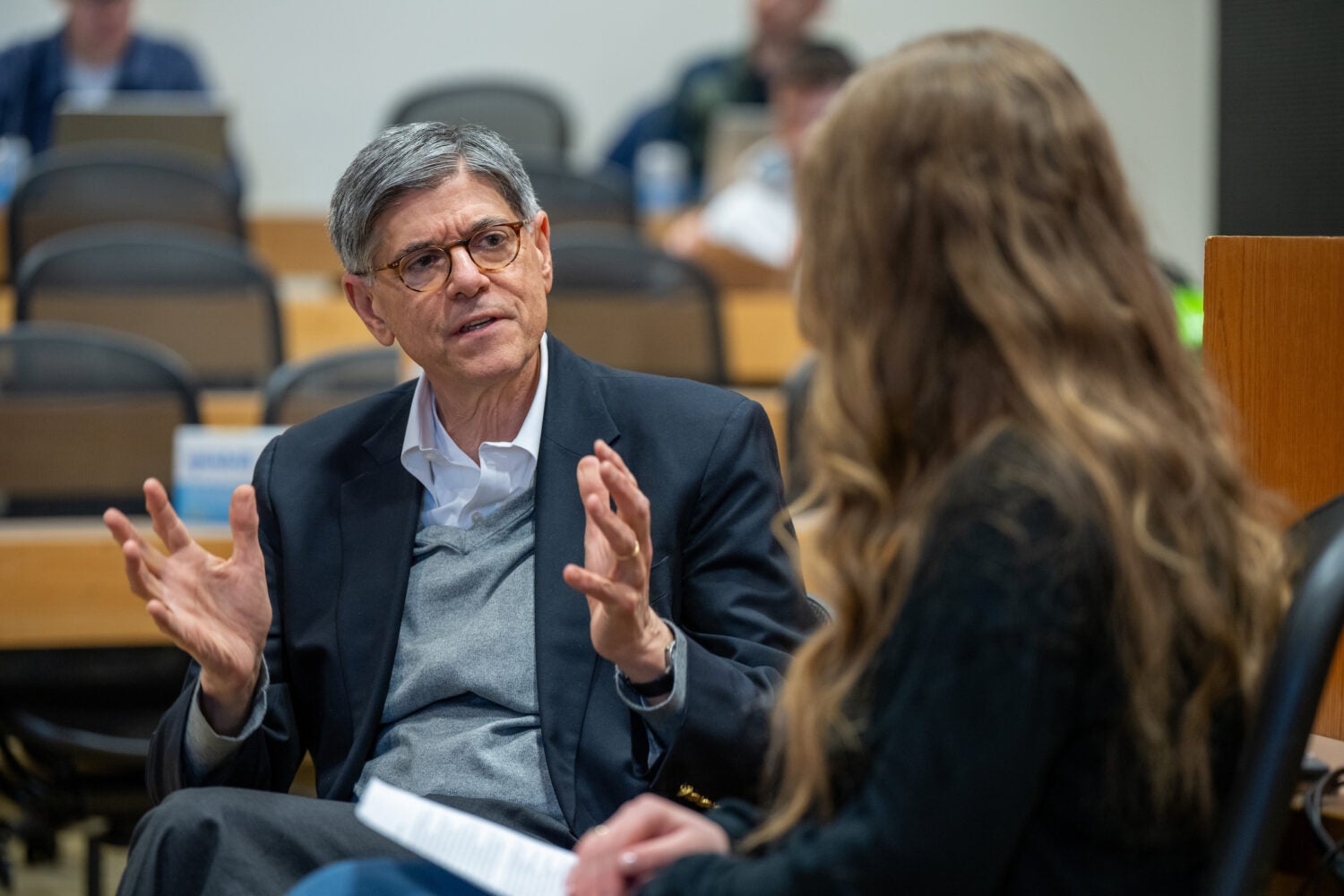
During the Biden administration, the U.S. government worked diligently to ensure that Israel could defend itself after Hamas’ deadly attack on Israel on Oct. 7, 2023. But Washington also worked to hold Israel accountable for its humanitarian obligations, according to Jack Lew, who was U.S. ambassador to that nation at the time.
Lew acknowledged that neither effort proved satisfactory. Some critics believe that the U.S. thwarted Israel’s ability to accomplish its military goals; others say the Palestinian people suffered deeply and unnecessarily in the conflict.
“It was constant push and pull,” Lew said. “That’s the terrible tension of being in a war. You don’t get to choose between those two things.”
Lew offered his thoughts on a range of topics at a March 25 event sponsored jointly by the student groups Alliance for Israel, the Jewish Law Students Association, Harvard Hillel, and the American Constitution Society for Law and Policy. He conversed with Sabrina Goldfischer, the incoming president of the Jewish Law Students Association, before taking questions from the audience.
During the Israel-Gaza war, Lew said, the Biden administration negotiated over many months for release of the Israeli hostages. Ultimately the successor Trump administration was able to reach an agreement, with a major breakthrough in talks coming after Israel targeted Hamas leadership in Qatar, a country that had been hosting negotiations to end the war.
“The current administration, with the unique style that the president has, and mistakes that were made that gave leverage to the United States … it all ended up producing a better outcome than I thought was possible,” Lew said.
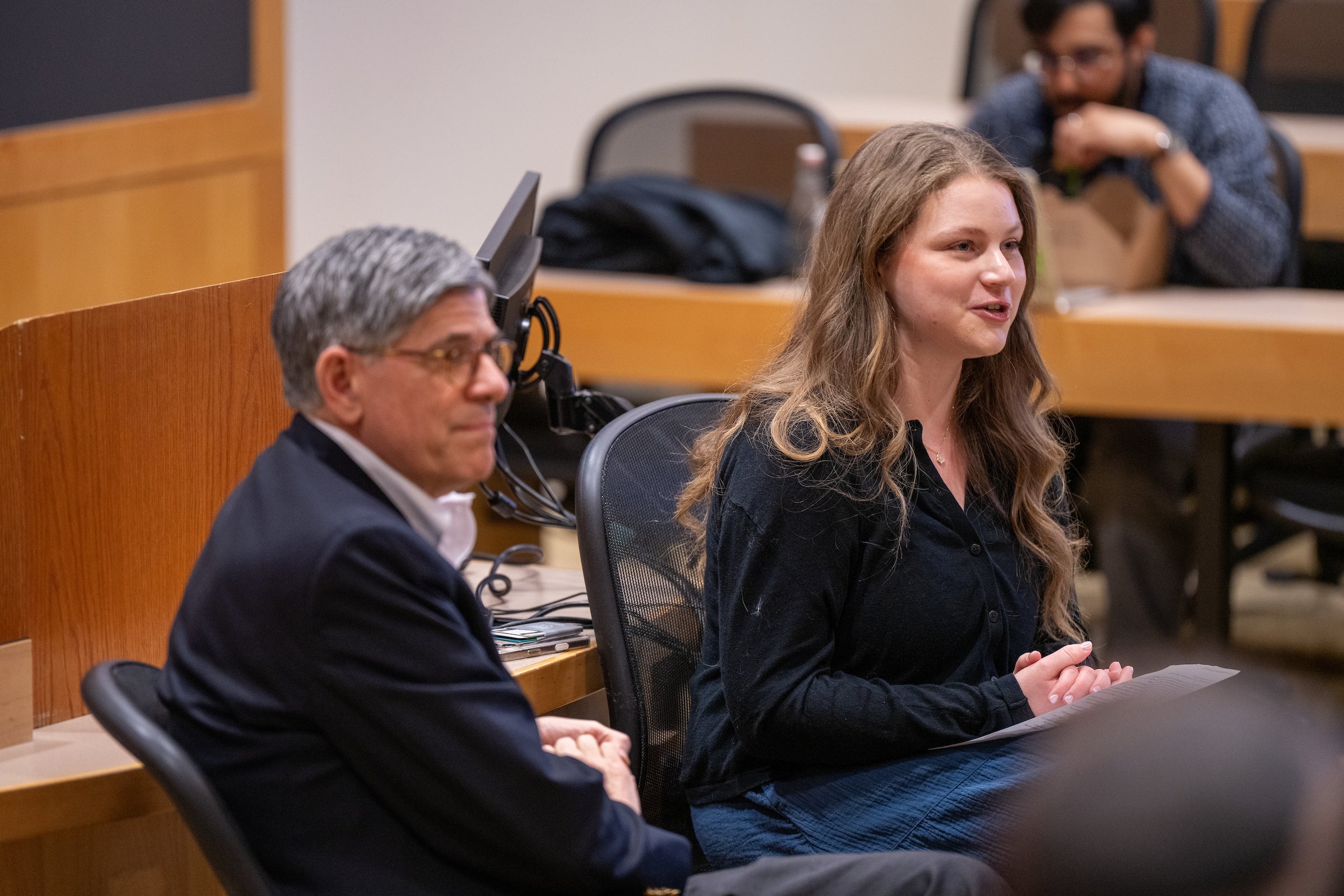
Although the agreement saved lives, Lew said, he can’t support the Trump administration’s approach to foreign affairs.
“If it becomes the normal means of engagement that the United States pursues in the world, I worry deeply about the future of the United States,” he said. “And I don’t know how to resolve that conflict.”
Before serving as ambassador, Lew headed the Treasury Department and was a White House chief of staff under President Barack Obama ’91. Previously, among other positions, he was deputy secretary of state for management and resources and director of the Office of Management and Budget under President Bill Clinton. In the private sector, he has been managing director and chief operating officer at Citigroup.
Lew said he never wanted to be an ambassador, adding that he was asked to accept the position when the U.S. was trying to help Israel and Saudi Arabia normalize relations. The Oct. 7 Hamas attack on Israel changed everything.
“I don’t know that I’ve ever been in a situation in which there was such widespread, pervasive pain and trauma,” he said.
A major problem during the Israel-Gaza war, Lew said, was trying to ensure that accurate information about Israel’s actions was available, including in the United States, where the public increasingly turned against the war as time went on.
Israeli officials, he said, were “almost defeatist: ‘There are going to be antisemites in the world no matter what, so we’re not going to win that,’” Lew said. “I actually don’t believe that’s true. I think there are more people, many times over, of good will who, with information, wouldn’t [be antisemitic], and the people who are going to hate you are going to hate you.”
In response to questions about how to encourage support for the U.S. relationship with Israel, Lew said it was important “not to equate any questions of Israel with being anti-Israel.”
Likewise, he said, “You can’t challenge the whole notion of the state of Israel because a leader does something wrong.”
Lew also said public opinion on Israel and its role in recent conflicts had not been helped by comments by U.S. Secretary of State Marco Rubio, which Rubio later walked back, that Israel’s plans to strike Iran led to the U.S. military actions in that country in late February. He described that as the “worst possible narrative.”
“I don’t know if that’s true,” said Lew, who is now a professor at Columbia University’s School of International and Public Affairs. “I have no idea what the real goal [of the war] is, what the strategy is.”
“I find it beyond puzzling,” Lew continued. “I worked for two presidents who made a decision to use force. The first thing they did was tell the public why … tell your allies why. If you don’t, you can’t be surprised when it’s hard to explain.”
Answering a question about domestic politics, Lew said he worries that the ability to negotiate in good faith with political opponents in this country has eroded over the years. He recalled his own negotiations with Republicans to raise the debt ceiling in 2011 when the United States was three days away from default.
“[In] a compromise environment, you don’t get everything you want,” he said. “[In any negotiation] I had in my pocket the things that I had permission from my president to give away.”
Resolving international conflicts such as the current war in Iran likewise requires compromise, he said.
“It’s not going to end by Iran conceding for all time everything,” Lew said. “It’s going to look a lot more like the Iran deal that came out of the Obama administration than regime change. Otherwise, I don’t know how it ends.”
Want to stay up to date with Harvard Law Today? Sign up for our weekly newsletter.