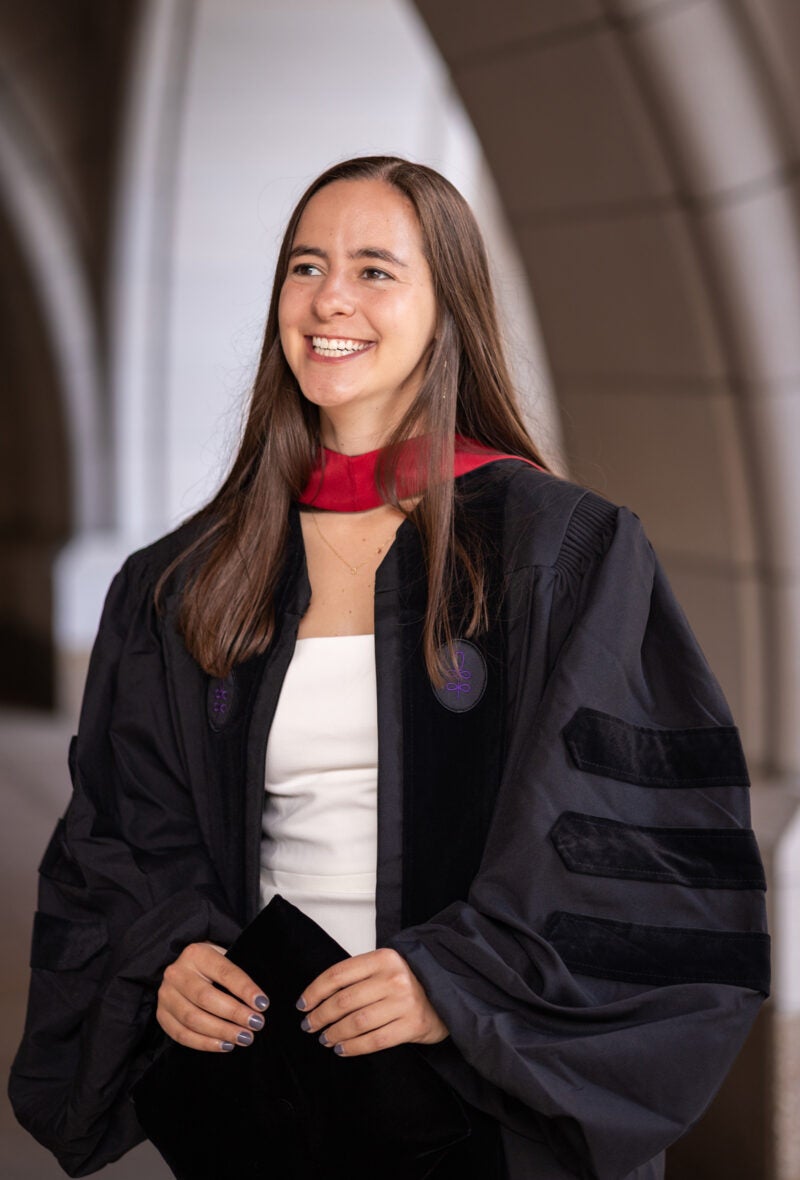
Abigail Simon ’26 may have been at the top of her class when she crossed the stage at Harvard Law School’s commencement in May. But despite her remarkable accomplishments — she was awarded the Sears Prize and the Fay Diploma for best overall academic record — she insists that she cannot take full credit for her success.
“Law school is truly a collective effort, and everything that I’ve done here belongs to my whole community as much as it does to me,” she says. “No one goes to law school alone.”
Simon grew up in Wellesley, Massachusetts, a “big Boston sports fan,” she says. As an undergraduate at Harvard College, Simon opted for a concentration in social studies, where she was excited to dig into foundational works of political and social theory, and to study the politics of spirituality in the U.S.
She says she loved the interdisciplinary nature of her program, which enabled her to explore seemingly disparate subjects such as economics, philosophy, and anthropology. But one class in particular stood out during her undergraduate years: a small seminar on American constitutional history taught by Michael Klarman, the Charles Warren Professor of American Legal History at Harvard Law School.
“It was a phenomenal experience,” she says. “It was so eye-opening to learn how Supreme Court decisions interact with our social and political culture.”
Simon says her interest in the law was piqued. “As it turns out, many of us from that seminar ended up at law school, including at HLS.”
Before graduating from college, she interned at the Legal Aid Society in New York and Prisoners’ Legal Services of Massachusetts, which furthered her interest in a legal career. Her first job out of college, as a paralegal in the sex crimes unit at the Manhattan District Attorney’s Office, confirmed her intuition.
“I found that work to be simultaneously very challenging and extremely rewarding, because I saw firsthand the powerful impact the law has on people’s lives,” she says. “I knew almost immediately after I started there that I wanted to go to law school to have a hand in shaping the law and advocating for its fair and just application.”
When it came time to pick a school, Simon once again opted for Harvard. She appreciated that Harvard Law had a wide array of opportunities, including an ample supply of classes, clinics, and extracurriculars. It also had Professor Klarman.
“My second year of law school, I got to take another class from Professor Klarman, this one focused on the Warren Court,” she says. “And just as before, it was an amazing experience. Professor Klarman has been a huge mentor to me over the past decade.”
Simon says she most enjoyed her courses in public law — that is, the law governing the structure of public power and the relationship between people and their governments — as well as “nuts and bolts” subjects like civil procedure or remedies.
“I find it fascinating to think both about the theoretical underpinnings of the cross-doctrinal rules structuring our legal system, and also the distributive consequences that they have in practice for litigants,” she says.
Other law school highlights included participating in an academic workshop where Simon got to read scholarly works in progress and talk with their authors, and being part of the Supreme Court Litigation Clinic. Internships at Gupta Wessler and the New Jersey Solicitor General’s Office rounded out her experience and helped her understand where a career in public interest might take her.
Outside of class, Simon was an editor of the Harvard Law Review, a teaching fellow, research assistant, and member of the Equal Democracy Project.
But even with her busy schedule, Simon took care to prioritize relationships and well-being during her three years of law school.
“I spent a lot of time with friends,” she says. “We planned adventures off campus, from cross-country skiing to dinners in Boston. I played lots of tennis, squash, and pickleball, and I was on the Harvard softball team. And I loved going to Thursday Bar Reviews, a weekly student social event.”
‘Harvard Law is big, but you can make it small’
Simon’s hard work earned her some of the law school’s top academic prizes and a place at the top of the Class of 2026. But she believes she owes her success not just to her own efforts but to the many people who assisted her along her journey — including her community, her mentors, and her Harvard Law peers.
“I’m so grateful for my incredible support system of the most wonderful friends and family imaginable,” she says.
That gratitude is also why she continues to mentor incoming law students. Her first piece of advice, she says, is to “enjoy every minute, and be sure to live a balanced and well-rounded life. Make time for the things that make you happy.”
Simon says one of the reasons for her own academic achievement was regular attendance at office hours. Meeting frequently with professors and instructors helped her master the material while also getting to know her teachers better.
“It was such an incredible opportunity to spend time with these experts in their field and go back and forth about the material and work through ideas and ask questions. I already really miss that.”
She encourages incoming students to take advantage of all Harvard has to offer — and to follow their interests wherever they may lead.
“March to the beat of your own drum,” she says. “Charting your own course is really the key to your happiness at law school.”
And although Harvard Law offers many kinds of experiences, there are plenty of ways to create and be part of a smaller community, she says, beginning with your fellow law students.
“HLS is a very collaborative place, and so one of the best ways for me to learn was just talking to my brilliant and talented and thoughtful friends and peers,” she says. “Harvard Law School is big, but you can make it small.”
Today, Simon is celebrating completing the bar exam and is preparing to move to Washington, D.C., where she will serve as a law clerk for three years — at the circuit, district, and ultimately, Supreme Court levels. “I’m excited to wrestle with new legal puzzles and absorb as much as I can from my judges and co-clerks,” she says.
Although Simon is not quite certain what lies beyond that, she does know that wherever she ends up, she will continue to work for the public interest.
“I want to protect the rule of law and advocate for people whose interests are often overlooked,” she says. “I’m also deeply interested in how legal ideas are produced and take root, and so whether through scholarship or advocacy, I would love to help shape the law in a more just direction.”
Simon emphasizes that she believes a Harvard Law education is an “extraordinary privilege” — one she feels a responsibility to harness to advance the public good and in service of her community.
“These three years have been such a gift,” Simon says, “and I think the real measure of that gift will be what we all do with it — how we build on the foundation we’ve been given and put what we’ve learned into practice in the world.”
Want to stay up to date with Harvard Law Today? Sign up for our weekly newsletter.