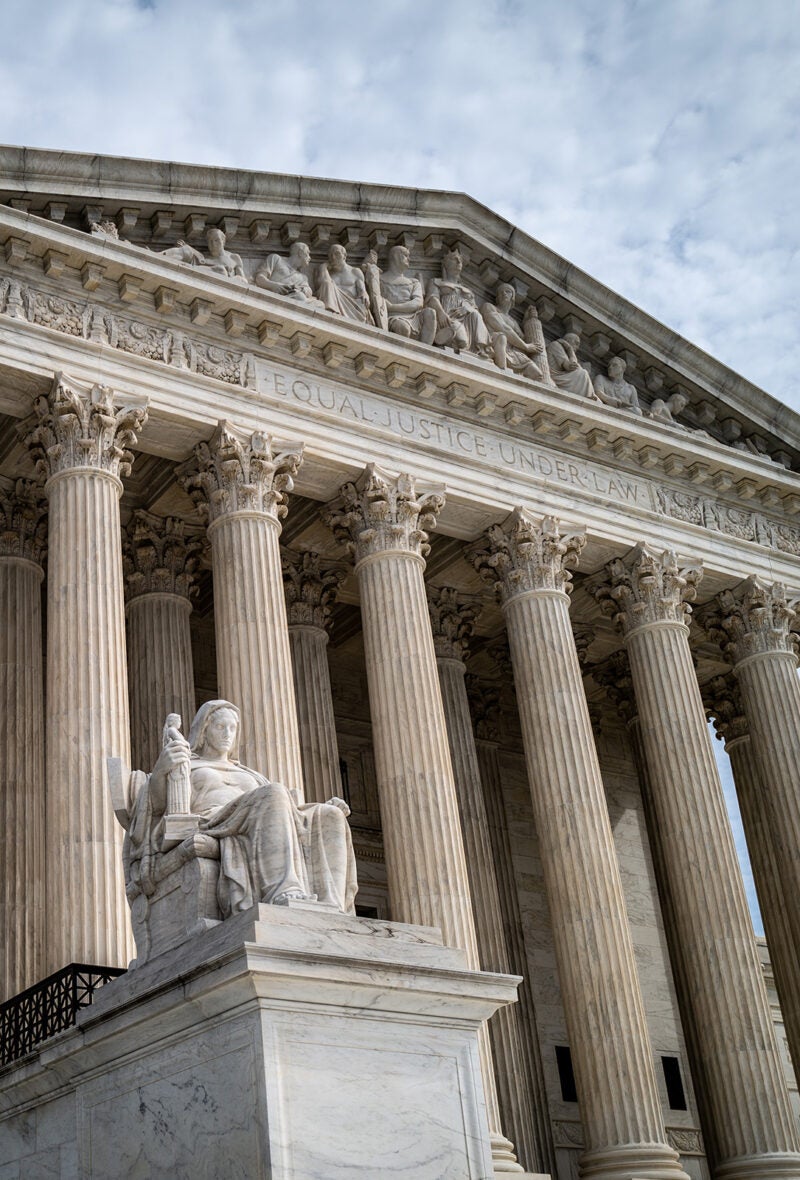
Last month, the Supreme Court closed its 2025-26 term, issuing landmark rulings on birthright citizenship, voting rights and election law, presidential power, immigration, and more. While the Court’s majority was not always predictable, the term was characterized by an increasingly conservative tilt and institutional instability, according to experts at Harvard Law School. Here, several Harvard Law faculty members weigh in on their takeaways from the term, including how key decisions will impact the Court — and the future of the United States.

Nancy Gertner, Senior Lecturer on Law
Each term, after the Supreme Court’s last decision, numbers of commentators try to normalize an abnormal Supreme Court. This term was no different. They seek to show that this Court is not materially different from other supreme courts in other eras, no more activist than the Warren court (whatever “activism” means), no more disrespectful of precedent, etc. It doesn’t work.
The pace of overturning precedent increased just when Trump secured his 6-3 conservative majority. More precedents have been overturned since Brett Kavanaugh replaced Anthony Kennedy on the Supreme Court in 2018 and especially since Amy Coney Barrett replaced Ruth Ginsburg in 2020 than in the preceding 10 years combined. It is not just that these overrulings — on abortion, gun rights, environmental protection, separation of church and state, etc. — align perfectly with a conservative agenda; it is that the vote is nearly always the same six justices against the same three (which was not the case with previous courts, with shifting majorities and frequent 5-4 splits). This term was no different.
Worse are the erasures of precedent through the shadow docket without oral argument or briefing. Long before the Court’s formal opinion in Trump v. Slaughter, allowing the president to dismiss Rebecca Slaughter, a commissioner on the Federal Trade Commission, it telescoped its intent in an emergency order. It refused to preliminarily enjoin Slaughter’s firing, effectively wiping out Humphrey’s Executor v. United States, a ninety-year-old decision, in a short unexplained decision that had all the gravitas of words scribbled on a napkin.
Then there are those who say that this Court should be praised for “standing up to the president,” by overturning his signature policies, like Learning Resources, Inc. v. Trump, which invalidated certain of Trump’s tariffs, or more recently, in Trump v. Barbara, the birthright citizenship case. That is damning this Court with faint praise. When a president is so, so lawless, when he seeks to do through executive order what he was supposed to do through Congress, there are bound to be some limits. Although he has majorities in both houses of Congress, he has governed by executive order, ignoring those institutions and their constitutional responsibilities.
Nor is this Court like others in terms of even attempting to hide their ideological preferences. On April 28, 2026, the night before the decision in Louisiana v. Callais was issued, the decision severely weakening Section 2 of the Voting Rights Act, the six conservative judges attended a reception at the White House for King Charles. The three Democratic appointees reportedly were not invited.
The birthright citizenship case was the coup de grace, not because of the outcome, which affirmed the 14th Amendment’s protection for birthright citizenship, mercifully allowing 1898 Supreme Court case (United States v. Wong Kim Ark) to stand, but because of the vote. A fringe legal argument, that the 14th Amendment did not protect birthright citizenship, garnered three dissenting votes. And the fourth, Judge Kavanaugh’s opinion, argued that Congress had the authority to create exceptions for the children of parents unlawfully or temporarily in the country, notwithstanding the plain language of the Constitution, thereby inviting the campaign to end birthright citizenship to continue.
No, this is not a “normal” Supreme Court. It has gone so far off the rails that I predict that calls for fundamental reforms will finally gain traction.

Richard Lazarus, Charles Stebbins Fairchild Professor of Law
The chief had his most challenging term since he joined the Court more than twenty years ago. Outside the Court, he faced a president who found obvious pleasure in lacerating any Justice, including the chief, who defied the president’s wishes. Within the Court, he faced a majority of five Justices (Thomas, Alito, and Gorsuch on the right and Sotomayor and Jackson on the left) who regularly made clear how little respect they had for others on the Court who do not share their views. A long distance traveled from the chief’s first year on the bench when he was greeted by veteran Justices like Stevens and Scalia, who could both sharply criticize opinions with which they disagreed, including those of the chief’s, but always make clear their shared, deep respect for each other in a collegial atmosphere. The chief has earned the summer recess.

Richard Re, Professor of Law
(The following is excerpted from Re’s full response on the Divided Argument blog.)
Two different things are true: (i) the Supreme Court is very conservative, and (ii) the Court, in tandem with the rest of the federal judiciary, has substantially checked the Trump administration.
This combination of facts creates cognitive dissonance for many (most?) members of legal culture, for conservativism is now linked to the administration. So many of us have trouble keeping both of these important facts in view at the same time.
One way to resolve the dissonance is to focus on the Court’s conservativism and downplay or ignore all the many ways that it has preserved the rule of law. ‘Sure, the Court blocked deportations under the Alien Enemies Act, stopped National Guard deployments, invalidated tariffs, preserved traditional birthright citizenship, safeguarded the Federal Reserve, and more — But don’t believe your lying eyes!’
A lot of progressive commentators are taking this approach.
Another way to avoid hard thinking is to do the opposite: Train attention on all the ways the administration has been stymied. ‘Yeah, the Justices vastly expanded the President’s power within his branch, stopped majority-minority districting, green-lighted immigration-enforcement efforts, offered expedited relief from lower court injunctions, and more — But don’t believe your lying eyes!
A lot of conservative commentators are taking this approach. …
I suspect that many people in each of these two groups are not cognizant of the other group. In other words, people who mainly absorb progressive media may not realize how many conservatives have been furious at the Court during the past year or so. And, likewise, many who digest conservative media may not appreciate how angry many progressives have been. Or perhaps each side does know about the other but still has a hard time seeing past its own sense of grievance — which would itself be a problem with seeing two things at once. …
Now, nothing I’ve said here disproves arguments from progressives or conservatives in favor of reforming the Court or changing the law. Sometimes when two sets of partisans disagree, one of them is correct. Maybe the Court has done much too little, or else much too much. Or maybe a combination of both.
In addition, nothing I’ve written here suggests that the Court is moderate, as judged by either legal or political standards. Again, what I’ve described is a conservative Court that has also checked the Trump administration. The Court has played that complex role in part because it is a relatively old-school conservative court and Trump is a relatively new-school conservative president.
Yet finding a way to see two things at the same time can inform or change how we think about the Court, the law, and proposals for reform.

Kenneth Mack ’91, Lawrence D. Biele Professor of Law
Despite certain voting configurations in which the Court has defied expectations, the striking fact about this term is the degree to which it demonstrates this Court is one in which conservative politics is being translated into conservative constitutional law. Take the birthright citizenship decision, Trump v. Barbara, for example, which affirmed that children born in the U.S. to parents who are unlawfully or temporarily present here are citizens at birth. There is some room for debate over the exact contours the exception to the territorial definition of birthright citizenship encapsulated in the text and history of the Fourteenth Amendment — a deliberately expansive definition created, in part, through the efforts of Black Americans in the years leading up to the Civil War. Since the nineteenth century, there has been a general consensus on the Court, in Congress and among government officials that the exceptions to the Amendment’s guarantee of birthright citizenship should be read narrowly. There have been periodic attempts to expand them and thus to deny citizenship to those born and raised here, notably during periods of anti-Chinese sentiment in the late nineteenth century, or the period of hostility towards Americans of Japanese descent during World War II. But, for the most part, the consensus has held. The present controversy has its roots in the debate over the presence of illegal or undocumented immigrants during the 1980s and 1990s, which reached its present state because of the anti-immigrant policies of the second Trump administration (policies with some exceptions, such as those for white South Africans). Some conservative scholars who once read the birthright citizenship exception narrowly have now changed their positions in the face of the recent political ferment, and some members of the Court’s conservative majority saw an opportunity to repudiate the Court’s previous jurisprudence and thus broaden the exception. The close vote in the Court’s recent decision, which endorsed the traditional territorial definition with a narrow exception, surprised many observers, who expected it to be perhaps 7-2 in favor of the traditional definition.
The Court’s recent decision in Louisiana v. Callais, reinterpreting Section 2 of the Voting Rights Act to reverse the long-held consensus on the minority vote dilution standard, illustrates a similar process. That decision has its roots in a political debate inside the Reagan-era Justice Department in which one faction of lawyers, led by now-Chief Justice John Roberts, argued forcefully against the vote dilution standard as a matter of policy when Congress amended the statute to codify that standard. That political position, which was contested even among conservatives at the time, lost in Congress during the 1980s when the Act was amended to codify the vote dilution standard, and lost again during the Court’s initial interpretation of the Act. It gained greater currency with Roberts’ ascent to the Chief Justiceship, with his 2013 opinion that invalidated the coverage formula under Section 4 of the Voting Rights Act, and reached its current state with Justice Alito’s opinion in Callais. As with many cases that reach the Court, there is room for debate over the proper interpretation of Section 2, but it seems impossible to escape the conclusion that this is a decision that is the product of a similar long-running evolution of conservative policy and political arguments being recast in the form of law.
There are other conservative traditions of jurisprudence. For instance, there is the institutional conservatism once associated with the Legal Process tradition of Harvard Law School, and figures such as the Second Circuit Judge Henry Friendly — for whom Chief Justice Roberts once served as a law clerk. That is a position that holds that courts should be modest about sharp reversals of settled understandings of law, and about overturning the work of the politically accountable branches of government. It was once called judicial restraint. “The only check upon our own exercise of power is our own sense of self-restraint,” wrote Justice (and later Chief Justice) Harlan Fiske Stone in a dissenting opinion during the famous conflict between the Court and the political branches prompted by the New Deal legislation of the 1930s. “Courts are not the only agency of government that must be assumed to have capacity to govern,” he wrote. That is not the inclination of the Court’s current 6-3 conservative majority. The limits of the present Court, it seems, will be set only by the ambitions of the individual Justices currently comprising its majority.

Laurence Tribe ’66, Carl M. Loeb University Professor of Constitutional Law Emeritus
From virtually every angle, this was a train wreck of a Supreme Court term. In a 6-3 opinion as disingenuous as it was destructive (Louisiana v. Callais), the Court dismembered what little remained of the Voting Rights Act. And it followed that up almost instantly with an unsigned and barely coherent 6-3 order (Allen v. Caster) overturning an impeccably reasoned fact-intensive decision by a unanimous three-judge district court (two of whose members were Trump appointees) faithfully applying the Court’s own purported standards for identifying and remedying purposeful racial discrimination in districting. So much for Congress’s power to enforce the Fourteenth and Fifteenth Amendments!
To similar effect the Court, without opinion, issued an “emergency” 6-3 order in Noem v. Vasquez Perdomo permitting ICE to continue its Los Angeles “roving patrol” stops relying on apparent race or ethnicity, as inferred from Spanish language accent or presence at day-laborer sites. Justice Kavanaugh’s solo concurrence, furnishing the only published reasoning accompanying the Court’s action, unconvincingly denied that the factors he identified as justifying the stops were proxies for race. He brushed off as brief inconveniences the way such stops sometimes swept in and detained U.S. citizens and legal residents.
In the same spirit, the Court was particularly tough on people seeking asylum here pursuant to our refugee laws, clearing the way by a 6-3 vote in Mullin v. Doe for DHS to end Temporary Protected Status for some 350,000 Haitian and 6,000 Syrian nationals while implausibly denying that Haiti and Syria were singled out at least in part for racial reasons. It would be impossible to improve on Justice Kagan’s dissenting observation that President Trump himself made plain that race played a role with his odious public references to taking “people from shithole countries” like “Haiti [and] Somalia” rather than “some people from Norway [and] Sweden.” Twisting the blade, she noted simply: “Haitians are Black. (Norwegians and Swedes not so much.)” Ouch.
The climactic decision in the immigration space was yet another 6-3 ruling, Mullin v. Al Otro Lado, holding that a noncitizen physically standing in Mexico just feet away from the U.S. border doesn’t “arriv[e] in the United States” within the meaning of the Immigration and Nationality Act — even if the only reason the noncitizen hasn’t stepped across is that a U.S. border agent has physically blocked the refugee’s path! Justice Sotomayor, writing a compelling dissent (joined by Justice Kagan), shredded Justice Alito’s hairsplitting majority opinion with proof that the relevant provision of the INA was enacted specifically in response to U.S. agents blocking Vietnamese refugees at the threshold. Her invocation of the MS St. Louis — the ship carrying Jewish refugees that was turned away from American shores in 1939 only to see over 254 of its 937 passengers murdered in the Holocaust — added historical weight to her documentation of the violence and death, including families drowning in the Rio Grande that the Alito majority opinion said absolutely nothing about. The brutal insensitivity of Justice Alito’s only defense — that a “running back does not arrive in the end zone when he reaches the 1-yard line” — fairly summarizes the spirit of the reigning supermajority.
The Court’s wrecking ball didn’t stop with race and immigration. In a widely anticipated but nonetheless stunning 6-3 decision (Trump v. Slaughter), the Court completely dismantled the power of Congress, rooted in the First Founding and celebrated by as pro-executive a Framer as Alexander Hamilton (Federalist 77), to create agencies run by appointees not subject to “displacement” at the president’s pleasure. Making a conspicuously unprincipled 5-4 exception for the Fed (Trump v. Cook) — ironic in light of the principles set out in the Court’s classic decision upholding the Second Bank of the United States in McCulloch v. Maryland (1819) — the Court overturned its 9-0 decision in Humphrey’s Executor v. U.S. (1935) and at one stroke exposed everyone but bankers (and them, too, in the long run) to the whim of whoever sits in the Oval Office, handing extraordinary power over ordinary life to the Colossus in the White House.
Although the Court in Learning Resources v. Trump (again 6-3) struck down the so-called “Liberation Day” tariffs the president had brazenly tried to impose under a statute not delegating to him any tariff-imposing powers at all (IEEPA), it looked the other way while the president, enabled by the Court’s unprecedented use of its emergency docket, repeatedly usurped the power of the purse and expanded the powers of an already dangerously bloated presidency. And what should have been a quick and unanimous repudiation of the president’s performative attempt to erase birthright citizenship from the Fourteenth Amendment ended up (Trump v. Barbara) being a dragged-out affair cruelly leaving millions of citizens born in the U.S.A. under a cloud of doubt until the last possible moment, when 4 of the 9 justices announced their discovery that the first sentence of that nation-defining amendment didn’t mean what it said. Focusing narrowly on immediate results rather than on long-term consequences, many in the media misreported Barbara as a 6-3 victory for birthright citizenship without noting that Justice Kavanaugh joined Justices Thomas, Alito, and Gorsuch in concluding that the right to full citizenship of just about anyone born here was subject to elimination by Congress. Rather than breathing a sigh of relief, those watching the Court closely shuddered to realize that we are now one justice away from essentially undoing the Second Founding and unraveling the meaning of America.
Although not all the Court’s disturbing rulings found the justices divided along strictly party lines, the number of 6-3 decisions in which all the Republican-appointed justices lined up against all the Democratic appointees more than doubled, from just 6 in the 2024 term to 13 in the 2025 term. Nor does the Court come off much better if looked at through an entirely apolitical lens. In the first opinion of the term in a fully briefed and argued case, Bost v. Illinois State Bd. of Elections, the Court strangely held (per the chief justice) that, as Justices Barrett and Kagan put it (concurring in judgment only), Bost means that, to “challenge ‘the rules that govern the counting of votes in his election,’ a candidate need only allege that he is in fact a candidate in that election.” To their credit, those two justices wouldn’t “join the Court’s creation of a bespoke standing rule for candidates,” wryly noting that, while “[e]lections are important, so are many things in life.” And Justices Jackson and Sotomayor, the only two dissenters, rightly concluded that, under the Court’s “standing precedents, this is an easy case.” Easy — and wrongly decided, as the Court “subtly shifts … to a presumption that certain kinds of plaintiffs are sufficiently aggrieved to satisfy Article III standing, regardless of whether they will experience any particularized harm,” thereby disregarding “both the equal treatment of litigants and judicial restraint.”
Bookending the Court’s abuse of Article III, National Republican Senatorial Committee v. FEC, decided on the term’s last day, featured a 6-3 majority striking down limits on party-candidate coordinated spending — and thereby, as Justice Kagan (joined by Justices Sotomayor and Jackson), put it in her compelling dissent, inviting “the same opportunities for quid pro quo corruption that the contribution limits were meant to check.” I call this final-day case a bookend for Bost because it was another case that the Court almost certainly should have dismissed 9-0 for want of Article III standing. The majority opinion by Justice Kavanaugh held that the Court had Article III jurisdiction because, believe it or not, Vice President JD Vance maintains an active “statement of candidacy” on file with the FEC indicating his intent to run for the Senate in 2028! Understandably eager to point out how terribly wrong their six colleagues were on the merits — and how horribly their casual overturning of a 2001 precedent (FEC v. CRFCC, known as Colorado II) would corrupt our politics — the three dissenters paid no attention to the Court’s lack of Article III jurisdiction to proceed at all, let alone to rely on a transparent fiction to widen the window for money to influence elections.
It’s hard to have much respect for a body that acts the way the Supreme Court did this term.
All the more reason that introductory courses in constitutional law should focus less on what passes for “constitutional doctrine” in the often unconvincing opinions of that one increasingly discredited Court than on constitutional history; the way the Constitution works (or doesn’t); the way the Second Founding differed from the First; the differences between judicial review and judicial supremacy; the available approaches to reforming the Supreme Court as part of the effort to save constitutional democracy; and the ways “We the People” can play a more active and informed role in making constitutional meaning rather than just passively imbibing the fumbling efforts of nine politically vetted but not invariably principled or always brilliant lawyers.
Additional Commentary

Jeannie S. Gersen ’02, John H. Watson, Jr. Professor of Law

Noah Feldman, Arthur Kingsley Porter University Professor

Cass R. Sunstein ’78, Robert Walmsley University Professor

Adrian Vermeule, Ralph S. Tyler, Jr. Professor of Constitutional Law
Want to stay up to date with Harvard Law Today? Sign up for our weekly newsletter.