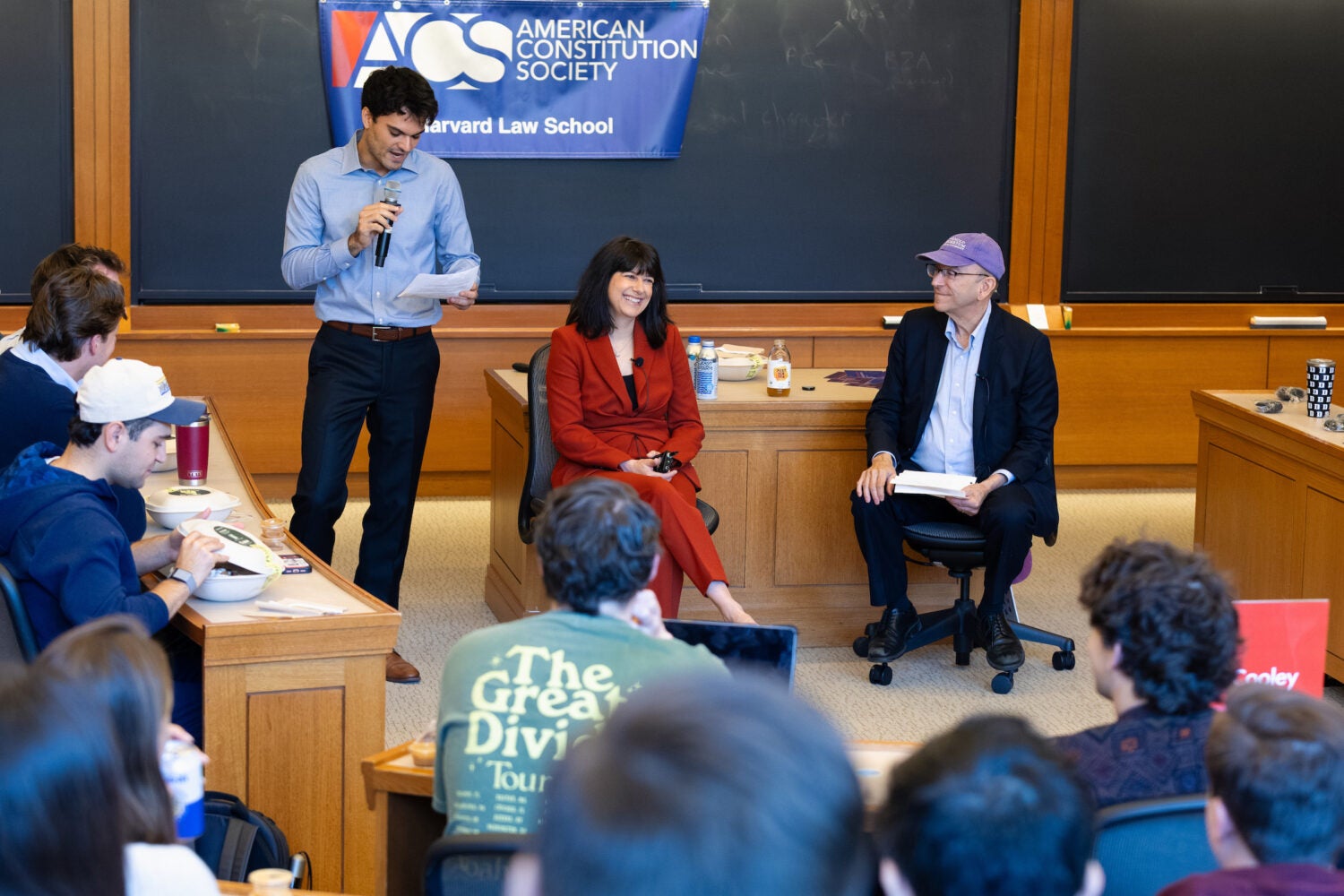
As they waited for a lunchtime discussion to begin in a packed classroom last week, one Harvard Law School student could be heard saying to another, “It’s not surprising that this is packed.”
And the crush wasn’t because of the salads on offer.
It was because a Harvard alumna, former solicitor general of the United States, clerk for two U.S. Supreme Court justices, lecturer at the law school, Fulbright scholar, and Idaho beauty queen was about to speak.
Elizabeth Prelogar ’08 didn’t disappoint the eager crowd, offering up thoughts on her career, her cases before the high court, her Harvard time, tips for lawyers in training interested in a similar path, and more during an hourlong conversation with Richard Lazarus ’79, the Charles Stebbins Fairchild Professor of Law, that was sponsored by the American Constitution Society for Law and Policy.
An unexpected path to the law
In a surprising admission, Prelogar, currently head of the Supreme Court and appellate practice group at Cooley, said she arrived in Cambridge with no intention of becoming a lawyer. Law school was a means to an end, she said, a way of gaining deep knowledge of the legal fields she hoped to cover in a future career as a journalist. Then everything changed.
“I would say it was in that first year and really in the first few days that I fell in love with the idea of legal writing, legal analysis, how you form arguments, how you reason from first principles and precedent and the text and the history and put it all together,” said Prelogar. “And so I really discovered, I think, my passion for and love of the law in those first weeks here at HLS.”
A number of classes she took made a lasting impression: civil procedure, federal courts, administrative law, and constitutional law, taught by “an all-star cast” of Jack Goldsmith, Elena Kagan ’86, and Richard Fallon. While studying hard and getting good grades was important, perhaps her biggest takeaways from Harvard were the deep ties she made there. “I think the thing that has mattered most of all are the relationships I’ve formed and the connections I’ve made,” she said. “Making those connections and having those opportunities to get to know my fellow classmates are the moments that stand out and are most memorable.”
One prominent memory is her participation in the Ames Moot Court Competition. Though she and her team didn’t win (something she joked she is “still hung up on”) she was named best oralist for the semifinal stage, despite having little prior experience with debate. She remembered calling her mother immediately afterward to say: “Maybe I could be an appellate advocate.”
Indeed, it turned out she could.
Preparing to argue before the Supreme Court
As solicitor general from 2021 to 2025, Prelogar argued 35 cases before the Supreme Court, many of them high-profile constitutional and political ones involving abortion, voting rights, environmental regulation, and the Second Amendment.
Anyone who has listened to the Supreme Court’s oral arguments knows that is a pressure-packed environment, one in which the nine justices press the lawyers before them with rapid-fire questions. Rigorous preparation is essential.
Prelogar said she begins her prep process for a case by diving back into the briefs, reading them carefully and jotting down every question that comes to mind. “In part that task helps me unearth what are the repeat questions that are really the central pressure points or the moments in the case that are obviously going to be impactful and important to the court.”
When she has a list of 150-200 questions, Prelogar closes her office door, reads the questions aloud and talks through her responses. The goal isn’t to memorize a reply, she said, but to become “fluent in the language of my case” and ready to answer anything the justices throw her way. Taking part in moot courts with colleagues, she added, is another key to her process.
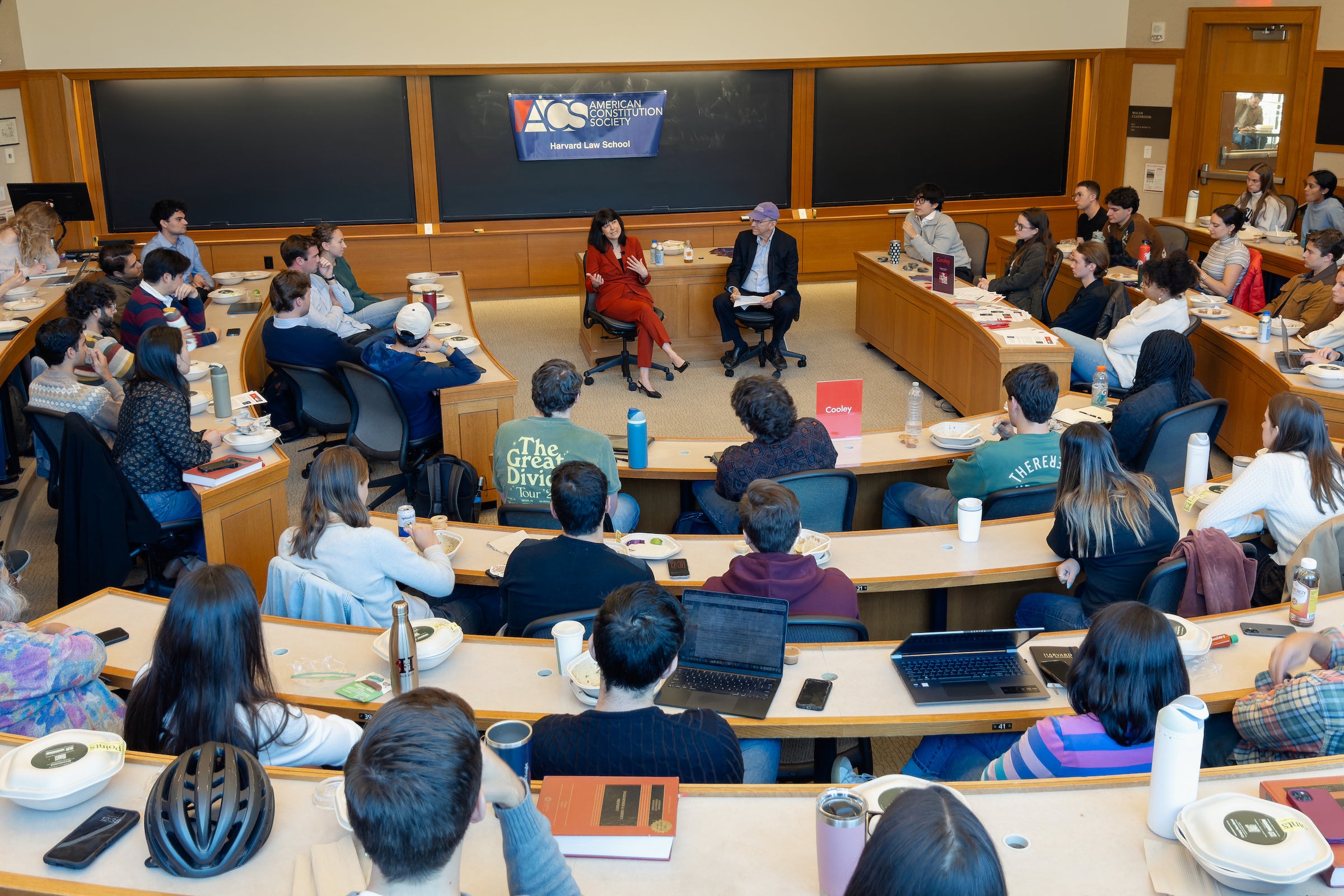
That intense prep work served her well when appearing before the high court with its conservative majority. As solicitor general, Prelogar said she was “frequently arguing cases that were the highest priority for the Biden administration, and therefore the ones that might have the biggest headwinds in the Supreme Court.” In that kind of environment, she thought a lot about the particular justices when envisioning her path to victory, anticipating how each justice might react to her argument and the ways that she could “put together a coalition.”
“Even if I don’t have five votes on the merits, and I’m quite confident I’m not going to get five votes to say ‘this policy is perfectly fine,’ are there ways that I can persuade Justice [Amy Coney] Barrett on the standing threshold issue in the case? Or the chief justice and Justice [Brett] Kavanaugh might be with me with respect to the national security concerns. And so kind of carve out that exception or find a way to really try to speak across the broad section of the court.”
Her most memorable case involved United States v. Rahimi, a 2024 landmark ruling accepting her argument that the government could disarm someone who posed a credible threat to others, in accordance with the Second Amendment. (The respondent Zackey Rahimi had been served with a two-year domestic violence protective order by a Texas court.) The case came just two years after the Court’s decision in New York State Rifle and Pistol Association, Inc. v. Bruen, which established an individual’s right to carry a handgun in public for self-defense. The earlier ruling had “adopted history and tradition as the guiding principle for how you interpret the Second Amendment right,” said Prelogar, who delved into domestic violence case law with her colleagues to craft her argument in the Rahimi case.
“You have a judge who’s deciding this person presents a threat to an intimate partner, and that helps to underscore the judgment Congress has made, the legislative judgment, that as a class you can reasonably say this is a dangerous situation, and so we pursued this strategy.”
She said the win felt so important both because she was able to win over justices who firmly believe in the constitutional right to bear arms, and because she’d become familiar with the grim facts.
“The statistics were really alarming, that if you have a gun in the house with someone who is prone to domestic abuse, it can take abuse and it can turn it into murder. And so it felt like there were profound public safety interests in play, and to be able to advocate and get to that good result that is good for public safety was also really, really gratifying.”
Prelogar also touched on her time clerking with Associate Justice Ruth Bader Ginsburg and Associate Justice Kagan, her former law school dean.
Prelogar recalled watching Ginsburg, a long-established justice, focus on the facts of the case. “She really wanted to wrap her mind around the procedural history and the exact nature of the facts of the dispute, and it opened my eyes to that because in law school you’re studying cases a little less for the facts and a little more for the broad legal principles, and the legal principles matter plenty. But I thought it was this really fantastic experience to learn from an experienced jurist that the facts matter.”
By contrast, Kagan, then new to the bench and “constructing her process of judging from the ground-floor up,” would walk into her clerks’ office, sit down with them and talk through the case issues in depth. It was an early training ground, said Prelogar, for that “rapid-fire questioning from someone who was brilliant and who could go straight to the heart of the issue, learning how to react in the moment and debate through the issues with her.”
Reforming the courts from within
Answering a question from the crowd about possibly reforming the makeup of the Supreme Court itself, Prelogar noted the challenges certain proposed changes present.
She said that a proposal to add justices to the court wouldn’t have a “natural stopping point” and could become a “slippery slope,” and that another proposal imposing term limits would require a constitutional amendment. Instead, she suggested working toward a better body of law and changing the system from within.
She tried to do some of that in her former role, she said, “by changing our briefing strategy to often develop a historical argument and lead with that,” citing the Court’s lean in recent years toward that type of reasoning.
“There were any number of cases I argued where I felt like … at the end of the day history is on my side, and so I’m going to take the jurisprudence and the tools that the justices have signaled are important to them, and I’m going to put forward the best possible argument.”
Prelogar thinks one type of concrete reform could focus on the lower courts and get rid of judge shopping, the practice by which litigants are allowed to file suit in a particular district court to seek a judge sympathetic to their cause.
“You should not be able to pick your judge for purposes of trying to ensure that you’ve got the most favorable decision maker possible for your arguments,” said Prelogar. “So that’s one that seems a little more within the realm of possibility to me, and one that I would hope to see more debate on.”
Prelogar urged students interested in pursuing a similar career to be flexible. There is no one path in a law career, she said, encouraging her listeners to take risks as she had with the Ames competition, despite not feeling like a natural public speaker. “I think actually one of the most beneficial things you can do is just be really open and receptive to new experiences, out-of-the-box things,” she said, “things that might make you outside your comfort zone that can really push you.”
Want to stay up to date with Harvard Law Today? Sign up for our weekly newsletter.