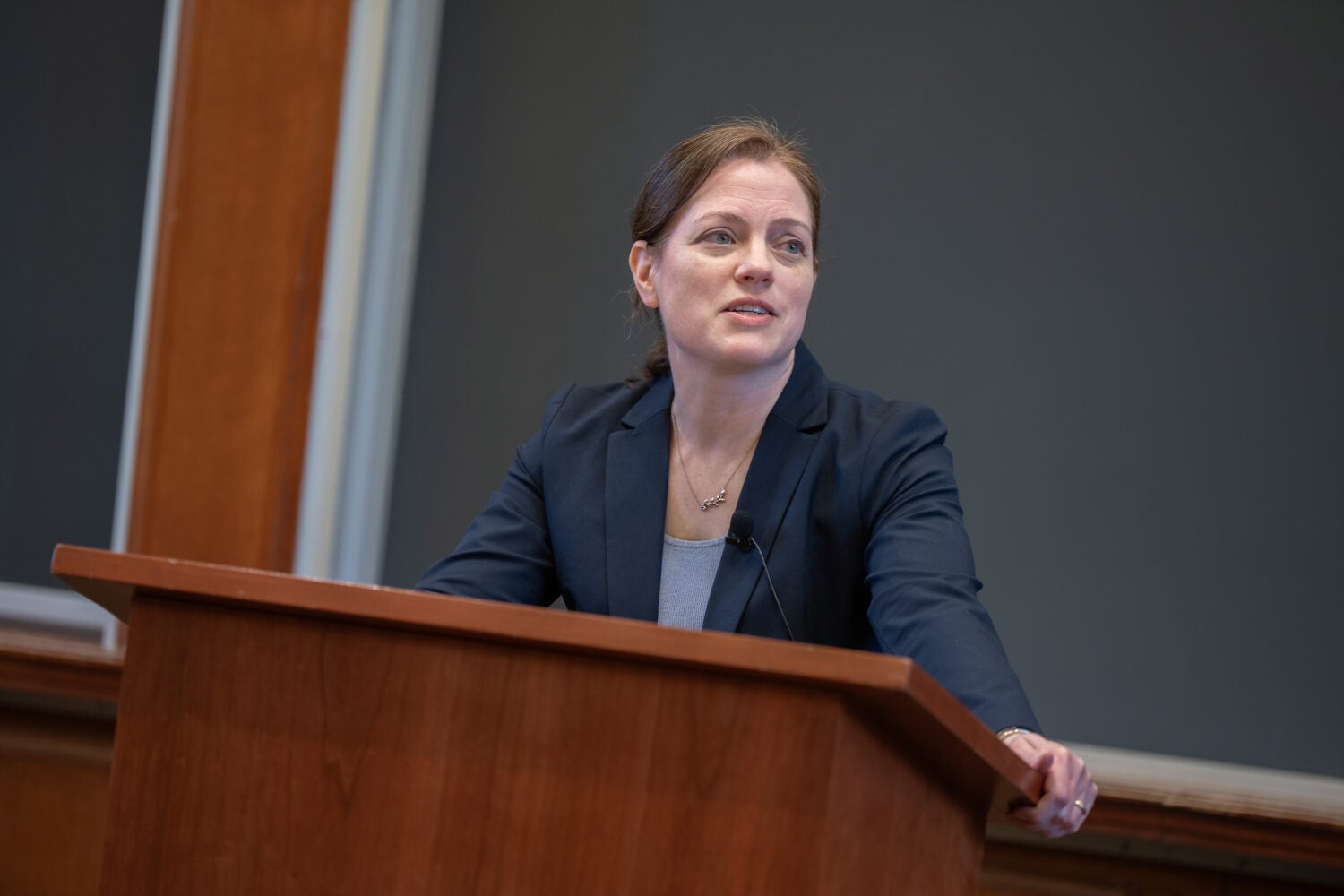
In an era of constant flux, lawyers are not just interpreters of the moment but stewards of the law’s power to shape it, argues Harvard Law School Professor Kristen Eichensehr.
“Expect the unexpected. This isn’t just a good idea for lawyers, it’s a responsibility,” said Eichensehr, an expert in foreign relations and national security law.
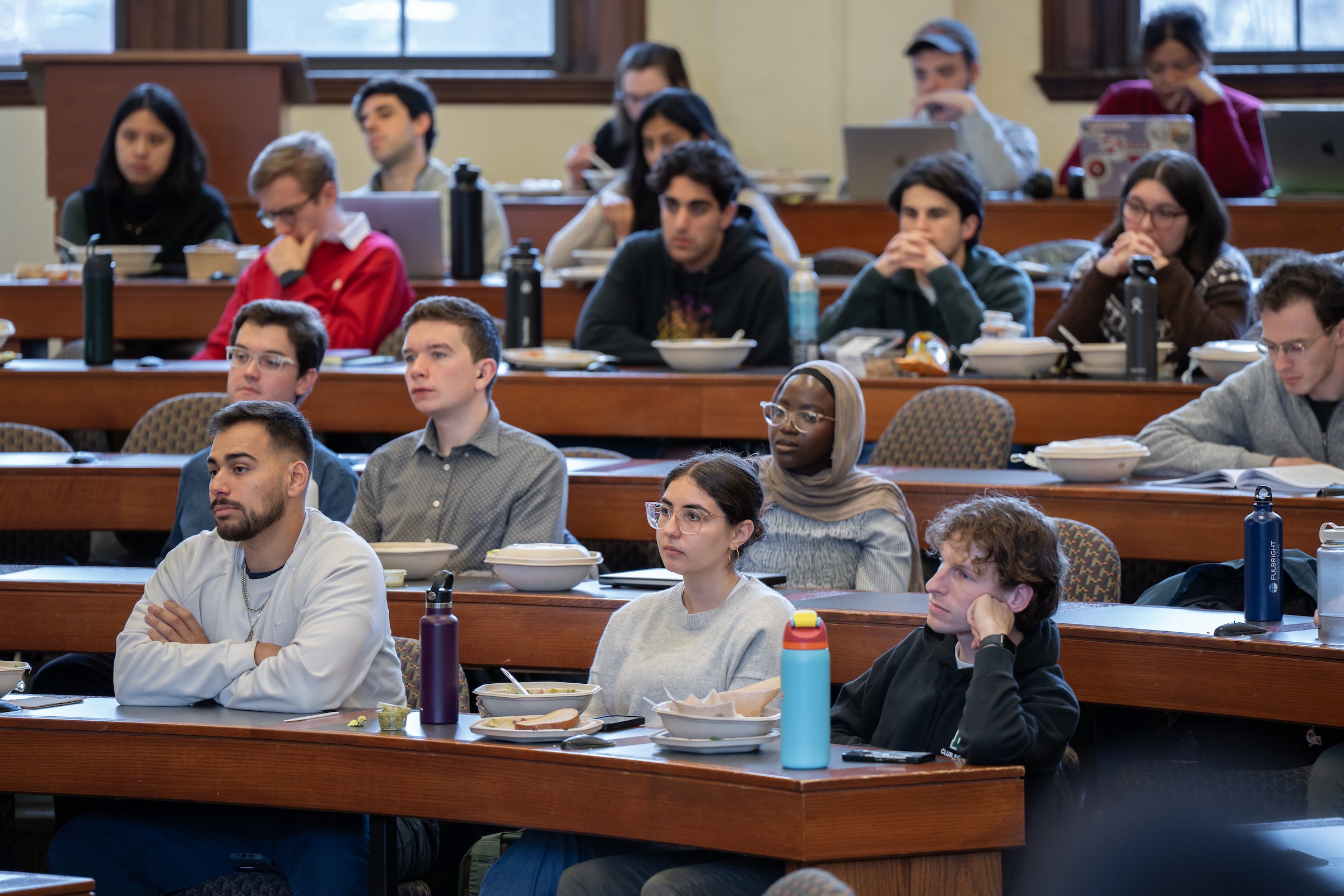
Eichensehr’s remarks on April 7 came as part of her Last Lecture to Harvard Law School’s Class of 2026 — a tradition in which cherished faculty members offer words of wisdom and advice to graduating law students.
In her talk, Eichensehr emphasized three key ideas to the soon-to-be attorneys: anticipate surprises; pace yourself in your work and career; and consider why law and lawyers matter today.
On the first point, she suggested that audience members were entering a career — and society — far different from what existed even a decade ago. “You’re graduating into a world of dynamic and dramatic and avulsive change, both domestically and internationally,” she said.
She pointed to sea changes in global economies, politics, international relations, technology — and the law. “You were the last class that learned Chevron in [Legislation & Regulation] when it was still … sort of good law,” she noted, referring to a once-key principle of administrative law that was overturned in 2024.
Eichensehr, an authority on foreign relations and national security law, said that this uncertainty extended to her own area of expertise. “International law too is in serious jeopardy of being effectively overturned in significant part,” she said.
While compliance with international law has never been perfect, Eichensehr argued, it has nonetheless reached a nadir. “This is a point where powerful countries, including this one, have stopped even trying to argue that they are complying with international law. They act, or threaten to act, in ways that violate the most basic foundations of the post-World War II international legal order, including the prohibitions on the use of force and on war crimes.”
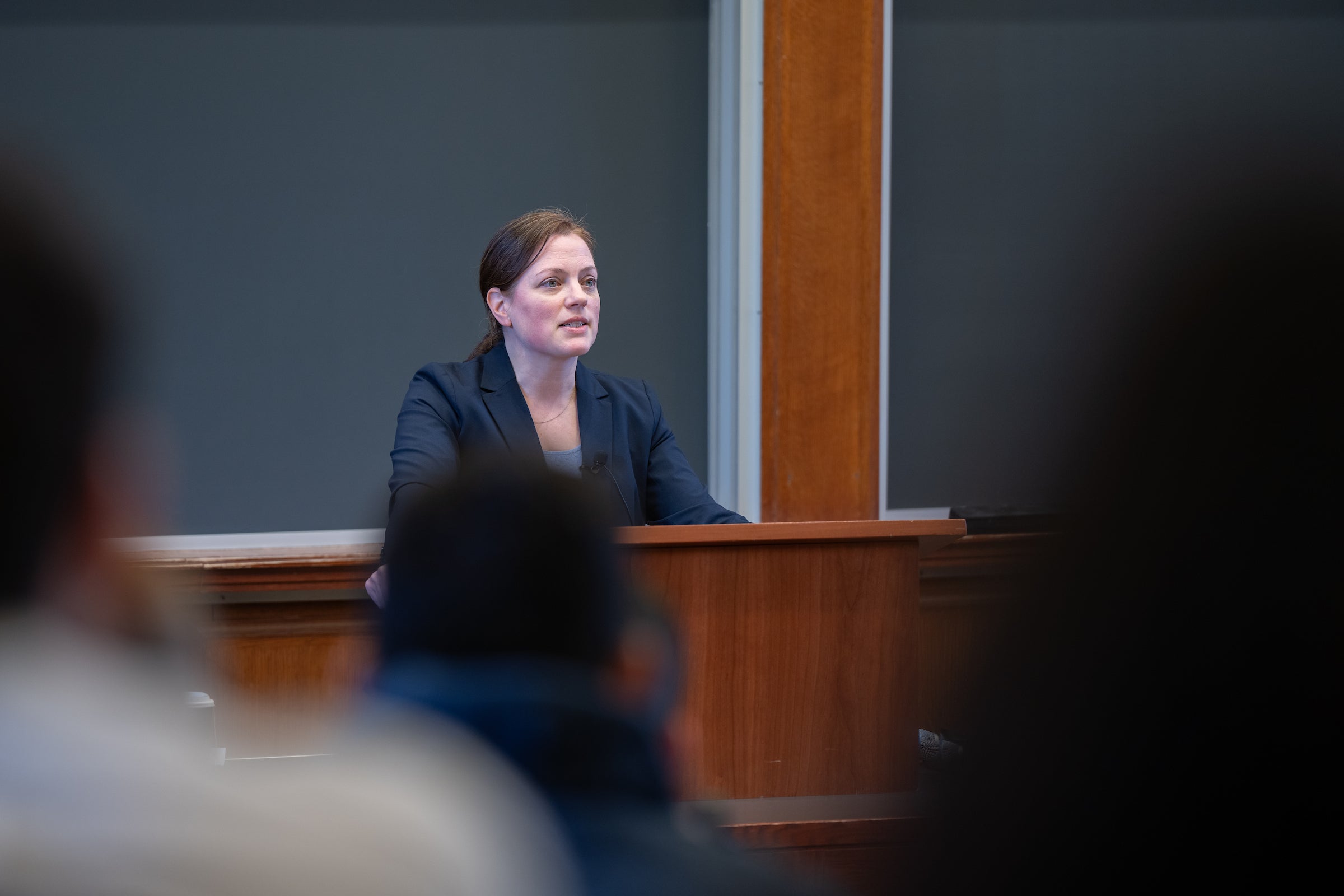
Despite, or perhaps because of, this tumult in the nation and the world, a lawyer’s job is to be a source of expertise and accurate information about these monumental changes, she suggested. “A big part of your role as a lawyer is helping people … to plan for and exist in uncertain futures.”
Eichensehr acknowledged that this responsibility can feel overwhelming — which is why she also urged her audience to pace themselves in their careers, to take time for family and friends, to develop a hobby. “You cannot do the most intellectually demanding part of your job all the time. To do your clearest thinking, to do your best work, sometimes, you need to just take a break.”
Doing so helps avoid burnout, which Eichensehr suggested would be vital for their mission ahead: helping to uphold the rule of law, even or especially, in a world seemingly less committed to it.
“For today’s lawyers, there are a lot of fights that need fighting,” Eichensehr said.
This does not mean there is always one obviously correct answer, she continued. “You may well end up on opposite sides with other people in this room. You may end up on opposite sides from other lawyers you respect and admire, and that is OK. Part of the function of law is to enable disagreements and to fight the good fights.”
“A big part of your role as a lawyer is helping people to plan for and exist in uncertain futures.”
In that spirit, she offered an example of a recent disagreement she had with another legal scholar she deeply respects. The other scholar had argued that the law has little to say about the U.S. president’s unilateral decision to use military force in Iran.
But Eichensehr pushed back, insisting that the law is crucial to such questions. “It is certainly true that politics plays an enormous role in whether legal actors choose to deploy their legal authorities,” she said. “But just because politics may influence whether or when law is enforced does not mean that law is irrelevant.”
For legal professionals to argue otherwise is self-defeating, she added. “Saying that the law is irrelevant, and that debates about the legality of uses of force are empty, cedes the ground that critics and skeptics of law very much want lawyers to give up. It plays into the idea that law doesn’t matter, that it’s just politics all the way down.”
Eichensehr argued that this line of reasoning is particularly damaging to international law. “Arguing that law is irrelevant shuts down the very debates about where the legal lines are that are absolutely necessary to have international law,” she said. “Shutting down those debates short circuits international law’s already imperfect enforcement mechanisms.”
And weakened global relations are no advantage, Eichensehr suggested. Because, while the world may be imperfect, she said, “what we have now — what we may be losing — is at least better than the lawless world that came before it. It came out of the ashes of the two world wars that led to its construction. … Are we better off with international law? I think the answer to that is a resounding yes.”
She urged the audience members to see the value of the toolset they had gained during their time at law school. “On some of the biggest issues and gravest challenges of the moment, it is the duty of lawyers to be the last, not the first, to give up on the law.”
Speaking on behalf of herself and her faculty colleagues, Eichensehr congratulated the graduates and wished them well in their journeys ahead.
“We are proud of you. We are excited for you. We are excited because of you, and we can’t wait to see what you do next.”
Want to stay up to date with Harvard Law Today? Sign up for our weekly newsletter.