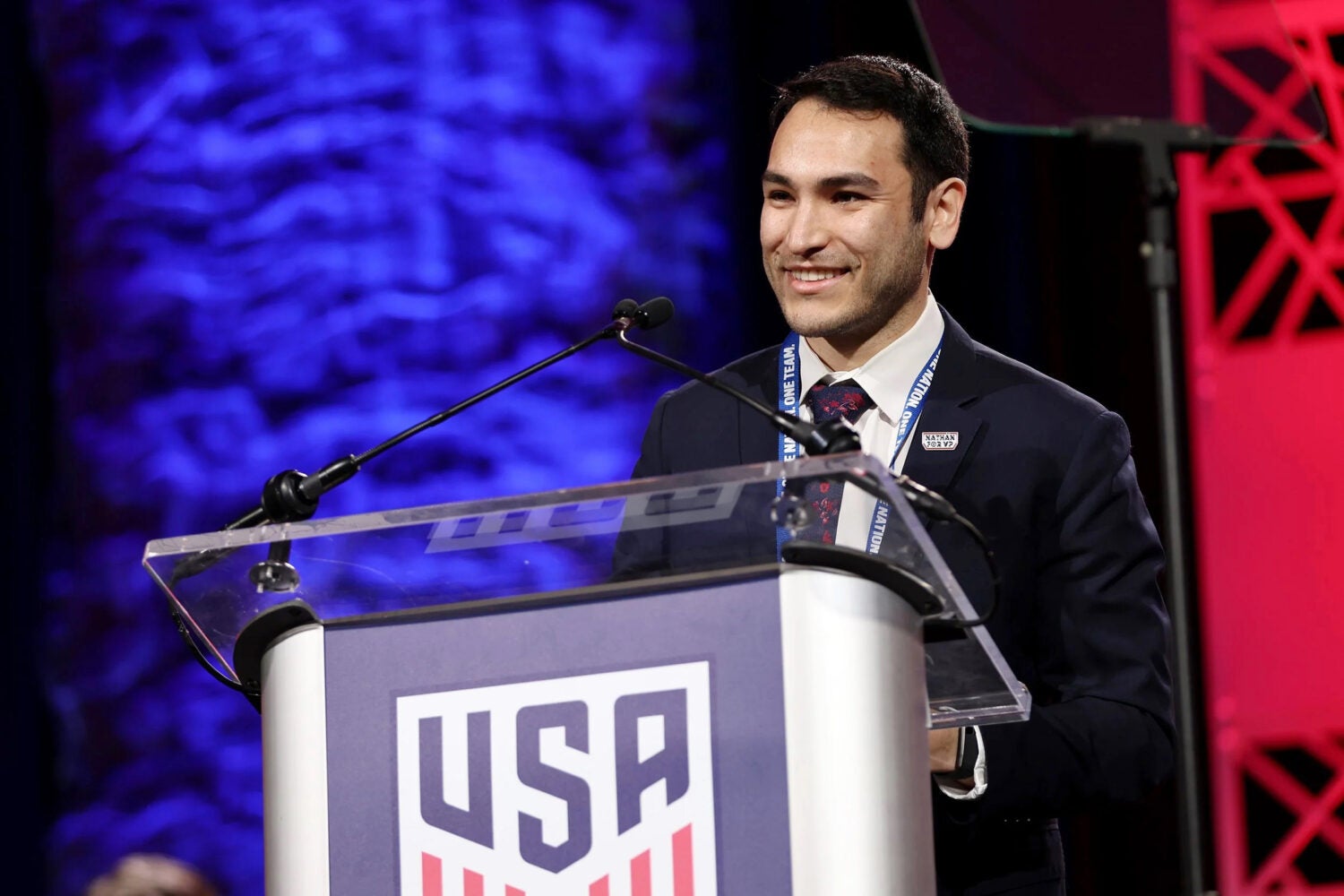
This past spring, on a Friday afternoon, a carry-on suitcase bearing the letters “U.S. SOCCER” sat on the floor of a Constitutional Law class at Harvard Law School. Soon, the suitcase and its owner would be flying to U.S. Soccer’s annual general meeting in Georgia. But not before the end of class.
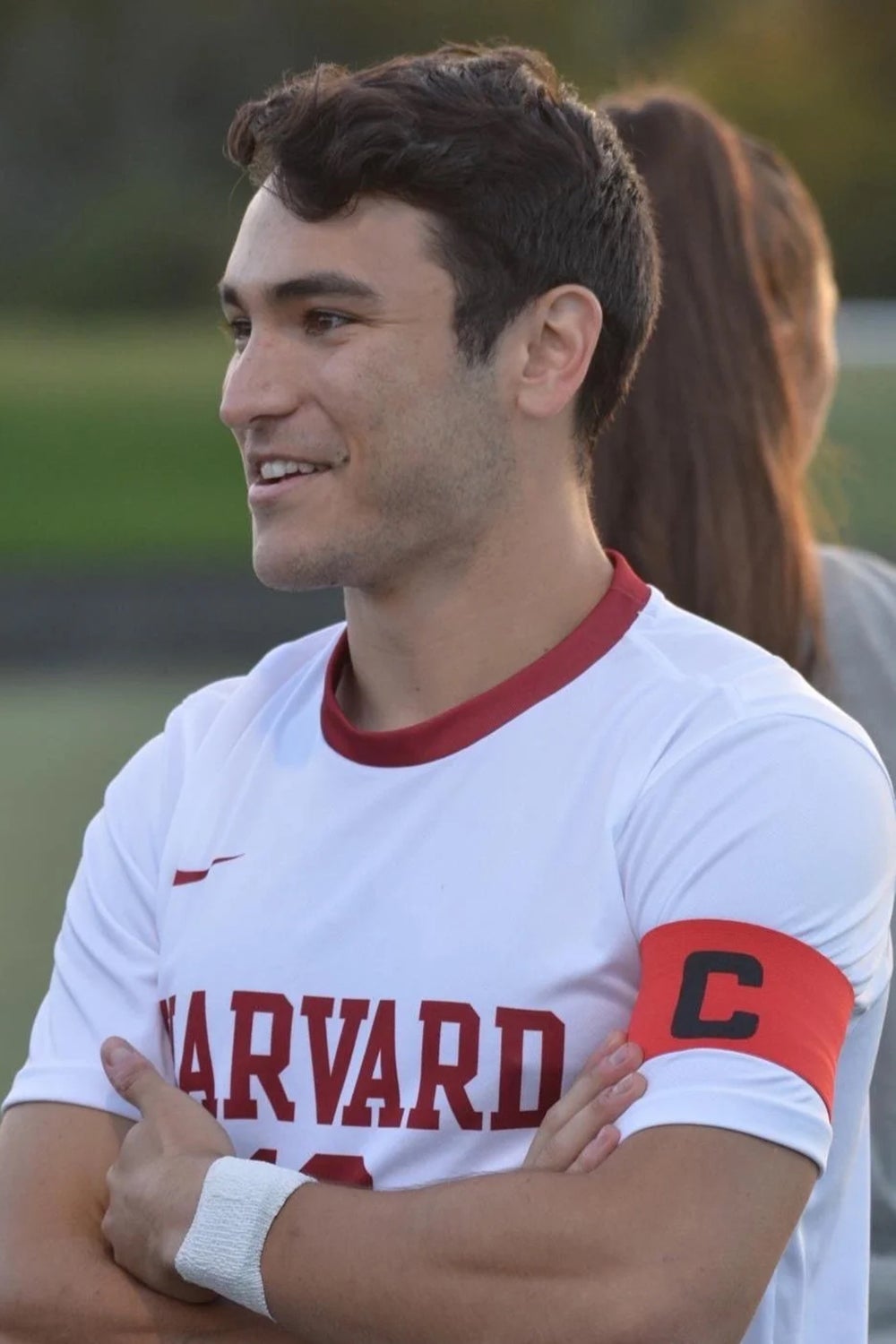
The suitcase belonged to Nathán Goldberg Crenier, a 2018 Harvard College alum and a first-year Harvard Law student who also happens to be the vice president of U.S. Soccer. As an undergraduate, the Mexico City native went from joining Harvard’s Division I soccer team as a ‘walk on’ to ultimately becoming team captain his senior year. After graduation, he worked under two different U.S. Soccer presidents. As the assistant general manager of the professional women’s soccer team Gotham FC, he helped turn a club that finished in last place in 2022 into NWSL champions in 2023. Then, in 2024, he was elected to become the vice president of the United States Soccer Federation, the official governing body for soccer in the United States, also known as the “USSF,” “the federation,” or, simply, “U.S. Soccer.”
Apart from undoubtedly shaping his professional career, soccer, Goldberg Crenier believes, can be a driving force for good that positively impacts all who play. “I only made it as far as college and soccer still changed my life dramatically for the better,” he said. “So, even for the 99.9% of people who are never going to go pro, having the access to play soccer and giving them the chance to have soccer change their lives for the better is a major long-term goal and a major component of our overall vision.”
As the United States, Canada, and Mexico host the biggest sporting event in world history — the 2026 FIFA World Cup — Goldberg Crenier met with Harvard Law Today to discuss his role with U.S. Soccer, his decision to attend law school, and his hopes for the future of the sport he loves here in the United States.
Editor’s Note: This conversation took place prior to the U.S. Men’s National Team 4-1 victory over Paraguay on June 12.
Harvard Law Today: How did you first get involved with U.S. Soccer?
Nathán Goldberg Crenier: It was actually a Harvard connection. I always knew that I wanted to work in soccer, so when I was an undergrad and my classmates were off doing tech, consulting, or finance internships, I was seeking out my own. I was a data analyst for Orlando City Soccer Club during my sophomore summer and then operations director for the St. Kitts and Nevis men’s national team during their trips abroad — all just because I had reached out. Then, there was an open presidential seat at U.S. Soccer in 2018 and a local attorney in Boston named Steve Gans was running for the seat. I thought his platform was really in-line with my vision for how soccer is meant to be a force for social impact and positive change. I volunteered for his campaign, and that’s when I got involved in the world of U.S. Soccer. He didn’t win, but the person who did [Carlos Cordeiro] was an alum of Harvard College and Harvard Business. So, I reached out to him and I said, “Hey, I’m on the soccer team here at Harvard. I’ve done these random soccer internships during my time. I graduate in six months. I’m not really sure what’s next, but I want to work in soccer. I’d love to get your advice.” And his advice was, “Come be my personal assistant.” So, I graduated in 2019 and immediately went to work at U.S. Soccer as the assistant to the president. I worked there for two years. It was a great experience, but it was also a tumultuous time for the federation in terms of lawsuits. I ended up working under two presidents and left at the end of 2020 to do some independent consulting. Then, I worked for the professional women’s team in New York [Gotham FC] and returned to U.S. Soccer about two years ago in this new role on the board as the vice president.
HLT: When did you decide to go to law school?
Goldberg Crenier: I think there were multiple points where I decided to go to law school, but the first time was during the women’s national team equal pay lawsuit against the federation. Because of my role as assistant to the president, I had a front row seat to all the legal strategy and emergency communication meetings. I was mostly there just to listen and take notes. But throughout that time, I felt like some of the decisions were missing a piece of the puzzle by being too narrowly focused on the legal issue. U.S. Soccer had a really strong legal argument for why the contract negotiations for the men’s and women’s national team did not constitute gender discrimination. Partly because of the strong legal position, I think, no one stopped for two seconds to ask, “Hey — is this the right thing to do morally or ethically?” Because it was not just a legal issue, it was a social issue, an ethical issue, a moral issue. There were other considerations like the court of public opinion, our sponsors, and, very importantly, our relationship with the women’s national team. … I saw how the game could be used, not just as a catalyst, but in this case as an impediment to the kind of social change and social values that we want to communicate and foster. And I didn’t want to ever again be in a position where I have to delegate the big picture thinking to the lawyers because I don’t have the background to oversee them and decide how to incorporate their perspective into what should be a big picture decision. That’s what pushed me. That’s what inspired me to go to law school.
HLT: How difficult has it been balancing the demands of attending law school and serving as vice president of U.S. Soccer?
Goldberg Crenier: I’ve had to make trade-offs and live with that, but I’m very happy with the decisions I’ve made. Basically, Monday through Friday I was a 1L and then Friday through Sunday I was the vice president of U.S. Soccer. We had Contracts on Fridays in the fall and Constitutional Law on Fridays in the spring. My classmates would see me come in with my U.S. Soccer carry-on suitcase, because I was usually headed off to the airport immediately after class to go visit with our member state associations and clubs that were having their home openers in new cities where soccer is expanding. So, I could have spent more time studying, but I think in the grand scheme of things I’m very glad about the work that I do and I’m very lucky that I get to do it. It’s been a balancing act, but one that left me very fulfilled because both are things that I really enjoy. I also want to give a special shout out to my classmates. My classmates were so great … I really felt like I had a team of 82 people behind me and supporting me.
“Growing up in Mexico City as a kid, I’ve seen what it looks like when soccer is so dominant that any kid sees any roughly spherically-shaped object and is compelled to kick it. That’s where we want to get to, but it’s not an overnight journey.”
HLT: What are U.S. Soccer’s responsibilities relative to the 2026 Men’s World Cup?
Goldberg Crenier: FIFA organizes the World Cup. Their operational model has essentially become all-encompassing, so, they manage virtually every aspect of the World Cup. But U.S. Soccer directly manages all of the men and women national teams’ operations. That is probably our most visible public-facing action in the soccer world. We organize their friendly matches, we book the stadiums, sell the tickets, prepare for game day, etc. We also just opened a national training center for the first time ever. We now have a centralized home for everything U.S. Soccer in Atlanta that we inaugurated last month. That’s where our national team has been training this week. Because our World Cup matches are out on the West Coast, we’re going to be based out of Irvine for the first section of the tournament. But our operations team is top notch and I know our team is going to have not just the home field advantage of playing at home, but also the advantage of having a team that has been working on every single detail of our team’s experience at this World Cup for years.
HLT: As someone who had already worked for two U.S. Soccer presidents, what were your priorities and/or goals stepping into the role?
Goldberg Crenier: My main priority entering the vice president role was to support the vision that the current president and CEO have charted out for the organization. Cindy [Parlow Cone], the president, was my boss when I was staff at U.S. Soccer. I was her assistant once upon a time and a big factor in my decision to come back to the federation was the fact that they are willing to address challenges by taking actions no one has dared to do before. They are pushing the sport in a better direction, and I wanted to be part of that. I campaigned mostly on being, first, ears for our members and then, a voice for them. When I was campaigning, I went to visit Montana, Arkansas, Hawaii — all of our member states — to ask them about the challenges they are facing because they know them better than I do. In order for me to be an effective board member and effective steward of the federation’s mission, I need to have a sense of what they need help with. I got the sense the members really appreciated someone taking the time, effort, and energy to go see the fields that they play on, visit their offices, and meet them personally. Doing so gave me the opportunity to hear about the things they are proud of, the challenges they are facing, and how they think U.S. Soccer could be a helpful partner in tackling them. That’s what I campaigned on, and that’s the thing I’ve been most focused on since being elected.
In our organizational structure, the role of the vice president is pretty ambiguous, so I’ve been able to continue serving as the federation’s ambassador and representative maintaining touch points with our members all across the country. So, even though the World Cup is happening, we’re making sure that some of my time is spent visiting some of the states that don’t have World Cup action because they’re all part of our family too. Between our first World Cup game in Los Angeles and our second game in Seattle, for example, I’m flying to Alaska to meet with the Alaska Youth Soccer Association, the Alaska Adult Soccer Association, and the referee committee. That’s because we truly care about what’s going on in every single corner of our “soccer country” at all times.
HLT: For U.S. Soccer, how would you define success in the 2026 World Cup? What does a successful World Cup look like?
Goldberg Crenier: We’ve done a lot of work at the federation to try to align our goals with what we think should be the goals of soccer in the United States. For one, we want to be successful on the field. We want to build national teams that win. That is a perennial ambition, of course. We want our men’s national team to go as far as they can in the 2026 World Cup and, hopefully, bring home the first Men’s World Cup. We take a lot of pride in holding very high standards for what we expect of our teams and ourselves.
“We want to make sure that people can see themselves represented and see the pipeline for how they can make it to the highest ranks of the game. Not just as players, either, but as coaches, as referees, as administrators, and all the pieces of the soccer ecosystem that interact with each other.”
Our other two goals go beyond the field. The second one is that we want people all over the country to feel ownership over soccer as a sport in the U.S. We want everyone to feel like they have a stake in our success and our rise as a soccer country. To do that, we want to make sure that soccer is accessible to everyone. We want to make sure that people can see themselves represented and see the pipeline for how they can make it to the highest ranks of the game. Not just as players, either, but as coaches, as referees, as administrators, and all the pieces of the soccer ecosystem that interact with each other. People talk about the “European taxi driver” paradigm, where you can get in a cab anywhere in Europe and someone can give you a super detailed tactical breakdown of the game from last night. That’s how ubiquitous we want soccer to be in the United States.
Lastly, we want soccer to be everywhere. We want soccer in every community. So, no matter if you are born in Alaska or in Texas, you have the access and the ability to play soccer and the opportunity to get scouted if you’re going to play competitively. I only made it as far as college and soccer still changed my life dramatically for the better. So, even for the 99.9% of people who are never going to go pro, having the access to play soccer and giving them the chance to have soccer change their lives for the better is a major long-term goal and a major component of our overall vision. Hosting the World Cup can help push all those things and I think it will. The amount of interest it will drive will result in more player sign-ups, referee sign-ups, coaching sign-ups, and people who want to have a career in soccer. That will help with all three of these prongs: having success on the field, making people feel ownership over the sport, and having soccer in every community in America.
“Even for the 99.9% of people who are never going to go pro, having the access to play soccer and giving them the chance to have soccer change their lives for the better is a major long-term goal and a major component of our overall vision.”
HLT: Major professional soccer leagues in the U.S. — the MLS for men and one of the predecessors to the NWSL for women — were both established largely as a result of hosting the Men’s World Cup in 1994 and the Women’s World Cup in 1999. What kind of impact do you think hosting the 2026 Men’s World Cup will have?
Goldberg Crenier: At this stage, there’s no more silver bullet and what we’re doing at the federation is a lot of work for what often turns out to be marginal gains. You have to find joy in that type of work. It’s more about longer term goals because there’s not a button somewhere that we can press that puts soccer in every community in America. I think the World Cup will help raise the floor. Then, it’s up to us to make sure that we’ve put ourselves and our members in a position to capture the upside as much as possible. That means that, as we continue building, we’re building from a higher floor.
One of the things that I see being reborn through the World Cup is the federation itself. This is not your grandmother’s U.S. Soccer Federation. We’re making bold moves like creating the national training center we just inaugurated. It’s the first time ever that U.S. Soccer has a home and we’ve merged our office for all our business functions with the fields for all the sporting functions. We have a lot of new sponsors that want to be part of the party and that is money that we’re able to then redirect to grassroots development all over the country. None of these things individually are going to be the thing that unlocks the new phase of growth in soccer in America. But all of them together are going to make it so that, in ten years, soccer will be thought more of as one of the top sports in America compared to now. Growing up in Mexico City as a kid, I’ve seen what it looks like when soccer is so dominant that any kid sees any roughly spherically-shaped object and is compelled to kick it. That’s where we want to get to, but it’s not an overnight journey.
HLT: Is there ever a scenario where you think the MLS, the NWSL, or other professional soccer leagues in the U.S. will adopt a system of promotion and relegation like they have in many European leagues?
Goldberg Crenier: I think one of the differences about professional soccer in the U.S. and other countries is a legal one: The U.S. has stronger antitrust laws than a lot of other countries. Also, the other sports in the U.S. have antitrust exemptions that soccer doesn’t have. Without weighing in on whether that’s good or not, it’s just a fact. But, what that means is, we are able to have multiple first division leagues here as opposed to just a single league that has a monopoly on professional soccer. That means the MLS can choose their business model and say they’re going to keep selling franchises one by one when they determine it’s the right thing without establishing promotion and relegation. Then, the USL [United Soccer League] can say they’re going to try doing promotion and relegation between their first, second, and third divisions. They’re launching a men’s first division in 2028, and we’ll see how that goes. Maybe the market, and the fans, respond really well to that model. I think that would be exciting, but what I think is really cool is that we get to have both of these approaches play out and see how it goes.
HLT: How do you think the U.S. team is going to do? What’s the key to their success in the 2026 World Cup?
Goldberg Crenier: The key to their success is going to be the fact that they have a Harvard soccer alum, my former teammate Matt Freese. I think Matt has the potential to drive us further than we’ve ever been before!
Want to stay up to date with Harvard Law Today? Sign up for our weekly newsletter.