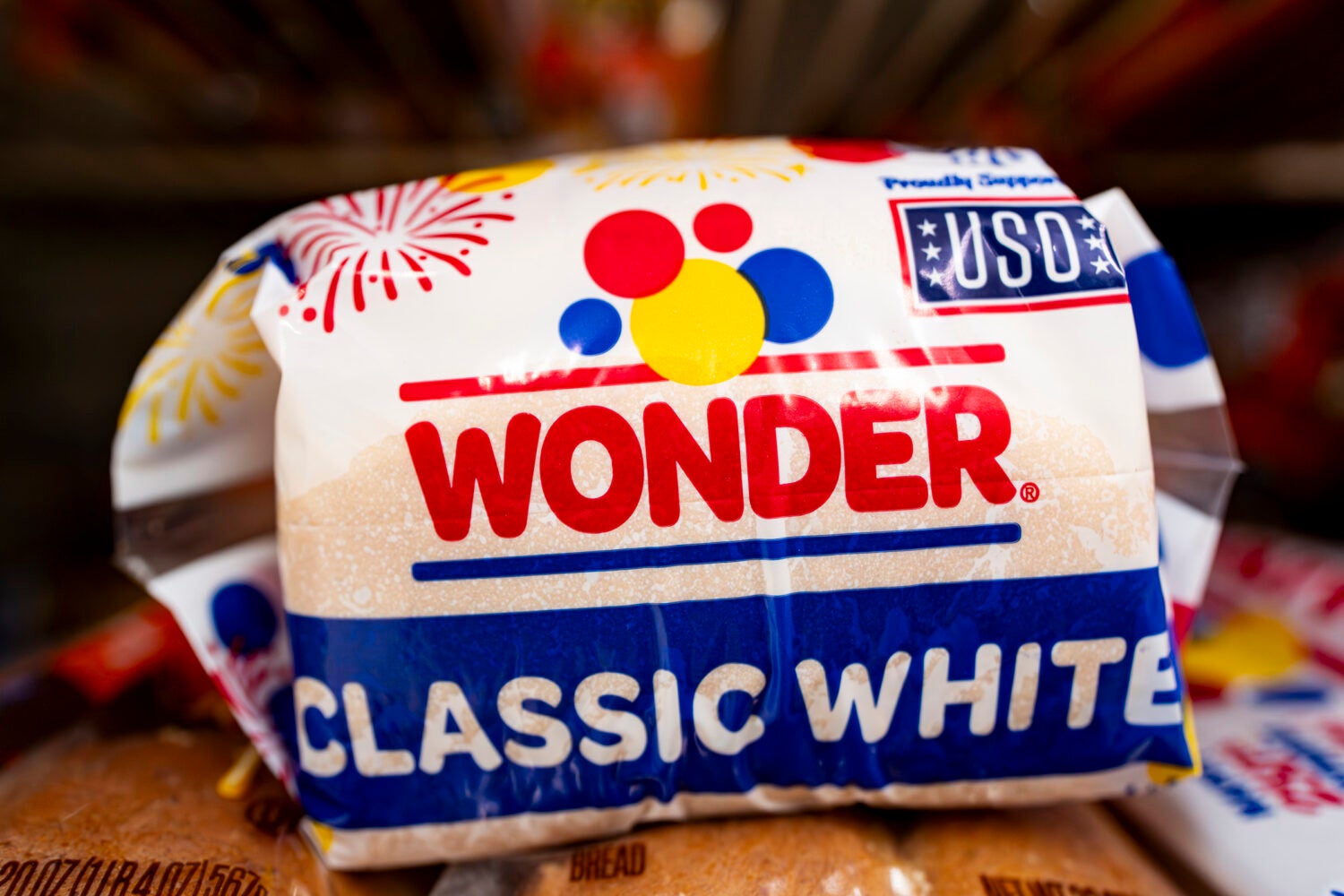
As grocery prices continue to climb, it may be tempting to reach for a cheaper loaf of bread to save a little dough. But that choice may be bad for your health — if not your wallet — suggests a new study by the Food Law and Policy Clinic at Harvard Law School in collaboration with Yuka, a health and wellness app.
“As we learned, packaged food that is lower priced is lower quality, meaning it is actually worse for your health,” says Emily Broad Leib ’08, the clinic’s director and one of the study’s lead authors.
Using data gleaned from retailers around the United States, the study analyzed the correlation between price and nutritional quality — the amount of sugar, sodium, and food additives — of 805 processed foods in 12 categories, including bread, cookies, breakfast cereal, and ice cream. Additives are natural or artificial substances added to products to improve shelf life, taste, or appearance (and include many of those unpronounceable ingredients listed on your favorite snack’s Nutrition Facts panel).
The team found that the cheapest items in each category were more likely to be loaded with sugar and salt than the pricier options. The cheap products also contained 2.6 times more additives than the most expensive ones — including more than 5 times as many substances designated as high risk by the study’s authors (based on detailed peer-reviewed studies of such substances).
“Sadly, this was not shocking,” she says.
Broad Leib adds that the report’s findings have serious implications for all Americans — but especially people living in poverty. “Those who have less income are buying the least expensive foods and are therefore exposed more to higher-risk additives.”
The report, which was co-authored by Harvard Law students Andrea Alegre ’26 and Sydney Pine ’27, also offers ideas for reform, including regulatory changes to how additives or chemicals added to food are overseen before and after they hit the market. (The full list of policy recommendations appears in the report’s lengthy appendix six.)
“I came into the project quite naïve. I had always assumed that all the ingredients in food sold in the U.S. had gone through at least some level of government testing or evaluation, so learning just how many additives are put on the market without FDA review or even knowledge was really surprising to me,” says Pine.
Coincidentally, on August 10, the FDA proposed a rule requiring food companies to notify the agency when they use new substances in their products — a policy change the clinic’s report also recommends. But while Broad Leib applauds the FDA’s move, she thinks the rule needs to go much further.
“The bright side is that they’ve shown they want to take action, so my hope is that through the work of advocates in this area, we can push back a bit and strengthen the final rule.”
In an interview with Harvard Law Today, Broad Leib shared more about the study and why the FDA’s proposed rule is a welcome effort — but maybe not enough to solve what she sees as a critical problem in our food system.
Harvard Law Today: How did you wind up partnering with Yuka for this study? What did you hope to learn from it?
Emily Broad Leib: One of the greatest joys of this kind of work is collaborating with unusual partners — some of the most innovative and impactful projects we have done were with people from very different academic disciplines or in the tech or startup space. With respect to this particular partnership, Yuka had been on my mind for a while. The app, which allows you to scan and track the food and cosmetic products you buy, started in France, but has grown very quickly in the U.S. My understanding was that it was primarily a consumer education tool, but when I met the founder, I heard that they have a second goal, which is to make systemic change to improve food quality and safety. In France, they’ve petitioned the government to ban unsafe additives, and have been involved in advocacy around that in the U.S. as well. They also use their platform to empower consumers to directly advocate to companies to stop using the ingredients with known health risks. I realized that there was a lot of overlap in our clinic’s goals to shape the laws and regulations around our food systems to improve public health, and Yuka’s work.
HLT: What was your clinic’s role in the report?
Broad Leib: We were tasked with policy implications for the findings. What can we do, now that we know there are so many high-risk substances being used in food products? How can we hold industry more accountable? What policy changes can improve food safety and public health? We worked on two kinds of recommendations — the first having to do with improving the minimum threshold for safety and transparency of substances added to food, and the second to reduce exposure to ultra-processed foods and high-risk additives.
HLT: What do you consider the most important conclusion from the study?
Broad Leib: My biggest takeaway is that lower priced food products are far lower quality than higher price versions of the same food product — and sadly, this was not shocking. Intuitively, that’s what we thought would be the case, but this study gave us very clear data on what that risk looks like.
HLT: Can you give us an example?
Broad Leib: The one I often point to is bread. It’s a common food in America; people eat it believing it to be part of a healthy meal. No one thinks of it as a dessert. But low-priced breads are so bad that they don’t deserve to call themselves bread: they have many more additives, including more high-risk additives, and are much higher in nutrients of concern, like sugar and salt. But people don’t know that by saving money on their bread purchases they are taking so much more risk with their health.
There’s also a disparity in foods that people know are treats, like ice cream. Everyone knows ice cream is a dessert. But we see that there are huge differences in additives and sugar content between the lower-cost choices and the higher-priced ice creams as well.
HLT: Why is this a problem? Isn’t this just consumer choice?
Broad Leib: We know that high food prices are a big challenge facing consumers right now, but it’s not a good solution to say, ‘let’s just make really low-quality food that’s going to make people sick and sell that.’ Think about a person selling very cheap but faulty toasters — we’re not going to let them sell a toaster that catches fire during normal use, just because it’s cheap and people can choose to buy something else. We have to figure out some other way to set a bottom threshold of safety level for what food can be, and if it falls below that, it needs some kind of warning. These low-quality foods shouldn’t be in schools, either. Children are smaller and are more sensitive to cumulative exposure to many of these substances, meaning we need to be even more careful about what we offer in school meals.
“People don’t know that by saving money on their bread purchases they are taking so much more risk with their health.”
HLT: Tell me more about the clinic’s policy recommendations.
Broad Leib: There are a lot of issues with the ways that we oversee the substances added to food, which ties in nicely to the big announcement from FDA this week. As I mentioned, one of our policy solution buckets was about increased oversight of additives and other substances that go into our food. The other bucket is around reducing exposure to high-risk additives.
To the first bucket, our point is: If an additive is truly unsafe, it shouldn’t be in food. We need much better oversight by the FDA for those substances going into food — which starts with stronger pre-market notification and review of all substances added to food. With respect to things like sugar and salt, or other additives that are concerning at high levels, we’re not saying they should be eliminated from food. But we’re saying that there are some kinds of breads that have two or three times as much sugar in them than others, and we should be limiting those as options in school meals or in other government programs. We also talk a bit about the possibility of using tax policy to put a thumb on the scale in favor of less processed or less risky foods.
HLT: You mentioned the FDA’s new proposed rule around additives called “Generally Recognized as Safe.” What does that designation mean, and how does it relate to what you’re talking about here?
Broad Leib: Coincidentally, it involves one of the top recommendations in our report.
Here’s the history: In 1958, Congress became concerned that so many chemicals and substances were being added to food without oversight. It decided to set a new requirement that all food additives need to be reviewed by the FDA before they’re included in food. The statutory text lays out a detailed process — the manufacturer would be required to petition the FDA for a new additive approval, the public would be notified with a chance for public comment, and if it agreed with the additive’s safety, the FDA would issue a regulation prescribing the conditions under which the additive could be used. But Congress made an exception to the definition of “additive” for any substances that are “generally recognized as safe” based on common use in food or based on being recognized by scientific experts as safe. I think it’s clear from looking at the Congressional Record that Congress meant that to be a fairly narrow exception, limited to things in food that everyone is familiar with, like pepper or paprika or baking soda.
They were trying to ensure oversight for the novel substances that you see on a package and don’t recognize what they are. They intended for those to go through pre-market review. But over time, the industry has used that exception to get most new substances into food, and the FDA has been extremely permissive in letting that happen. From the 1970s until now, the FDA has allowed substances to go into food without even requiring notice to the agency before they’re included, so long as the manufacturer makes a determination that the substance is “generally recognized as safe,” even if this is done without any external review. This is sometimes know as “self-GRAS.” We don’t even know how many self-GRAS substances there are — one estimate that the FDA just cited in their proposed rule was that there are over 1,000 such substances. The most comprehensive fix that we mention in the report is that Congress could amend the original law to remedy this huge loophole with much narrower language. They also could give the FDA more resources and make it clear that these types of substances need to go through the review process. But we note that the FDA can also take action to at least require pre-market review for new substances to make a judgment about whether the substance is actually an additive that must go through the full additive review process or is able to use the more limited GRAS pathway.
HLT: As you said, the FDA on Monday proposed a new rule about the “Generally Recognized as Safe” additives. What would that proposed regulation do?
Broad Leib: The rule would, in theory, require mandatory notification to the FDA for any new “GRAS” substance, and it also creates a streamlined process to make a list of all substances that have been used in food up until now that didn’t go through any FDA notice or review.
I’m very excited that they’re doing it, but there are some concerns with the rule. The biggest problem is that while the rule says notification is mandatory, it doesn’t have to be pre-market. That is, FDA says it doesn’t have to be before the product is actually on grocery store shelves. The rule doesn’t even include any timeline as to when the manufacturer must notify FDA about a new GRAS determination. Additionally, there is no penalty for not notifying the FDA. So, it is hard to see how this is actually mandatory notification.
The bright side is that they’ve shown they want to take action. Indeed, the background and justification section of the rule is incredibly strong and persuasive as to why this mandatory notification is required. My hope is that through the work of advocates in this area, we can make a concerted push for FDA to strengthen the final rule.
HLT: In your view, what happens if we do nothing about the issues raised in the clinic’s report?
Broad Leib: We have reached a point of concerning population levels of diet-related diseases. A 2021 GAO report found that diet-related conditions, most notably cardiovascular disease, cancer, diabetes, and obesity, accounted for about 1.5 million deaths (half of all annual U.S. deaths). A lot of what we’re doing is trying to understand what’s causing that and how it intersects with other factors. With respect to our study with Yuka, we can see how low-income populations, people of color who have on average less income and wealth because of historic discrimination, and other marginalized groups are buying the least expensive foods and are therefore exposed more to higher-risk additives.
It’s interesting, because the biggest brands usually do notify the FDA about their GRAS determinations — they don’t want to be called out for using substances that FDA has never heard of. It’s more often non-name brands and off brands that are more likely to be using cheaper substances that haven’t gone through. So, we are seeing a situation where populations that are already the least resourced are also more burdened with diet-related diseases, such as diet-related cancers, heart disease, cardiovascular disease, etc.
Ultimately, we’re on a trajectory that’s very unsustainable in terms of health. This is impacting the population as a whole and costing huge amounts of money nationally for treatment and care; but as we exposed in this report, it is extra burdening to the people who have the least means to afford treatments and healthcare, which is a very inequitable outcome.
This interview has been edited for length and clarity.
Want to stay up to date with Harvard Law Today? Sign up for our weekly newsletter.