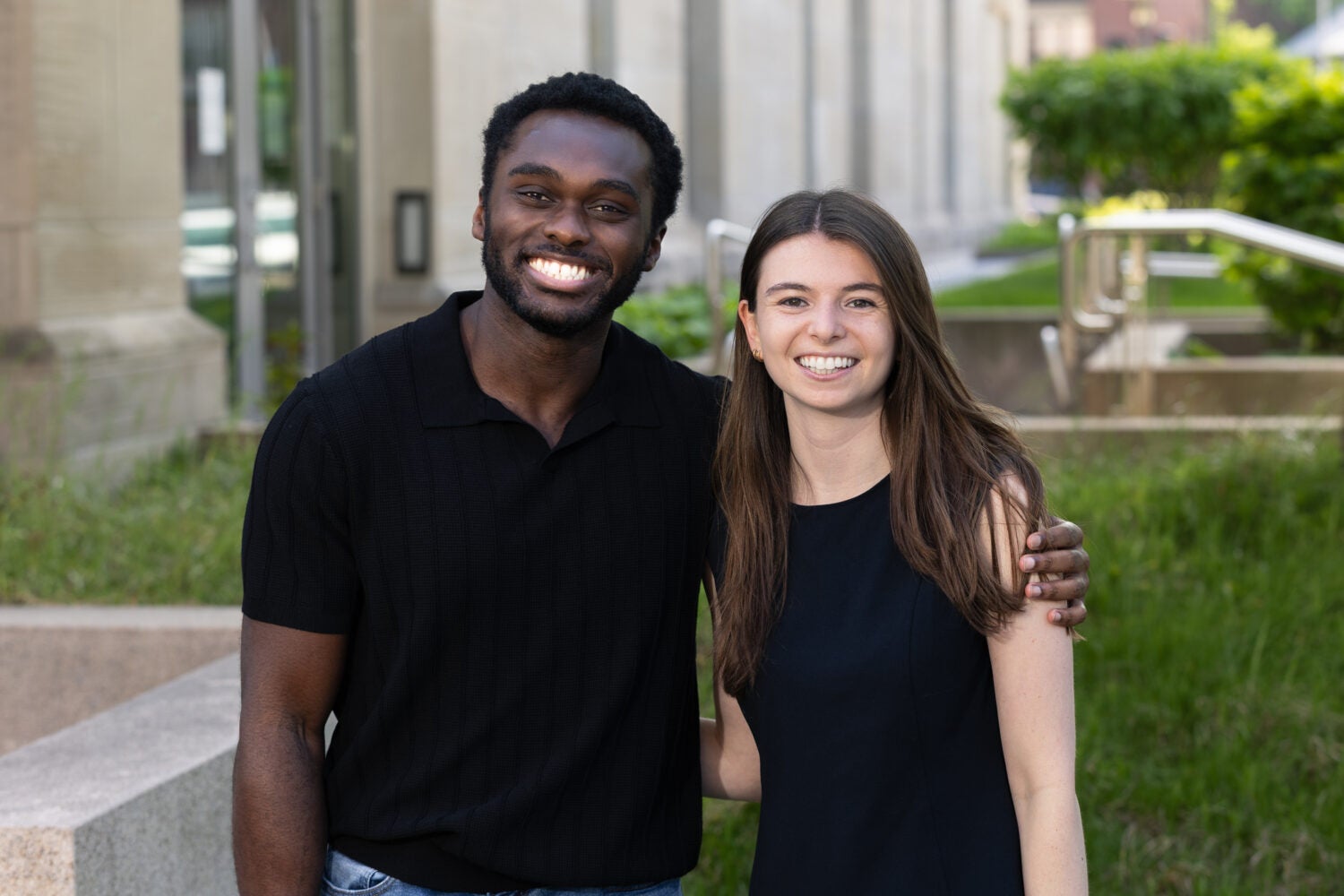
Cordy McJunkins ’26 and Wesley Streicher ’26 are the recipients of the 2026 Clinical Legal Education Association (CLEA) Awards, presented annually for outstanding clinical coursework and fieldwork, and for contributions to the clinical community. Students are selected by full-time clinical faculty at each law school with faculty members of CLEA.
CLEA Outstanding Clinical Student Award: Cordy McJunkins
Cordy McJunkins received the Outstanding Clinical Student Award for his transformative contributions to the Youth Advocacy & Policy Lab, or Y-Lab. Across four semesters in the Education Law Clinics, McJunkins was guided by a single conviction: that young people most affected by these systems belong not at the margins of advocacy, but at its center.
“This award reaffirms a core value of mine,” McJunkins reflected. “Growing up, I experienced firsthand how youth-facing systems can fail the children they’re meant to serve — spending over two years navigating a foster care process that was anything but smooth, and then sitting in classrooms where teachers and counselors looked past me and told me, in so many ways, that I wasn’t the right fit for advanced coursework. I often wondered whether those experiences had any place in legal practice. Law school is doctrinal by design, and it can quietly signal that what you lived before you arrived doesn’t belong in the room. But I brought my story into every space I occupied anyway, and receiving this award tells me that it isn’t just welcomed, it’s needed.”

“Young people navigating these systems today deserve advocates who understand what it feels like to be counted out before you’ve even walked into the room. This recognition has made me more committed to that focus and to ensuring that young people’s own voices and expertise remain at the center of any effort to create real, lasting change in our education and child welfare systems.”
McJunkins joined Y-Lab as a Youth Advocacy Fellow the summer after his first year, and from the outset he approached the work with a combination of strategic vision and genuine investment in the young people he served. Before the summer was over, he had identified an opportunity to deepen his understanding of school governance by enrolling in the Election Law Clinic, where he worked on a case representing Hispanic parents on Long Island seeking greater influence over their local school board. Recognizing the synergies between that work and Y-Lab’s advocacy, he helped forge a novel connection between the two programs.
In the spring of his second year, McJunkins enrolled in the Movement Lawyering Education Law Clinic, where he supported youth leaders through Y-Lab’s Students Speak initiative, which works with secondary school students in Massachusetts to build a movement for their voice in educational decision-making. He was assigned to mentor two students —an eighth grader in Haverhill and an eleventh grader in Chelsea — working on their personal leadership development as well as co-designing and implementing a curriculum for their peers on youth voice, advocacy, and critical thinking. He traveled repeatedly to both communities to support his mentees as they delivered that curriculum through local afterschool programs, forging close relationships with the students.
During his third year of law school, McJunkins enrolled twice in the Strategic Litigation Education Law Clinic, working on two active cases: KSVT v. Commonwealth of Kentucky and A.B. v. Hochul. In the Kentucky litigation, which aims to rebuild the state’s public education system, he worked with student clients to prepare for public engagement hearings and introduced an innovation that has since become a standard feature of the clinic’s practice: a structured process through which students could participate in evaluating potential expert witnesses, from developing a curriculum explaining the expert’s role to synthesizing students’ research findings into a memo assessing each expert’s strengths.
As a teaching fellow in both Lawyering for Justice and The Art of Social Change courses, McJunkins helped shape Y-Lab’s intellectual environment for his peers, bringing his personal experience to bear in a way that illuminated alternate perspectives and fostered deeper learning. He earned Dean’s Scholar Prizes in both The Art of Social Change and the Youth Advocacy Seminar, and as an editor on the Harvard Law Review, he authored a student note proposing a new First Amendment framework for evaluating curricular restrictions in public schools.
“Y-Lab fundamentally changed how I thought about what a lawyer is for,” McJunkins said. “What I learned in Y-Lab is that the most important thing a lawyer can sometimes do is make room — room for community members, for parents, for grassroots organizations, and above all for the young people most directly impacted by the issues we are trying to solve. I don’t want to just be a voice for young people; I want to be a voice with them, using whatever privileges and credentials I have so that they can be heard rather than me speaking in their place.”
After graduation, McJunkins will join Vinson & Elkins in Houston, Texas with a focus on building pro bono engagement with education rights work. “My clinical experiences showed me the important role large law firms can play in education rights litigation,” he said. “My time in the clinics showed me that this kind of support can make a real difference in whether a case succeeds.”
“Every child deserves to be seen, taken seriously, and given a real chance to pursue what they are capable of. That belief brought me to Y-Lab, and it’s what I am carrying forward from HLS.”
CLEA Outstanding Clinical Externship Student Award: Wesley Streicher
Wesley Streicher received the Outstanding Clinical Externship Student Award for her unwavering commitment to advocating for the dignity and humanity of clients navigating the margins of the legal system in the Child Advocacy Clinic and the Capital Punishment Clinic.
“My clinical experiences have been the most meaningful part of my time at Harvard Law,” Streicher said. “What I’ll carry with me most is the chance to learn from attorneys who are not only brilliant advocates, but deeply compassionate people. They invested so much in my growth, not just as a future lawyer, but as a person learning how to show up responsibly for clients and communities. To be recognized by mentors and faculty I admire so deeply makes this honor especially meaningful.”
Streicher came to Harvard Law after working in the juvenile division of the Miami-Dade Public Defender’s Office, where she says she began to see how early and often young people can encounter the criminal legal system. “Since then, I’ve tried to build on that perspective and learn how to be a better advocate through my pro bono work. Each experience has taught me different aspects of advocacy — from working directly with clients navigating high-stakes school discipline proceedings to engaging in more systemic, impact-oriented litigation work.”
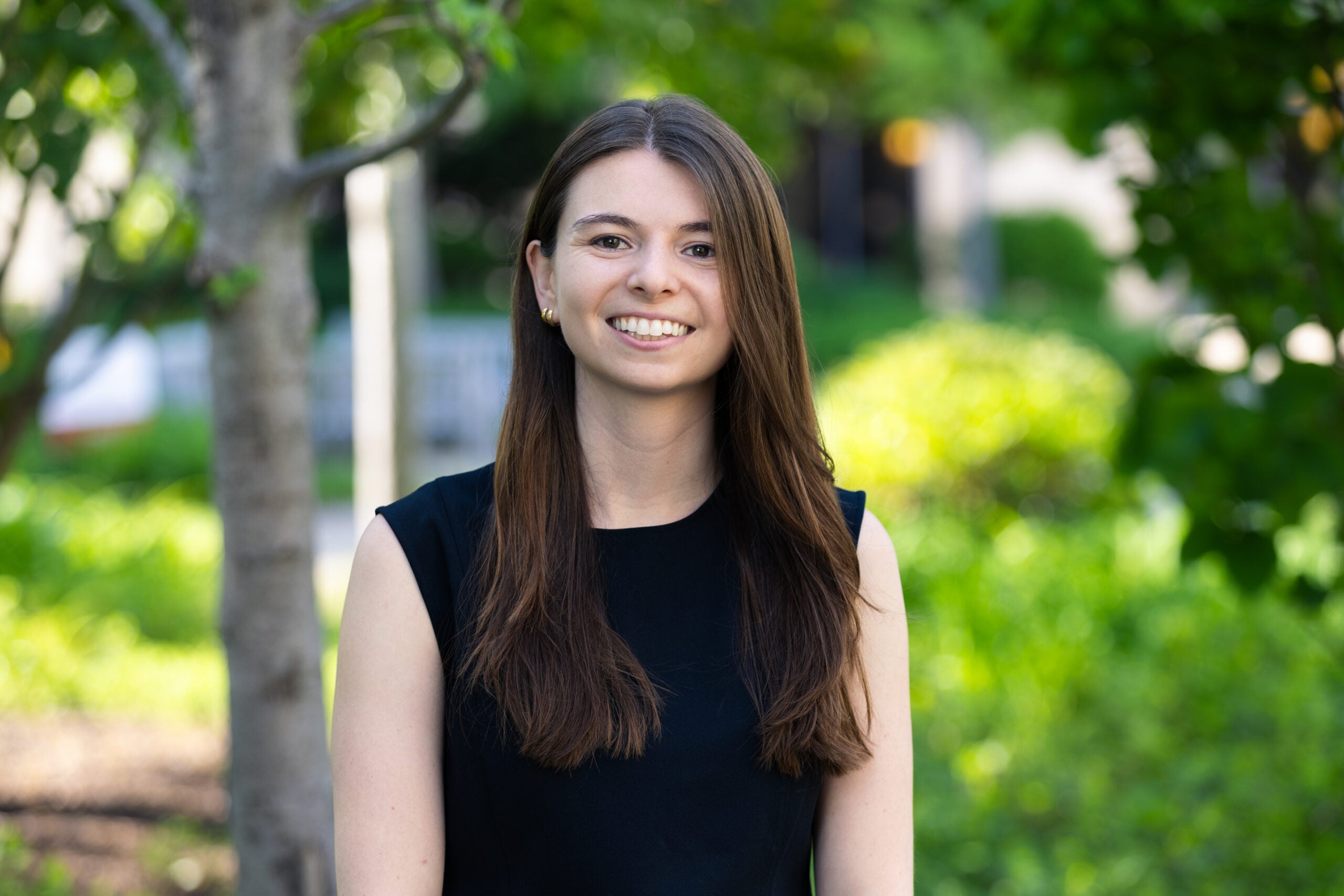
Through a placement in the Child Advocacy Clinic, Streicher spent the fall of her second year working at Health Law Advocates’ Mental Health Advocacy Program for Kids, where she advocated on behalf of children facing suspension or expulsion from school. With her characteristic patience, tenacity, and emotional intelligence, Streicher served as a support for families navigating complex educational systems as they tried to protect their students’ rights. Peers who worked alongside Streicher in the clinic describe her commitment to her young clients as immediate and unqualified. Despite the many other demands on her time, she approached each family’s situation with the attentiveness and urgency of a seasoned advocate, working hard to make sure that each client’s full story and needs were clearly heard and understood.
Streicher brought the same depth of purpose to the Capital Punishment Clinic, where she spent her 2L winter and spring semesters with the Federal Community Defender Office for the Eastern District of Pennsylvania Capital Habeas Unit. There, she worked with clients on death row, taking on the painstaking task of reviewing case records, identifying constitutional violations, and crafting arguments aimed at securing relief for individuals whose rights may have been compromised. Habeas work demands a particular combination of qualities: resilience, stamina, and the willingness to invest deeply in cases where outcomes are uncertain and timelines are long. Streicher met that challenge with the same discipline and care she had brought to her advocacy for children.
“The two experiences were vastly different, but together they gave me a fuller understanding of what meaningful advocacy can look like,” she said. “They taught me to be dynamic in my approach. In the Child Advocacy Clinic, there was often little clear legal framework to rely on. And in the Capital Punishment Clinic, we worked within highly complex and restrictive layers of law that required creative and strategic lawyering. These experiences reinforced my commitment to public interest work and showed me that, regardless of the setting, the most impactful legal work begins with a client-centered approach.”
Streicher’s clinical work extends beyond her externship work. She has been deeply involved in the Harvard Prison Legal Assistance Project, representing incarcerated individuals in parole and commutation matters and, as Impact Litigation Director, leading longer-term advocacy projects aimed at addressing systemic injustice in Massachusetts prisons. This year, she is also a student in the Criminal Justice Institute, representing clients facing criminal charges in Boston courts.
After graduation, Streicher will join the ACLU Criminal Law Reform Project as a Skadden Fellow. Her fellowship project aims to protect the constitutional rights of minors in encounters with law enforcement, particularly in cases involving possible excessive force. Streicher says her clinical experiences have done more than prepare her for practice — they have shown her what kind of lawyer she can become.
“I have been inspired by the commitment and compassion I have seen through clinical placements and am lucky to be beginning my career with so many role models. Taken together, my clinical experiences have strengthened my commitment to public interest work that is grounded in the realities clients face. In my fellowship, I hope to build on this foundation.”
Want to stay up to date with Harvard Law Today? Sign up for our weekly newsletter.