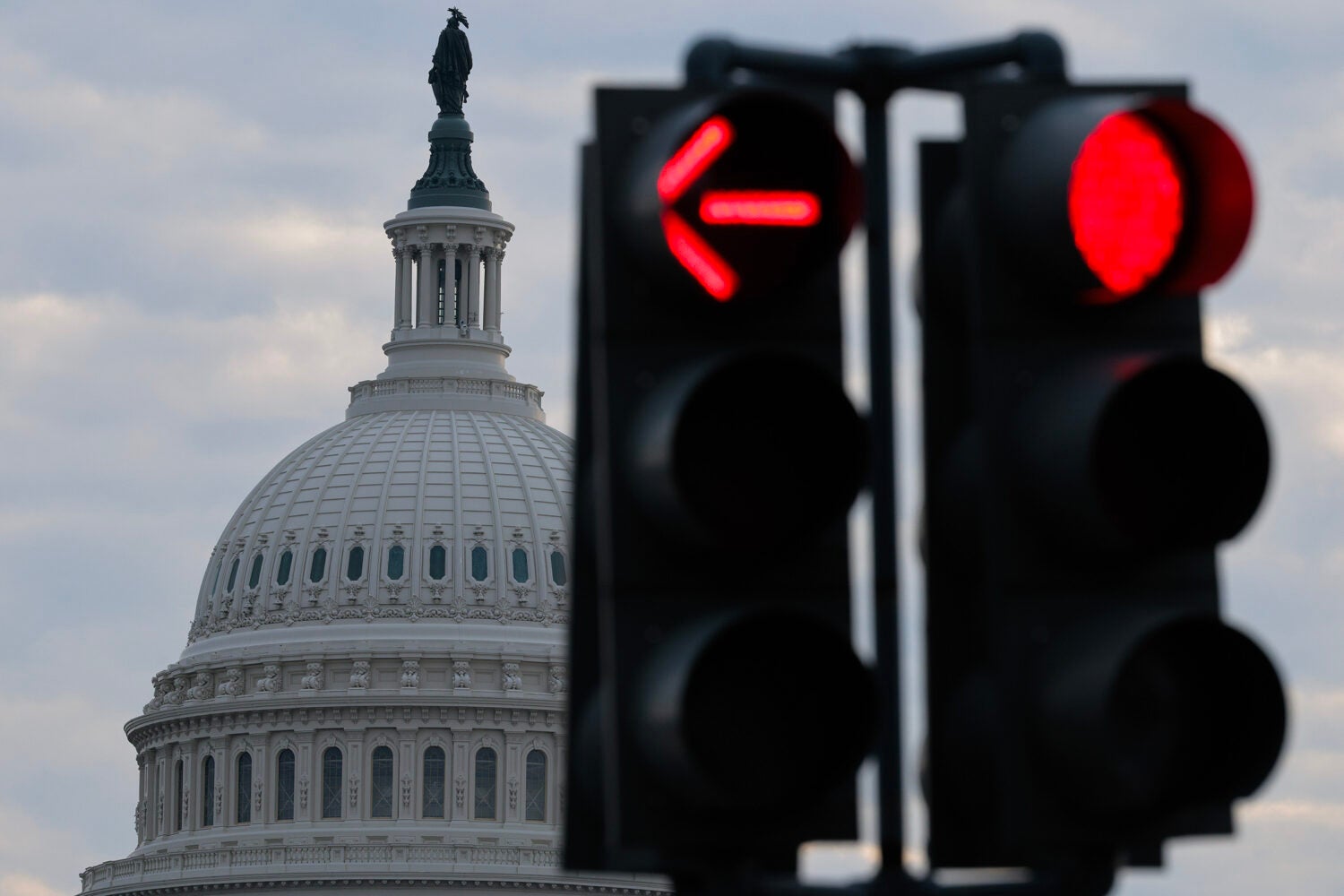
With Democrats picking up 42 seats in the U.S. House of Representatives and nine in the Senate, both chambers of the 120th Congress, which begins in January of 2027, will be controlled by a party in opposition to the president. What legal tools does a president have when faced with opposition in both houses of Congress? What leverage does Congress have to check the president?
To help answer these questions, Harvard Law Today enlisted the expertise of Warren Neil Eggleston, a lecturer on law at Harvard, who served as chief lawyer to President Barack Obama ’91 during the 114th United States Congress — the last time a president faced opposition party majorities in both the House and Senate.
In our Q&A, he discusses where Congress has its strongest leverage, both the power and the limitations of executive action without congressional support, and what the past could tell us about the future.

Presidential power and congressional checks
Harvard Law Today: Where can President Trump continue to act without congressional support, and where will he face greater obstacles?
Warren Neil Eggleston: We should anticipate that President Trump will continue to act by executive action as he has done throughout his second term. He has the power to issue executive orders, and he is commander in chief of the armed forces. He also has substantial authority in areas such as immigration, trade, and national security, although the scope of that authority is subject to statutory limits.
Particularly with Stephen Miller as chief of staff, it seems likely we will continue to see executive orders on a range of subjects from immigration to voting to birthright citizenship. Those actions will follow the pattern that we have seen in this term, with parties suing to set aside the executive actions and the courts deciding.
President Trump has been significantly more willing than most presidents have been to issue an executive order in the face of substantial doubt about its legality. Ultimately, two of his most pronounced executive actions — his effort to restrict birthright citizenship and his imposition of tariffs under the International Emergency Economic Powers Act — were struck down by the Supreme Court as unlawful.
In the birthright citizenship case [Trump v. Barbara], the Court held that the executive order violated the Fourteenth Amendment. In the tariffs case [Learning Resources, Inc. v. Trump], the Court concluded that Congress had not authorized the president to impose tariffs under the emergency powers statute he invoked. Many more actions in a variety of areas have been set aside by the lower federal courts. The Supreme Court has revived some of them on its shadow docket, but most court orders barring executive actions remain in place.
HLT: What are the limits on what a Democratic-controlled Congress can accomplish without the president’s cooperation?
Eggleston: Even though Democrats will control both chambers, there are significant limits on what Congress can accomplish on its own. Congress can pass legislation, but the president can veto it. Overriding that veto requires a two-thirds vote in each chamber. Even resolutions overturning federal regulations under the Congressional Review Act remain subject to a presidential veto.
President Trump has already signaled that he is prepared to use his veto power, suggesting that Democrats will eventually have to negotiate with him. The new Congress will therefore have considerably more power to check the administration through other means than to enact a legislative agenda.
HLT: What checks or congressional actions do you anticipate we’ll see first?
Eggleston: The most immediate change will likely be a substantial increase in congressional investigations. We saw something similar when Democrats took control of the House in 2019 and launched investigations into President Trump’s first administration, including the Ukraine investigation that led to his first impeachment. This time, Democrats are more experienced and organized, with investigative priorities already taking shape.
Incoming House Oversight Committee Chair Robert Garcia has identified corruption, the Trump family’s business dealings, and immigration enforcement as priorities. Sen. Richard Blumenthal, who is expected to chair the Senate Permanent Subcommittee on Investigations, has already sent document demands and preservation requests to federal agencies and private companies, signaling the investigations to come. Democrats campaigned heavily on affordability and corruption, and we should expect those issues to be central to their oversight agenda.
The other significant source of leverage will be the Senate’s authority over confirmations. Historically, many executive branch and judicial nominations were relatively routine, but confirmation battles have become increasingly tools for influence and negotiation. A Democratic-controlled Senate can refuse to confirm cabinet secretaries, senior agency officials, ambassadors, and federal judges, leaving important vacancies unfilled and limiting the president’s ability to reshape the judiciary. Senate Democrats have already indicated that they intend to scrutinize President Trump’s nominees much more aggressively, and Republicans are seeking to confirm as many nominees as possible before the new Congress takes office. The precise approach may depend in part on the Senate’s leadership.
HLT: How much leverage does Congress have through its control over government funding?
Eggleston: Congress will have leverage through its appropriations authority, particularly over government funding, but even that has its limits. During President Trump’s first term, for example, Congress refused to provide the $5.7 billion he sought for a border wall. The dispute resulted in a 35-day government shutdown, and Congress ultimately appropriated $1.375 billion. President Trump then declared a national emergency to redirect other federal funds toward the wall and vetoed a bipartisan congressional resolution seeking to terminate that emergency.
Although divided government can still produce bipartisan legislation, there are few obvious areas of agreement between the incoming Congress and the White House. President Trump has suggested that an initial period of vetoes could eventually lead to negotiations, but it remains to be seen how willing he will be to negotiate with a Congress simultaneously investigating him, his family, and his administration.
HLT: What about military action? Does Congress have more leverage here?
Eggleston: Military actions are in a different category. A president’s decisions in that realm are rarely subject to judicial review, largely because of limitations on standing and the courts’ reluctance to intervene in military operations. The strikes against suspected drug-trafficking vessels in the Caribbean, for example, have raised significant legal questions and prompted bipartisan demands for briefings, investigations, and the administration’s legal justification. Congress has also introduced legislation to halt the strikes, but these efforts have not stopped the operations.
Congress has substantial constitutional authority over military action, but relatively few effective tools to stop a president determined to proceed. For example, Congress has already attempted to constrain the war in Iran through the War Powers Resolution. Both chambers passed a resolution directing the withdrawal of U.S. forces, but the administration disputed its legal effect and continued military operations.
Congress could also restrict funding for military operations, although doing so would require legislation that could withstand a presidential veto. We should expect the new Congress to pursue more aggressive oversight, additional war powers measures, and potential funding restrictions, but absent substantial bipartisan support, those efforts are more likely to increase pressure on the president than to bring military operations to an end.
What history tells us about divided government
HLT: What can we learn from similar situations in recent history? The most recent was the 114th Congress, and you were serving as the president’s chief lawyer. Can you talk about what we saw during that era that we could learn from in anticipating what the next two years could look like?
Eggleston: I started as White House Counsel to President Obama in the spring of 2014, when the House was controlled by Republicans, but Democrats still held the Senate. That changed with the midterms in the fall of 2014, when the Republicans took control of both houses of Congress. With diminished prospects of new legislative accomplishments, President Obama, as most presidents do, turned to executive action and action in foreign affairs, areas in which the president can exercise substantial authority without new congressional approval.
The most obvious example of congressional leverage was President Obama’s effort to fill the seat of Justice Antonin Scalia, who died in February 2016. President Obama nominated Chief Judge Merrick Garland of the D.C. Circuit the following month. But on the day Justice Scalia died, Senate Majority Leader Mitch McConnell announced that the vacancy should not be filled until after the presidential election. Senate Republicans maintained that position, declining to hold hearings or a vote on Judge Garland’s nomination. As a result, Justice Scalia’s seat remained vacant for more than a year. The episode illustrates the Senate’s considerable leverage over presidential appointments.
In addition to that high-profile example, Senate confirmations of President Obama’s judicial nominees all but came to an end. I was able to negotiate some deals where we nominated judges Judiciary Committee Chairman Chuck Grassley wanted confirmed in exchange for him agreeing to let through committee certain judges we wanted. Frequently, however, Leader McConnell simply ignored the agreements Chairman Grassley and I had reached and advanced the Republican-supported nominees to confirmation without taking up the Democratic nominees who had been part of the deal. With that experience so recent, I doubt that the Democrats who will now be running the Senate will be in much of a mood to move any judges that President Trump might nominate.
HLT: What are a few examples of President Obama’s action in the foreign affairs space, and the limitations to acting without the support of Congress?
Eggleston: During his last two years, President Obama spent significant time and energy on three important foreign policy goals. The first was the Joint Comprehensive Plan of Action (JCPOA), which was the nuclear deal with Iran. JCPOA was a comprehensive and verifiable agreement designed to prevent Iran from developing a nuclear weapon. Granted, it did not solve all of the problems with Iran, including its use of non-nuclear weapons and support for terrorism around the world. But it went a very long way toward precluding Iran from developing nuclear weapons.
During his first term, President Trump withdrew the United States from the JCPOA and announced that he would negotiate a much better agreement. That did not happen in his first term. And in his second term, President Trump has instead gone to war with Iran, with all the consequences that have followed.
President Obama also pursued an opening to Cuba and negotiated the Paris Agreement on climate change. Both initiatives showed what a president could accomplish without new legislation — and how vulnerable those policies could be to reversal. President Trump rolled back important elements of the Cuba opening and withdrew from the Paris Agreement during his first term.
All of these examples show the limits of executive action, which can be undone by a subsequent president unless the actions are incorporated into a statute. And when the House and Senate are held by a different party than the president, the likelihood that Congress will pass any of the president’s initiatives is substantially reduced.
HLT: Were there certain areas of law or policy that saw greater action because of a climate where bipartisanship was necessary for progress?
Eggleston: Even in today’s complicated political environment, history suggests there can still be opportunities for agreement. Criminal justice reform is one example. When I served as White House Counsel, we undertook a major clemency initiative under President Obama, ultimately commuting the sentences of more than 1,700 individuals, largely nonviolent drug offenders serving disproportionately long sentences.
President Trump also embraced aspects of criminal justice reform, signing the bipartisan First Step Act in 2018 and granting clemency to some nonviolent drug offenders. But even clemency has now become the subject of congressional investigations, including scrutiny of President Trump’s pardon process.
With the midterms now over, both parties are also already looking to how to position themselves for the presidential election in 2028. That reality will permeate all congressional and executive branch actions for the next two years.
I would not rule out narrower bipartisan accomplishments, but I am skeptical that we will see significant legislative cooperation.
This interview has been edited for length and clarity.
Want to stay up to date with Harvard Law Today? Sign up for our weekly newsletter.