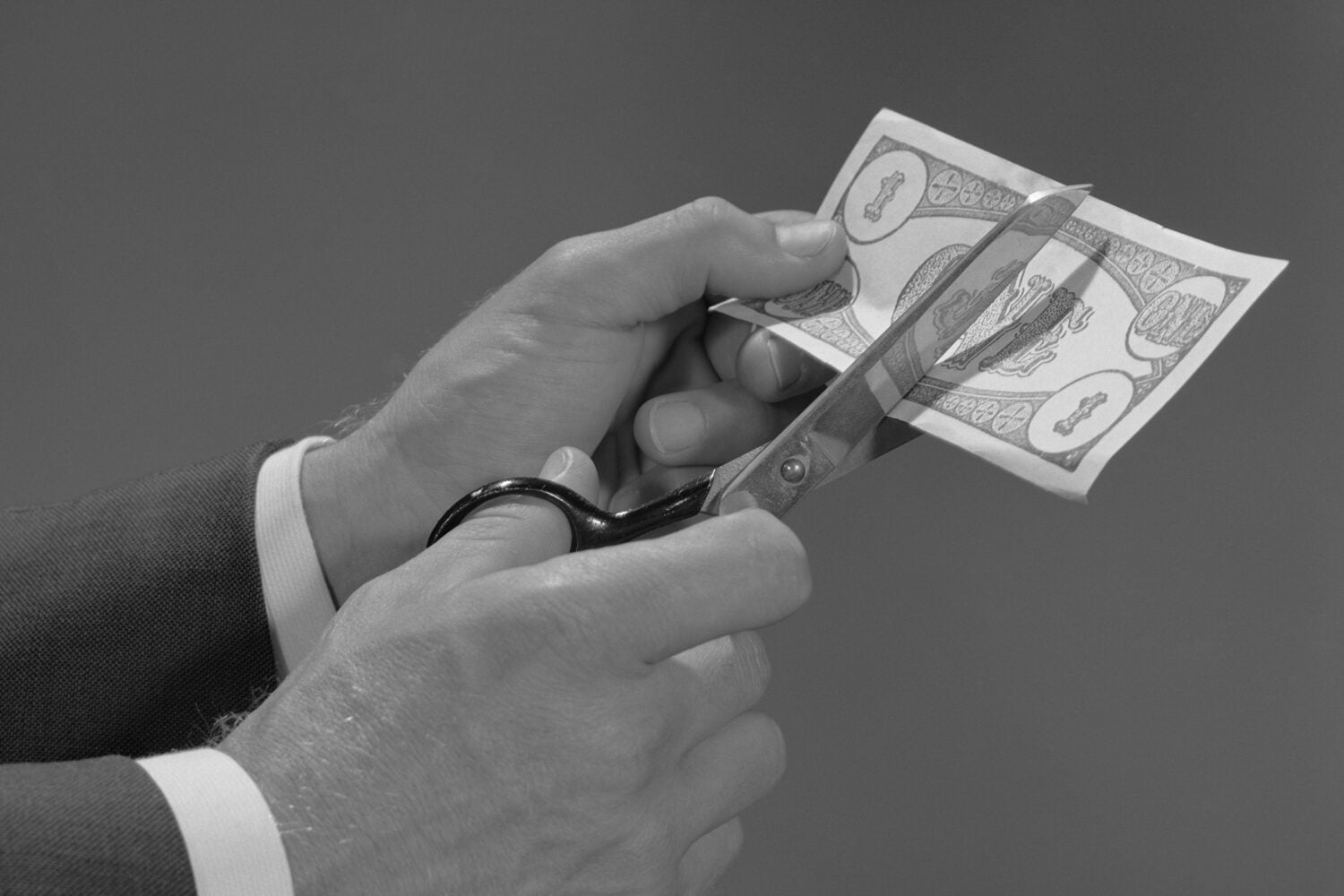
It has long been understood that, in the United States, the Constitution invests Congress with the power of the purse — the authority to make tax and spending decisions. With some exceptions, the executive branch’s job has been to administer the legislature’s fiscal priorities. But a recent move by the Trump administration to cancel $810 million in spending appropriated by Congress via a rarely used ‘pocket rescission’ raises fundamental questions about who gets to decide how Americans’ tax dollars are distributed.
In the waning days of Richard Nixon’s presidency, Congress passed legislation, the Impoundment Control Act of 1974, to curb his practice of refusing to spend appropriated funds. The law created a process by which future presidents could ask Congress to revisit spending provisions they’d already approved. If Congress didn’t act within 45 days, the money had to be spent.
In the last two years, the Trump administration has attempted pocket rescissions. Last year’s pocket recissions reduced foreign aid spending. This year’s proposed cuts primarily target health and social services for refugees and other noncitizens, among other programs.
U.S. Senator Susan Collins of Maine, who chairs the Appropriations Committee, has called the administration’s approach “unlawful” and an “usurpation of Congress’ appropriations powers.” The administration, meanwhile, says it is exercising authority granted by the Impoundment Control Act.
In a Q&A with Harvard Law Today, federal budget expert Howell Jackson J.D./M.B.A. ’82, the James S. Reid Jr. Professor of Law, discusses pocket rescissions, the power of the purse, and Congress’ legislative and legal options for responding.

Harvard Law Today: What are pocket rescissions?
Howell Jackson: To understand pocket rescissions, you have to back up a little bit and talk about what happens when Congress appropriates money and the president doesn’t want to spend it. There was a big controversy over this during the Nixon administration, when President Nixon asserted fairly broad authority to decline to spend money that Congress had appropriated. Congress responded by passing the Impoundment Control Act of 1974, which established procedures governing when and how the executive branch can withhold congressionally appropriated funds.
One of those procedures is rescission. If the president wants to cancel spending that Congress has appropriated, the president can send Congress a rescission request identifying the funds that he proposes not to spend. Congress then has an opportunity to consider that request. Congress can accept those requests or not, and if they don’t accept the request, the money has to be released 45 days after the date of the president’s request.
And then there’s another procedure called deferral, where the president can delay, in the course of a fiscal year, spending money under certain circumstances. The rules there are a little bit different when it’s just a delay in spending as opposed to cancellation of spending.
There have been relatively few examples of presidents making rescission requests, but there have been some, and occasionally they’ve even been approved. For example, last year, Congress approved President Trump’s recission request for $18 billion in foreign aid and support for public broadcasting.
HLT: And how does a pocket rescission fit into that process?
Jackson: A pocket rescission is a special kind of rescission that takes place only rarely. The Trump administration, however, has now engaged in the practice two years in a row. Pocket recissions have to be sent up to Congress at the tail end of the government’s fiscal year, which ends on Sept. 30. The practice exploits what proponents argue is an ambiguity in the Impoundment Act. Under the statute, an administration is allowed to withhold spending for 45 days while Congress considers the recission.
The trick with the pocket rescission is that the fiscal year ends before the 45-day waiting period expires and before Congress, in all likelihood, will have acted on the administration’s request. Because many appropriations are limited to one year, spending subject to pocket recissions will likely expire before the 45-day waiting period is over.
So, a pocket rescission effectively cancels the spending authority without congressional assent, which is why it’s so controversial. A pocket rescission is a rescission request made at the tail end of a fiscal year with the understanding that Congress is unlikely to act, and then the executive — or at least the Trump administration — takes the position that it is not obligated to spend the money once the fiscal year is over.
HLT: So, they run out the clock?
Jackson: They run out the clock. They put together two things. One is that there is a one-year limit on most federal spending. And the second is that the Impoundment Control Act does give Congress 45 days and does allow the executive to wait those 45 days to see if it gets permission.
Congress could have said, but did not say in the Impoundment Control Act, “45 days, or some lesser time if made at the end of the fiscal year.” But they just said 45 days.
HLT: Is there a previous example of a president putting those two things together in that way to create this timing coincidence?
Jackson: Before President Trump’s second term, there have only been a handful of examples, all from the 1970’s under Presidents Ford and Carter. Experts dispute the exact number, but under five and possibly only two clear-cut instances. Before last year, the only place where pocket recissions regularly have been encountered has been law school classrooms where a professor dreams up weird interpretive questions about the Impoundment Control Act.
Legal authorities — including the dissenters on the Supreme Court in an order last year [Department of State v. AIDS Vaccine Advocacy Coalition] — have pointed out that pocket recissions are just antithetical to the whole idea of the Impoundment Control Act, because it basically allows for impoundment if you do it in this one special way. And that just seems to be inconsistent with the goals.
On the other hand, there is this weird 45-day waiting period that’s allowed and a couple of other provisions of the Impoundment Control Act that point in somewhat conflicting directions. So, there’s a little bit of textual ambiguity, and that’s what the Trump administration is hanging its hat on here.
HLT: Does Congress have any legal recourse?
Jackson: Congress could do a number of things.
One is it could get its act together when a rescission request comes in and immediately get votes from both houses. They could act on the bill and say, “You can’t do it.” Then, the funds would have to be released. As a practical matter, that just can’t be done, given the speed at which Congress works and the fact that in many years — like 2026 — Congress is often out on recess in anticipation of November elections.
Congress could also amend the Impoundment Control Act to make clear that pocket recissions are not permitted — to say that rescission requests have to be made at least some period of time before the end of the fiscal year. That would require both houses to vote on it and presidential approval, or supermajorities to override a veto. So, it would be hard for this Congress to do, but there are legislative responses.
And then there are the many informal things that Congress could do when it’s aggravated, including, in the next fiscal year, adding the money back in and reauthorizing it and putting special provisions on that make pocket recissions more difficult. For example, they could write special apportionment rules requiring all spending to be made in certain accounts by the 1st of July.
So, Congress could do things. This particular Congress, of course, has not been aggressive about responding to the pocket rescissions. The majorities in the House and the Senate are largely sympathetic to the policy agenda that the Trump administration has behind these pocket rescissions, and so they’re not acting right now.
HLT: Does this practice of cancelling previously agreed spending at the last minute disincentivize bipartisan budget compromises? If two sides engage in a give and take, and the benefits one side wins get cancelled unilaterally by the other side, why engage in deal making at all?
Jackson: You’re right that it makes it harder to make deals, because if this can be done, the deals are just not binding.
I would say that the Republicans in Congress also have an incentive to have appropriations stick. So, they may be happy with Trump’s pocket rescissions, but when a Gavin Newsom or someone else comes in as president in 2029, they may not be so happy with other uses of a pocket rescission.
The heads of the Senate Appropriations Committee — Susan Collins is the chair on the majority side right now — have been critical of this practice because, from a congressional authority perspective, it dilutes everyone’s authority.
But it does make deals a little bit more complicated right now.
HLT: That leads me exactly to my next question. Do Congress, congressional committees, or individual legislators, including Susan Collins in her role as chair of the Appropriations Committee, have standing to bring a lawsuit to resolve the textual ambiguity?
Jackson: With a lot of litigation over spending, the Supreme Court avoids getting to the merits on standing grounds or wrong-venue grounds or other technical reasons.
With pocket recissions., there’s a question about who does have standing to sue. You might think that the people who were supposed to get the money would have standing to sue if it doesn’t get provided to them. But which court should they go to? Do they need to go to the Court of Claims as opposed to other courts? What remedies do they have available? It’s complicated.
The statutory structure contemplates that it is for the GAO, the Government Accountability Office, to investigate and litigate impermissible impoundments. But GAO’s authority to bring cases is contested, as the GAO is a legislative body, and prosecution is an executive function. So, under the currently ascendent unitary executive theory, there’s a question whether the GAO can sue.
Conceivably, a house of Congress might have standing to sue, but that’s also kind of a contested issue and might require a statutory basis. So, getting the right litigant in the right court to decide the case is complicated.
And, of course, going back to the pocket rescission problem, if you’re talking about money that has to be spent within the current year, litigation can take a long time. The appropriations may well expire, and then that raises another problem of mootness that can also be problematic.
So, it’s been hard to get the courts effectively engaged in these issues.
HLT: You already mentioned this briefly, but what about the people or organizations for whom the money was notionally intended? Can any of them establish the kind of concrete, particularized injury necessary to have standing?
Jackson: Yeah. For example, last year on the pocket rescission, the litigation that got up to the Supreme Court was by an AIDS group that was very much involved in foreign aid to Africa, and one of the things that was being impounded there was foreign aid for AIDS programs.
So, they had a clear interest and connection to that pocket recission. They were good plaintiffs to bring the lawsuit. But they got caught up in the balance of the equities and national security considerations that the Trump administration advanced. Once the Supreme Court stayed the lower court’s injunction, the time expired and the appropriations evaporated on their own accord. But they were the right kind of plaintiff to have standing.
HLT: One final question. How big a problem is this in the grand scheme of things?
Jackson: These pocket rescissions, in the larger picture of the federal budget, are relatively small amounts of money. In my budget course, we rarely talk about anything under a hundred billion dollars, and this recent pocket rescission request was $810 million, which is small potatoes for the federal budget.
But the pocket recissions are more of a messaging campaign than an act of fiscal discipline. The administration is targeting spending that’s associated with DEI or racial inclusion. They are part of the anti-woke agenda. To some degree, last year’s foreign aid cutbacks had a similar sort of America First theme to them.
The messaging aspect of these pocket recissions is probably one of the reasons why Republican members of Congress are loath to push back hard on them. The Trump administration is not picking the Head Start program or agricultural subsidies with widespread support.
This interview has been edited for length and clarity.
Want to stay up to date with Harvard Law Today? Sign up for our weekly newsletter.