From the ratification of the Bill of Rights in 1791 to 2008, the U.S. Supreme Court never struck down a federal, state, or local gun law for violating the Second Amendment. Then, in 2022, the floodgates opened.
Between June 2022 and December 2024, federal courts ruled on more than 3,000 Second Amendment cases, according to data provided by the Gun Violence Data Hub. At least 279 were civil lawsuits brought by gun rights groups, individuals, and other organizations. In 28 percent of those cases, judges invalidated the gun policies at issue.
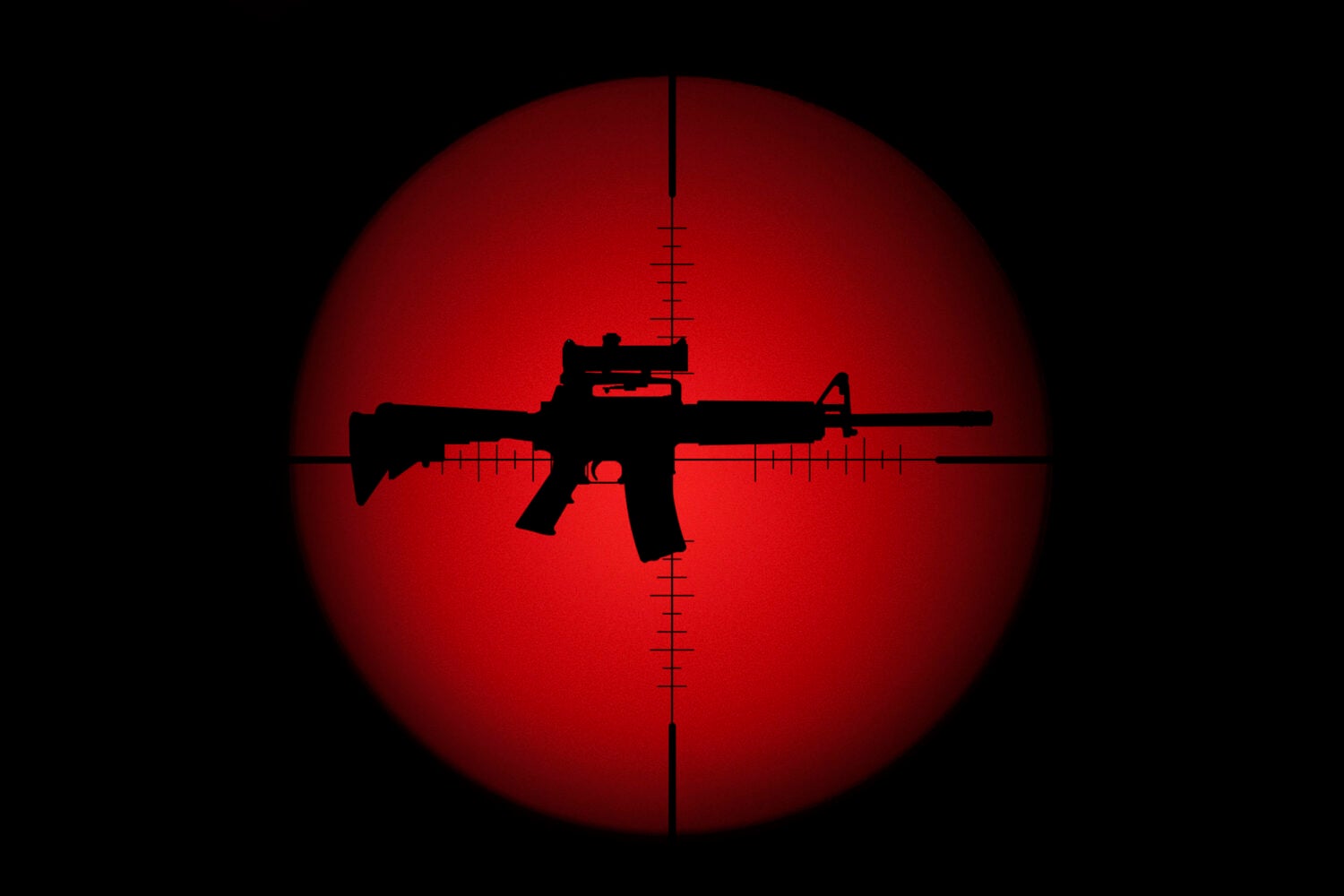
On Dec. 2, the Supreme Court will hear arguments in Viramontes v. Cook County, a challenge to a Chicago-area ban on the possession of AR-15s and other semiautomatic rifles. The case will test how courts apply the Supreme Court’s 2022 decision in New York State Rifle & Pistol Assn., Inc. v. Bruen, which requires gun regulations to be consistent with the nation’s historical tradition of firearm regulation.
According to William Nelson Cromwell Professor of Law Emeritus Mark Tushnet, however, asking whether modern gun policies have “historical” equivalents raises additional questions.
“To figure out whether today’s regulation fits into this history and tradition of regulation, you have to ask what the purpose behind the prohibition was, what were they concerned about when they regulated the carrying of dangerous weapons,” said Tushnet. “I think the answer to that question is, for all practical purposes, open-ended.”
In a conversation with Harvard Law Today, Tushnet explains why the justices’ interpretation of historical precedent could determine the fate of the ban, and what the ruling might mean for gun regulation nationwide.
Mark Tushnet specializes in constitutional law and theory, and writes in the area of legal and constitutional history.
How the Supreme Court transformed Second Amendment law
Harvard Law Today: Courts overturning firearms regulations seems to be a relatively recent phenomenon. Can you walk me through how it emerged?
Mark Tushnet: It really started in the late 20th century with the rise of originalist thinking, that is, the idea that the Constitution should be interpreted in terms of its original meaning. A bunch of people interested in gun rights started developing arguments that, as a matter of original meaning, the Second Amendment guaranteed individuals’ rights to own guns, weapons, handguns, etc. Initially, among elite legal thinkers, that argument was dismissed as silly. Chief Justice Warren Burger, for instance, called the idea that the Second Amendment guaranteed an unfettered individual right to own a gun a “fraud on the American public.” But, eventually, the idea took hold. It first got some foothold among legal academics. There was a large literature saying that, when the Bill of Rights went into effect in 1791, people did understand the amendment to guarantee some kind of right in individuals to own deadly weapons. Then, by 2008, enough justices had been converted to the idea of originalism and they applied it in the case of District of Columbia v. Heller, which invalidated a city code that, for all practical purposes, was a ban on the possession of handguns by people in the District of Columbia.
HLT: Is it fair to think of Second Amendment jurisprudence as ‘before Heller’ and ‘after Heller’?
Tushnet: That’s probably right. Once the Heller decision was handed down, it opened up a lot of questions about what legislatures could do to regulate the use of guns and other deadly weapons. After the Heller case and a follow-up case called McDonald [v. City of Chicago], which said the 14th Amendment incorporated the Second Amendment, states were prohibited from banning the possession of weapons that are useful for individual self-defense and in ‘common use’ for that purpose. And handguns fit that description. At the end of the opinion, the Court included a caveat saying they’re not trying to cast doubt on long-standing prohibitions on possession of firearms by felons and — this is the one that’s relevant here — ‘the historical tradition of prohibiting the carrying of dangerous and unusual weapons.’ So, now, after Heller [state and local governments] cannot ban the possession of weapons in common use or commonly used for self-defense. But there’s still a possibility of regulating possession by people like convicted felons who have shown they’re not law-abiding citizens and regulating dangerous and unusual weapons. Then, there are a couple of other cases — Bruen, [United States v.] Rahimi, and [United States v.] Hemani from last term — that start to flesh out basically what those exceptions are. This upcoming semiautomatic weapons case is the next step in figuring out, in this context, what ‘dangerous and unusual weapons’ means or what the long-standing tradition of banning the possession and carrying of dangerous and unusual weapons means for today’s law.
Are AR-15s protected by the Second Amendment?
HLT: What if a ‘dangerous and unusual weapon’ has become ‘in common use for self-defense’ and the standards you just described overlap?
Tushnet: This is the best version of the argument against the ban on the semiautomatic weapons at issue in Viramontes. Semiautomatic weapons are clearly dangerous. When they were first produced, they were unusual and, at the time, there weren’t that many of them. So, you could address their misuse simply by prosecuting people who misuse them. You didn’t have to ban possession, and that’s why legislatures didn’t. Why enact a statute to deal with what is at the time a small problem that you can deal with under the idea of misuse? Then, as time goes on, more and more people acquire semiautomatic weapons, and the vast majority of these people don’t misuse them. They have them for self-defense purposes, so that now they are weapons in common use for self-defense. If somebody misuses the weapon, you can prosecute them for the misuse. But, the argument goes, you can’t prohibit the mere possession of the semiautomatic weapon. You can go after people who again misuse them, but you can’t simply ban their possession. That’s the way the argument goes because, while it’s dangerous if misused, when possession is widespread, it’s become a weapon in common use for self-defense purposes.
HLT: How will Second Amendment precedent apply in Viramontes? What will the justices have to decide?
Tushnet: So, Heller says that weapons in common use for self-defense are protected by the Second Amendment with an exception for ‘dangerous and unusual’ weapons. The petitioners in this case say this is a straightforward case under Heller, that these are weapons in common use for self-defense directly covered by it. The initial brief for the petitioners is really terrible because it doesn’t address any of the complicated complexities. What Bruen says is, when you’re looking at a regulation, you have to see whether there is a history and tradition of this kind of regulation. You have to ask whether there is a history and tradition of doing something similar to banning the possession of semiautomatic weapons and whether these are dangerous weapons. At that point, all you can say is you’re going to have to listen to the oral arguments and see how the justices are thinking about that problem.
Taking this a step further, Bruen says that to figure out whether today’s regulation fits into this history and tradition of regulation, you have to ask what the purpose behind the prohibition was, what were they concerned about when they regulated the carrying of dangerous weapons? I think the answer to that question is, for all practical purposes, open-ended. Those in support of gun owners’ rights would say they were concerned about actual misuse. But you could also say they were concerned about the risk that a weapon in somebody’s possession would be misused, and that would support this kind of regulation. At that point, you just have to count noses [among the justices]. You have to see who thinks that the first or the second way of understanding the history and tradition is the better way of doing it.
How public opinion and public safety could shape the ruling
HLT: Do the characteristics of the type of case selected here tell us anything about where the Supreme Court is leaning ahead of its decision in Viramontes?
Tushnet: There is a certain amount of optics associated with some of these cases. Rahimi, for example, involved the application of a ban on the possession of handguns by people charged with domestic abuse offenses. Rahimi was a bad guy, he had a terrible record. The optics of saying, “Well, this guy who misused a weapon by shooting people in the course of domestic abuse is entitled to keep a weapon…” — they just were not going to do that. Chief Justice Roberts wrote an opinion that basically said they’re not going to say anything about the general statute, but, as applied to this guy, of course they can prohibit him from possessing a handgun.
Last term’s case, Hemani, involved somebody who while cooperating with agents searching his house commented that he regularly used marijuana. But otherwise he was an upstanding citizen. The agents found a gun in his house and he was prosecuted under a statute saying that habitual drug users can’t possess guns. The Court said you can’t ban his possession of a gun solely on the ground that he used marijuana regularly — after all, lots of people do that. So, the optics of Rahimi were it’d be terrible to say this guy can own a handgun. The optics of last year’s case were basically, “This guy’s fine.” So, the question is, what are the optics going to be of saying you can’t ban the possession of semiautomatic weapons?
“The question is, what are the optics going to be of saying you can’t ban the possession of semiautomatic weapons?”
HLT: In the context of public opinion on the prevention of gun violence and mass shootings, how might the Court be thinking about the optics around Viramontes?
Tushnet: My sense would be that the optics of invalidating a ban on the possession of semiautomatic weapons in a world where you have mass shootings in schools and churches and concerts would be pretty bad. But, in the circles that many of the justices move, maybe not. There’s a substantial amount of writing by gun rights people who say semiautomatic weapons have been demonized and aren’t all that different from regular handguns.
People have the image of semiautomatic weapons as you pull the trigger once and hundreds of bullets spew out before anything happens. If you look at how a semiautomatic weapon operates, that’s not true. It allows somebody to shoot bullets more quickly than a standard handgun does, but it’s not a machine gun. It’s not a fully automatic weapon. It shoots more quickly, but it doesn’t spray bullets uncontrollably into a crowd. So, if a justice thinks semiautomatic weapons have been demonized, they may think they can overcome the optics of saying you can’t ban possession.
From the point of view of gun rights proponents, banning what I’ll call ‘mere possession,’ which is what’s at stake here, is substantial overkill. Many people who own semiautomatic weapons use them responsibly — they use them for hunting, for self-defense, and so on. So, the fact that the policy challenged is a ban on mere possession is attractive to gun rights proponents. A bad case from their point of view would be somebody who misuses the semiautomatic weapon. From their point of view, a mere possession case is the best case for the optics. But my view, as a person who thinks gun regulation is a good idea, is that it’s going to be difficult to overcome the optics associated with the word ‘semiautomatic.’
HLT: How much weight should the Supreme Court give to public safety research and evidence about mass shootings when interpreting a constitutional right? Is there room for scientific evidence when you’re using a ‘history and tradition’ framework?
Tushnet: The answer is yes, if used in the right way. [Former Associate] Justice [Stephen] Breyer’s position on this issue was that contemporary evidence about misuses and about public safety should be sufficient to justify these kinds of regulations. The Court rejected that, but you can say that the purposes of the historical regulations were tied to public safety. That they made a judgment about public safety in light of the evidence they had at that time, and concluded that public safety justifications on the basis of that evidence were sufficient to justify the regulations that we’re talking about. We can look at contemporary public safety evidence to see if it’s sufficient to satisfy the purposes that justified the historical regulation. It’s a more complicated argument than Justice Breyer’s, but the evidence is relevant when fit into this history and tradition framework.
What the case could mean for future gun regulations
HLT: Is Second Amendment jurisprudence evolving in a straight line or are these decisions happening ad hoc as specific scenarios arise?
Tushnet: I think the best way to describe the course of decision here is that [the justices] thought, maybe correctly, that Heller was a limited decision justified by the historical record. Then, along came Bruen. [Associate] Justice [Antonin] Scalia wrote the Heller case and included qualifications at the end, whereas the Bruen opinion written by [Associate] Justice [Clarence]Thomas was much less qualified. I think what happened is, after Bruen, some of the Supreme Court’s defenders of gun rights came to think that the language in Bruen was too expansive and wanted to cut back to some degree on what that opinion seems to open up. They wanted to shift direction somewhat and Rahimi is an indication of how much they wanted to cut back. Then, the cases from last term tested exactly how far they wanted to cut back and that’s where they are. They’re trying to figure out what the equilibrium of regulation should be. But they’re not there yet, they haven’t settled in on a firm position.
“They’re trying to figure out what the equilibrium of regulation should be. But they’re not there yet, they haven’t settled in on a firm position.”
HLT: A recent New York Times article highlighted a potential error in Justice Scalia’s use of the term ‘dangerous and unusual’ in the Heller opinion. Do you think the apparent misquote actually matters?
Tushnet: The misquotation is sort of embarrassing despite the efforts by Justice Scalia’s defenders to explain it away. And it’ll be interesting to see if anyone mentions it in the oral argument. But I doubt that it’s going to matter to the result. After all, the justices themselves are in charge of interpreting what they or their predecessors wrote, and if they want to say there are two separate grounds for regulating — danger or being unusual — are only one — dangerous and unusual — they can choose today rather than say, ‘Well, Blackstone resolved this question almost three hundred years ago.’
This interview has been edited for length and clarity.
Want to stay up to date with Harvard Law Today? Sign up for our weekly newsletter.