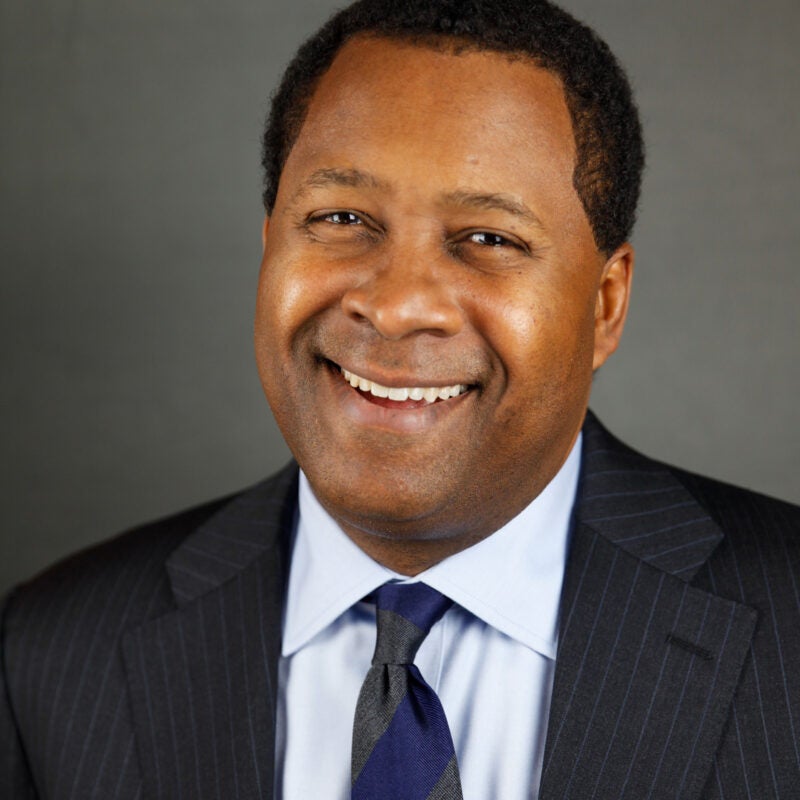
Growing up in Jacksonville, Florida, in the 1960s and ’70s, Reginald Brown ’96 saw firsthand the disparate effects of law and public policy.
“It was a large deep-South community, and the schools and neighborhoods were still completely segregated for the most part,” he recalls. Brown and his family lived on the Northside. His father, a merchant seaman, worked in the shipyards and on tankers, while his mother cleaned homes on the other side of the city.
Brown earned a spot in a magnet high school. “I was able to hang out with 43 kids who came from every imaginable economic background — and we’re still friends today,” he says. “The value of the legal framework that made that experience possible was obvious and important to me.”
When he applied to Yale College, his admissions interview was with a local real estate lawyer. “I met him at the biggest building in town, and it was my first time in that building, which made an impression. Law seemed like a space where you could rise above your station in life and also drive positive change.”
Based now in Washington, D.C., Brown is a partner in the firm Kirkland & Ellis, where he has worked since 2020 and where his focus on investigations-related guidance, strategic counsel, and crisis management frequently involves prepping clients for congressional hearings.
“You learn to sweat the small stuff while thinking about the big picture.”
“It’s an opportunity to use the left and right sides of your brain. You’re helping people think through how to convey their narrative, with the understanding that the legal aspect is not the only relevant factor,” Brown says. “If you say the wrong thing from a public perception standpoint — not necessarily the wrong thing legally — you can lose your job, and your institution can lose years of progress. But if you nail it, you can move past that moment and build to something bigger and better.”
Over his career, which has included 15 years as a partner at Wilmer Hale, Brown has advised senior executives in the financial, energy, health care, and tech sectors, including the CEOs of Meta, Google, and Chevron.
“The common thread is usually an individual or organization that doesn’t have the luxury of time to develop a narrative for the court of public opinion, where you must sometimes resolve matters very, very quickly because the stock price or the CEO’s job is at stake,” Brown says.
Brown’s work often brings him face to face with people going through the worst moment in their professional lives, putting a high EQ and strong interpersonal communication skills at a premium. Early work experiences helped him develop those qualities, from navigating cultural differences as a Peace Corps volunteer in Micronesia (where he studied for the LSAT by kerosene lamp) to working as the assistant to the CEO and vice president of corporate strategy for the financial giant Nationwide.
“I learned how to talk to a time-pressured executive with the right level of detail and the right level of the big picture,” he says. The same was true when Brown worked as deputy general counsel for Florida Gov. Jeb Bush during that state’s 2000 presidential election recount, and when he later served under White House Counsel Alberto Gonzales ’82 during the administration of President George W. Bush.

“Both of those experiences were fertile training grounds for crisis management,” Brown says. “You could see how even the smallest misstep could result in a loss of traction. So, you learn to sweat the small stuff while thinking about the big picture.”
Beyond his crisis management work, Brown commits pro bono time to issues including education reform and LGBTQ+ rights. In addition to working in 2021 alongside Ken Mehlman ’91 (who was Bush’s campaign manager in 2004) to line up the Republican votes needed to pass the Respect for Marriage Act, Brown contributed an influential brief to the landmark 2015 case Obergefell v. Hodges.
“I’ve always thought part of the job of a lawyer is to address discrimination,” he says. “Where children go to school is still largely determined by zip code and income, so education reform in particular will always be something I care about deeply.”
Brown is quick to mention the people who helped guide him along the way. Aside from the many influential attorneys he met while working at the White House, and other leading lawyers such as Jamie Gorelick ’75 and Mark Filip ’92, he also cites the early impact of clerking for Joseph Hatchett, then a U.S. circuit judge in Tallahassee, Florida.
“He was a civil rights pioneer who attended Howard University in the 1950s,” he says. “Joe took the bar exam in the same hotel as the rest of the students but wasn’t allowed to stay there. He was a remarkable man, and that was a terrific year of learning and growth.”
Brown now pays the favor forward, mentoring others, including last fall through the law school’s Alumni in Residence Program. “The 30 minutes you give a complete stranger comes back to you in so many different ways,” he says. “And watching someone grow and rise in the field is also pretty neat.”