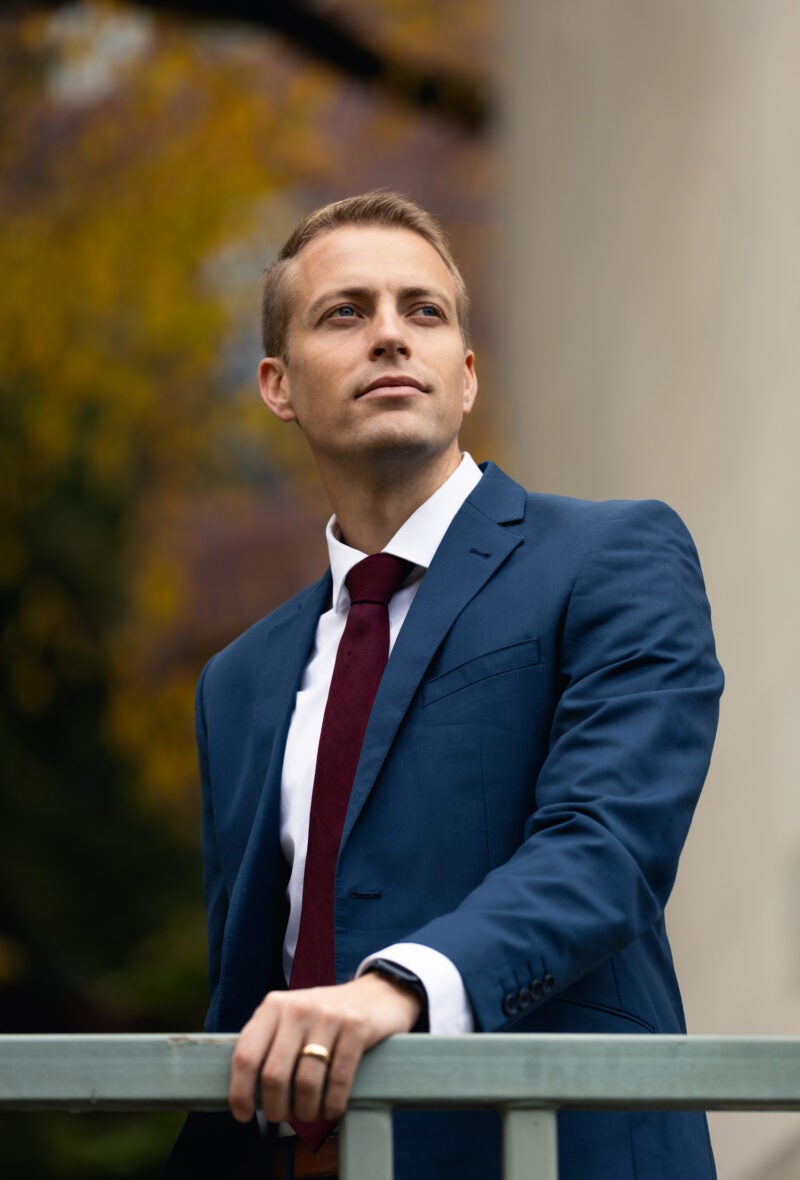
In the United States Air Force, a call sign — or nickname used over communications channels — is bestowed upon a pilot or officer by their peers.
During his half decade of military service, Kent Romney ’28 was graced with the call sign Vlad, a nod to his knowledge of the Russian and Ukrainian languages — and an acronym for “very long atrocious diatribe.”
The “diatribe” came during his military promotion ceremony, in which he swore an oath to defend the Constitution and then held forth on what the nation’s founding document means to him.
“I’m romantic about this,” he says. “The speech was about how inspiring it is that we were all there to defend the Constitution of the United States, because it’s the Constitution that provides us the liberties and the rights and the privileges to be our best people.”
Despite its teasing humor, the call sign reflects a serious truth about Romney. His service as an intelligence officer in the Air Force, and later Space Force, was motivated by the same thing that has pushed him to pursue law at Harvard: a deep commitment to democratic values and freedom.
“The rule of law is sacred and worth defending, just as our rights and the Constitution are worth defending,” he says.
Romney grew up in Utah, the second of six children. Although he had no family connections to the military, as a boy, he found himself fascinated by American history, particularly World War II.
“I would watch eight-hour documentaries about the war like kids today watch ‘Paw Patrol,’” he says.
Romney decided he would join the military someday. He says he didn’t realize what this would mean until years later, when he was an undergraduate student at the U.S. Air Force Academy. “Looking back,” he says, “I just wanted to serve my country.”
“I have a unique perspective on the value of liberal democracy, and that it’s worth fighting for.”
After his first year at the academy, Romney, a Mormon, took a leave of absence to serve a two-year mission in Ukraine, a time that coincided with the period of protests in that country known as the “Revolution of Dignity,” and the eventual ousting of its Russia-aligned president.
This was the formative experience of his life, Romney says, one in which he developed a deep connection with the country, its people, and their fight to control their democratic destiny.
“Parents were protesting in the street, chanting about how they were doing this for their children,” he recalls. “I saw that they were willing to put everything on the line to fight for these freedoms that I took for granted as an American.”
Romney’s mission confirmed his desire to serve his own country, “[which] I viewed as the shining light of democracy, that I hope it can still be,” he adds.
The Power of Information
Returning to the academy, Romney considered several different paths in the Air Force, but he ultimately settled on intelligence, which involves the collection and presentation of critical information that guides military leadership.
“Sun Tzu, in ‘The Art of War,’ says, ‘Know thyself and thy enemy, and 1,000 battles you will not lose.’ Well, intelligence is the ‘thy enemy’ side,” Romney explains.
His service landed him in Hawaii, first with the 8th Intelligence Squadron, where he led a crew of image analysts processing drone data from the Middle East, including images related to ISIS activity in Afghanistan.
“This required understanding whether something we were looking at was, say, a prayer rug or a rifle,” he says. “This ‘level zero’ analysis is incredibly important, and the analysts I worked with had amazing expertise and took their jobs very seriously. I don’t have to explain what a mistake here could mean.”
Romney’s next role was with the 15th Wing, where he analyzed data and created actionable intelligence reports for the unit’s commander.
During his subsequent assignment, with the 19th Fighter Squadron, he created tactical intelligence used by fighter pilots and led three intelligence teams during a major international exercise in Micronesia.
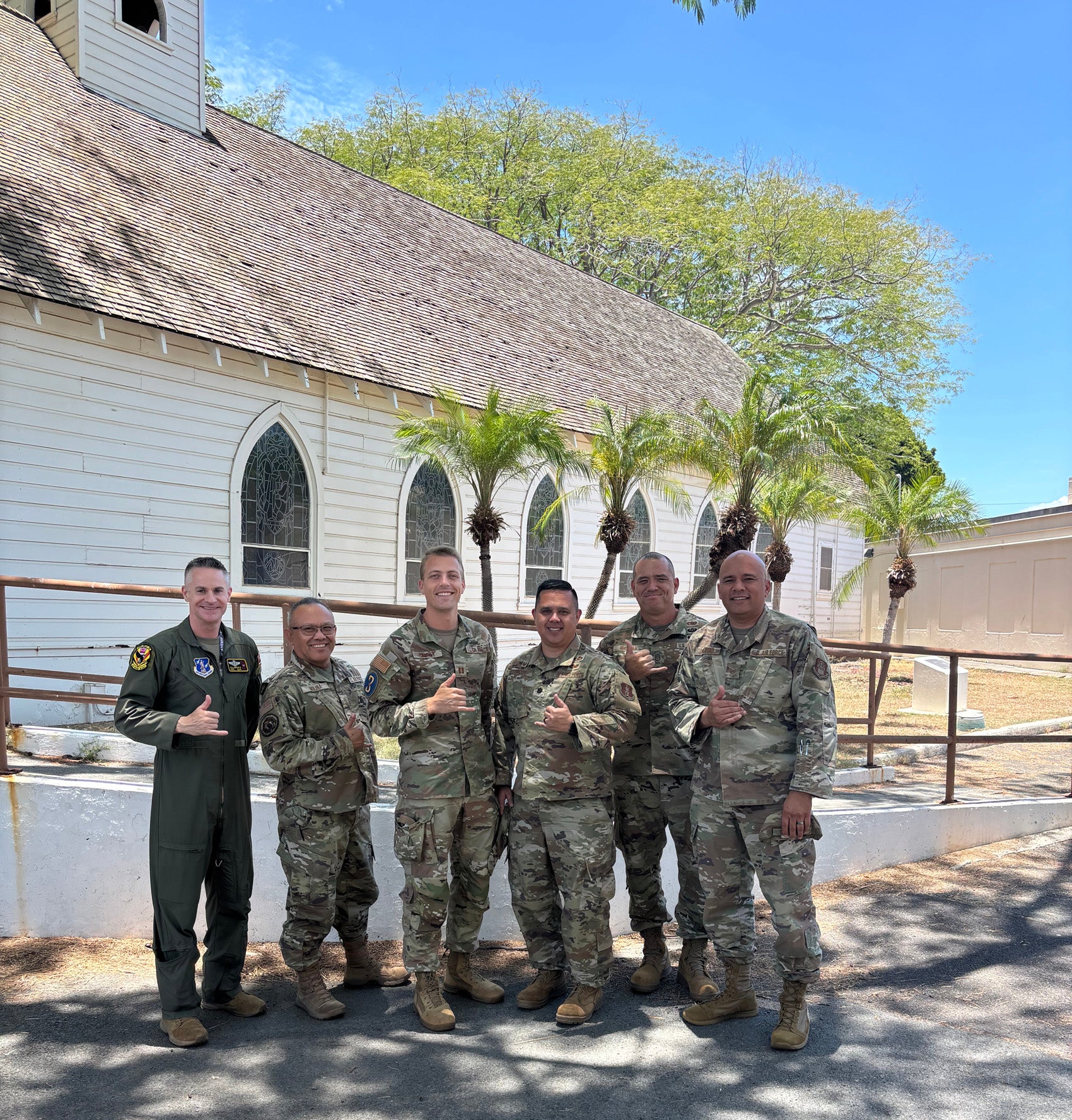
That job could be stressful in its immediacy, Romney says, but it’s also where he earned his call sign. “There’s definitely a camaraderie that comes from being at the tactical level that doesn’t come at the operational and strategic levels.” By the beginning of 2022, his active duty was coming to an end, but he continued to work in military intelligence, returning to the 15th Wing to oversee tactics and training.
During that time, he also became worried about something far outside the 15th Wing’s sphere — Russia’s impending invasion of Ukraine. “The day the war started was maybe the worst day of my life,” he says. “I had never felt fear like that.”
Romney says he was horrified for his friends and acquaintances who had worked so hard for their nation and was shocked by the destruction inflicted on many of the places he had visited years before. He leapt into action, raising nearly $50,000 for humanitarian support for Ukrainians impacted by the war.
But he didn’t stop there. “I went to my commander and said, ‘This is exactly why I joined. Get me on a plane — I’ll go anywhere.’”
Soon, Romney was on his way to Germany to provide intelligence and training to members of the Ukrainian Armed Forces, including information on long-range drone strikes and counter-jamming tactics. His American team consisted of several colleagues with a Ukrainian background or language skills, most of whom did not have experience in intelligence. But in the end, that didn’t matter, he stresses.
“We all wanted to be there. We believed in the mission; we had a shared desire to help the people of Ukraine,” he says. “I cannot emphasize this strongly enough — belief is the ultimate force multiplier when you have a fighting force.”
“It was an amazing experience,” he says. “This was exactly what I felt like I was born to do.”
In 2023, Romney became the information campaign lead for the Air Force’s new overarching strategy for agile combat employment — a way of deploying and positioning forces that doesn’t rely on traditional large, fixed bases.
“The Air Force is still so accustomed to not being under threat when they’re on the ground, but that is just not true anymore,” he explains. “This is a reflection of the new geopolitical and military reality that there is no sanctuary in modern warfare.”
Later, Romney shifted his focus to an even higher altitude — outer space — becoming the Space Force’s very first director of information warfare for the Indo-Pacific. There, he led the command in crafting a space information warfare strategy for the region.
“This is a completely new domain of warfare, and the basic rules we have don’t really apply in space,” he says. “There was little precedent for the position — we were building the ship when it was in orbit, as they say — but I think we made great progress.”
Shifting gears, but not direction
Even as he was leading intelligence operations against threats abroad, Romney was becoming increasingly worried about strife at home, including the risks of extreme political polarization.
“As Abraham Lincoln said, ‘A house divided against itself cannot stand,’” he says.
Seeking a fresh challenge and a new way to support the Constitution he holds dear, Romney decided to pursue a career in law.
“I think I have a unique perspective on the value of liberal democracy, and that it’s worth fighting for,” he says. “I have seen that when we believe in it, it can produce miracles. And that’s what I’m hoping to fight for as a lawyer.”
Today, as a first-year student, Romney says he’s grateful to be able to explore his interests at Harvard: “Harvard is not perfect, but we are a great American institution, an engine of American prosperity, and a defender of American values and the messiness of the American story.”
Romney, a husband and father of three, is also thankful to Harvard for respecting his other, more personal commitments.
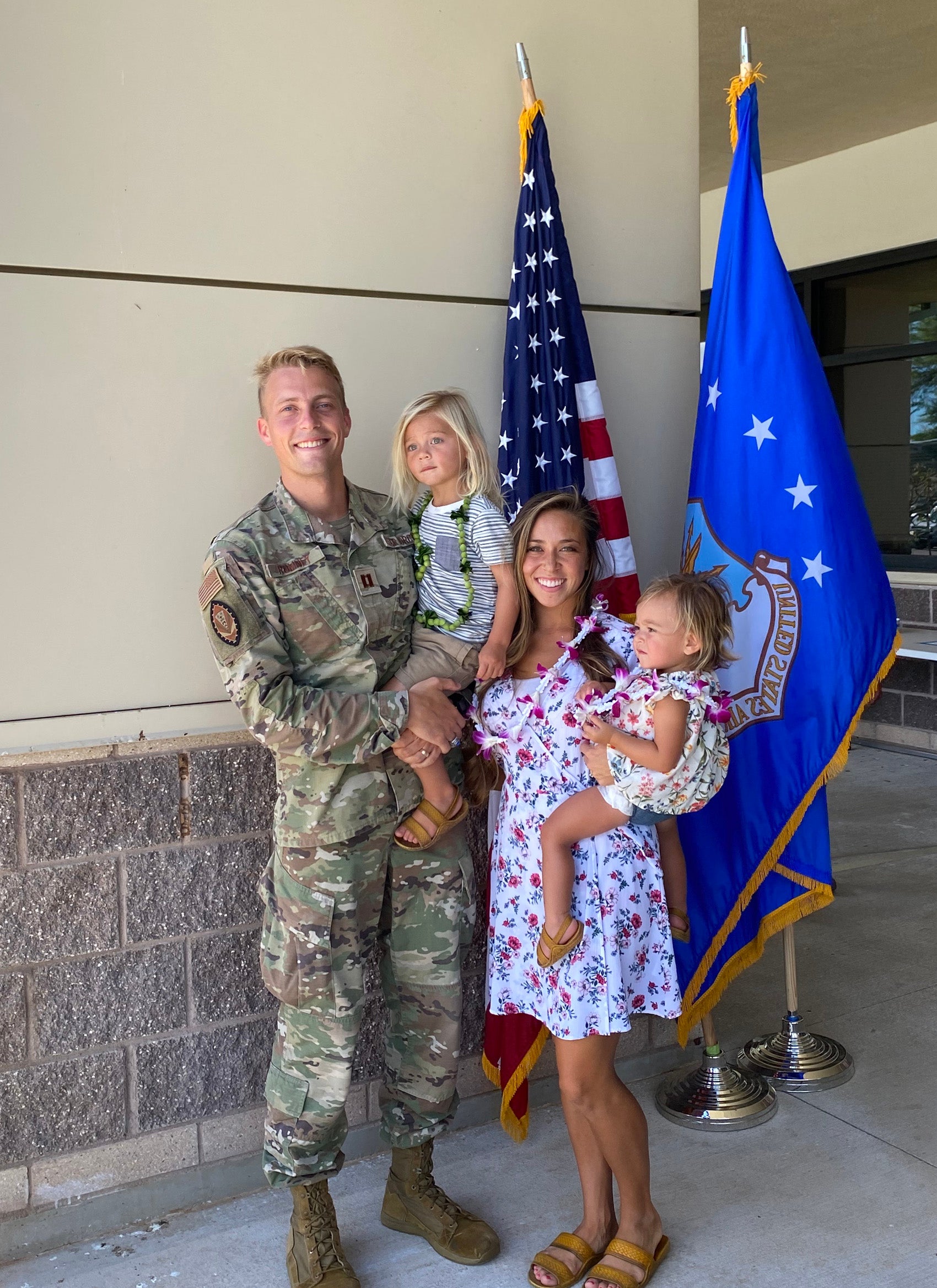
“Harvard took a chance on me, and I will always remember that,” he says. “I’m a ‘God, family, country’ person — and the law school has really valued that.”
Although he isn’t yet certain what his career will look like after graduation, Romney is sure of this: Like his military career, it will be in partnership with others, in service to something greater than himself.
“My basic requirement when I work with people is that they believe in something, that they are not apathetic,” he says. “When you have people who believe in something, that can take you anywhere.”