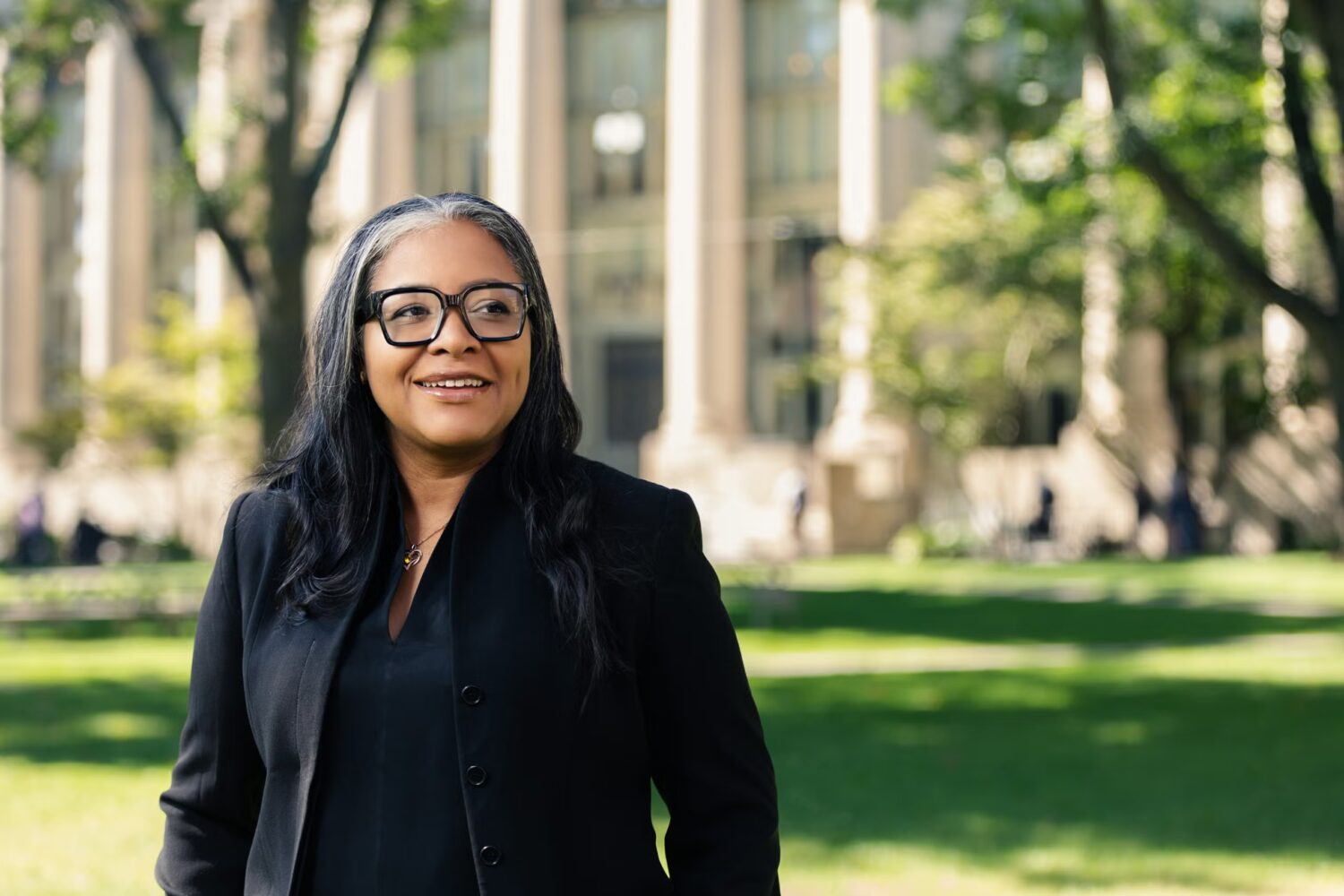
Several years into her career as an intellectual property and technology law attorney, Arianne de Govia ’01, an avid reader and writer who had considered journalism before law school, went back to school to earn her master’s degree in fiction at Johns Hopkins University.
A creative writing program was the last place she thought she’d run into a fellow HLS graduate, yet one of her most influential professors in the program was Brad Leithauser ’80, a poet and novelist whose work has appeared in The Atlantic and The New Yorker.
“He was a wonderful mentor,” de Govia says, adding, “you never know where you’re going to run into alumni.”
In her new role as president of the Harvard Law School Association, de Govia — who continues to practice law at the firm she co-founded more than a decade ago and still dabbles in fiction — hopes to facilitate that same sense of connection and rediscovery for her fellow alumni around the world. Some of her goals over the next two years include hosting and supporting gatherings for a wider range of communities
“I’m hoping to gather communities that we haven’t traditionally gathered.”
“I am interested in building bridges,” de Govia says. “Our common humanity is always something I am focused on. We may have many differences, and we do, but bringingpeople together to find unexpectedconnections — facilitatingthat has been a joy in my life.”
De Govia comes by those qualities naturally. Born and raised inthe dual-island nation of Trinidad and Tobago, she grew up around people of all cultures — her own family’s roots are a case in point:Her maternal grandfather came toTrinidad from Madeira, Portugal; her maternal grandmother, who was taken out of school at the age of 8 to help support her family, was Cocoa Panyol, a name for people of African, Spanish, and South American descent who owned or worked on cocoa plantations.
“I credit my grandmother with making and keeping me very grounded and focused on what truly matters for a good life — for her, it was always family, love, kindness, hard work, and community,” de Govia says. “I took notes.”
De Govia remained in Trinidad for a year after completing her A-level exams to work in education before coming to the United States, where she majored in economics and English at Barnard College.
Ultimately, she chose to attend law school to “preserve the greatest optionality” in her career, she says.
At Harvard, de Govia was exposed early to the Berkman Klein Center for Internet & Society. She took classes with center co-founder Jonathan Zittrain ’95 and worked with Berkman Klein fellow Diane Cabell on domain name- and trademark-related matters. The internet was new at the time — a cause of both concern and excitement on campus as students, faculty, and practitioners wondered how it would change the profession. She decided on technology law, she says, because “it’s not boxed in; it’s continuously evolving.”
“I’m really excited to be coming into the presidency [of HLSA] at a moment of similar transition,” she says, noting the widespread adoption of AI in society and the law. “It’s the same set of questions: How will these technological advances change our profession? What do we do with these gaps between what the law is and what is happening in the real world?”
De Govia began her career in the newly established IP practice at Fried Frank in Washington, D.C., and, during her time at the firm, worked closely with Daniel Glazer ’98, now a partner at Wilson Sonsini. They worked on large M&A transactions but also on helping emerging companies move from the United Kingdom to the United States.
“I credit him with giving me the startup bug,” de Govia explains. In 2014, she and another former colleague started their own firm, Freeman Wade, which focuses on early-stage companies. “I really enjoy meeting founders. Helping guide them in those early years is key and uniquely rewarding.”
The pair opened their practice with one Fortune 100 client and a few early-stage companies. They grew the business through referrals from former colleagues and clients.
“At the time, much of Big Law did not have a structure for startup pricing and compensation,” she says.
De Govia first became active in the HLSA in 2016 when she attended an event in the D.C. area and met the local chapter president, Juanita C. Hernández ’85. De Govia was already primed to receive and reciprocate the benefits of the alumni community: As a student, she was a social chair for the Harvard Black Law Students Association and participated in the first Celebration of Black Alumni.
“It made me feel very much part of an ongoing community — not just the community of people who fell within the square corners of my time at HLS, but people who had gone before,” she says. “That is something I hope our alumni get a chance to experience more of.”
De Govia ultimately became president of the HLSA club in D.C., where she helped expand programming beyond traditional alumni gatherings to include events focused on mental health and wellness. De Govia says she wants other alumni to make the kinds of connections she has made through her involvement with the HLSA. She has met some of her closest friends through her volunteer roles, including alumni who graduated in different decades.
In her two-year term leading the HLSA, de Govia says she plans to build on the legacy of past HLSA presidents, including Salvo Arena LL.M. ’00 and Judge Yvonne E. Campos ’88, as well as Hernández, who is one of this year’s recipients of the HLSA Award. During her time on the HLSA executive committee, de Govia has played a key role in streamlining the process for establishing HLSA clubs and shared interest groups. Recently formed entities include a club in Dallas-Fort Worth, the HLSA Jewish Alumni Network, and the HLSA of India. In May, de Govia attended the HLSA of Europe annual reunion in London, and she served on the honorary committee for September’s Celebration of Latino Alumni.
“I’m hoping to gather communities that we haven’t traditionally gathered,” she says.
Read more alumni profiles from Harvard Law Bulletin and Harvard Law Today