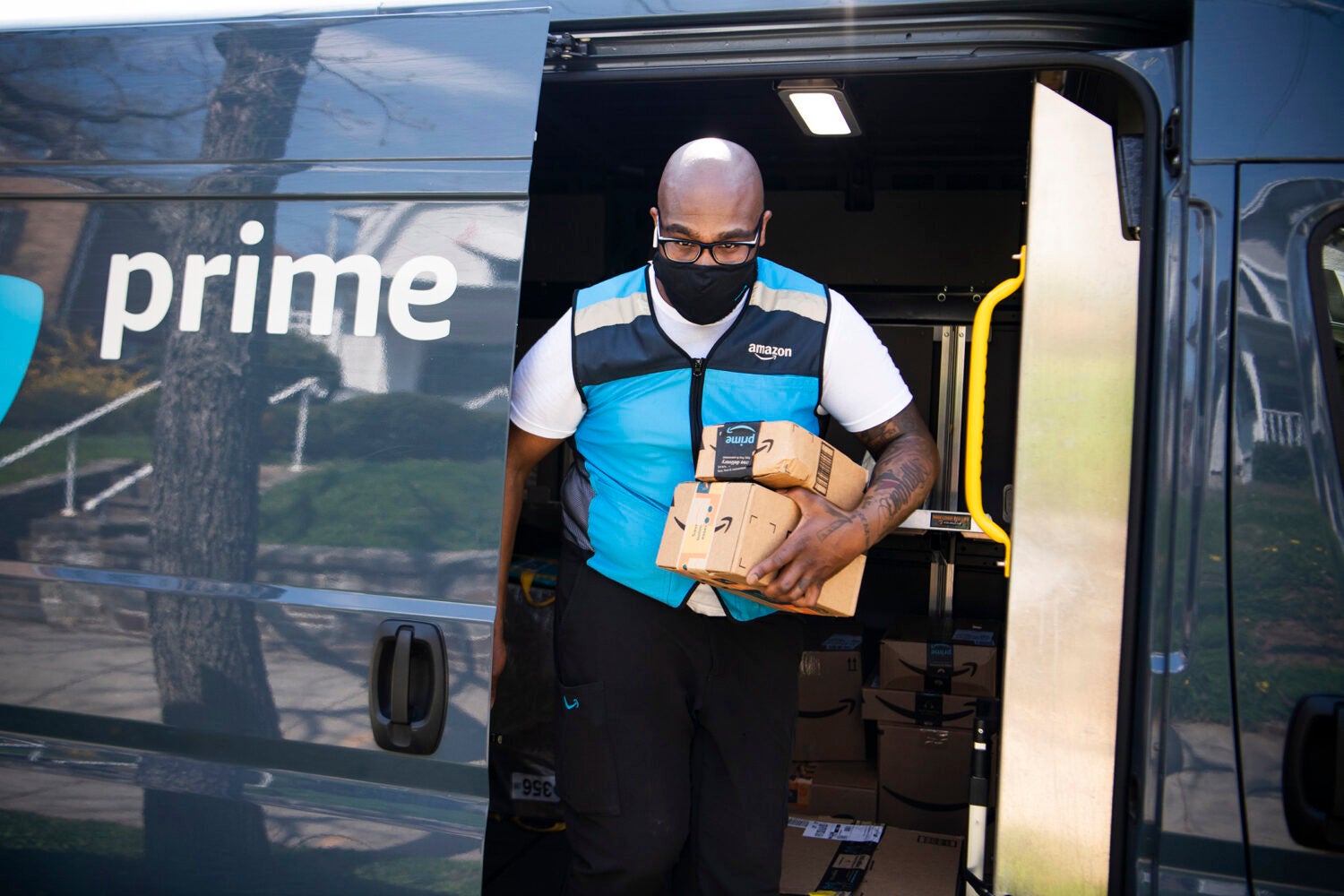
Last-mile delivery drivers seem to be everywhere these days. But despite their ubiquitous role in the modern internet economy, their rights as employees hinge, critically, on where their trips start and end.
The Federal Arbitration Act, or FAA, makes mandatory arbitration agreements enforceable, but the statute exempts delivery drivers who cross state lines, thus preserving those drivers’ right to sue their employers in court. The same law, however, requires last-mile drivers who pick up and deliver in the same state to resolve grievances with their employers through mandatory arbitration.
According to Harvard Law’s Kestnbaum Professor of Labor and Industry Benjamin Sachs, mandatory arbitration puts last-mile drivers at a significant disadvantage in the dispute resolution process. “The FAA intends to allow arbitration to substitute for court actions. But, in the employment setting, instead of lots of arbitrations, you just get lots of nothing. What we’ve learned is that, under mandatory arbitration clauses, very few employees are bringing claims anywhere,” said Sachs.
The Supreme Court is scheduled to revisit the distinction during oral arguments for Flowers Foods Inc. v. Brock next week. Sachs met with Harvard Law Today to discuss the upcoming debate, its likely outcome, and its potential impact on the U.S. delivery business.

Harvard Law Today: Who are the parties in Flowers Foods v. Brock and what is the overall issue?
Benjamin Sachs: Flowers Foods is a corporation in the baking industry that makes and sells, among other products, Wonder Bread. Angelo Brock is a distributor for Flowers Foods in Colorado where he delivers the company’s baked goods in-state. The goods are baked out of state, shipped to a Flowers warehouse in Colorado, picked up by Brock, and then delivered by Brock to retail outlets for sale. Brock is a “last-mile driver” — he completes a delivery process initiated from out of state that concludes in-state. The question in the case is whether, under the FAA, last-mile delivery drivers like Brock are transportation workers engaged in interstate commerce and therefore exempt from the statute’s mandate that arbitration clauses be enforced.
HLT: What’s the basic legal background for the case?
Sachs: The case involves a federal statute, the Federal Arbitration Act, that makes arbitration agreements enforceable in court. But section one of that statute says, “Nothing herein contained shall apply to contracts of employment of seamen, railroad employees, or any other class of workers engaged in foreign or interstate commerce.” The Supreme Court has interpreted that clause to exempt only a narrow group of workers from FAA coverage — namely, transportation workers “actively engaged in interstate commerce” — as opposed to, what strikes me as a more natural reading, any class of workers covered by Congress’s commerce clause power – which is essentially all workers.
HLT: What’s at stake in Flowers Foods? Apart from the immediate parties involved, who does the outcome of this case potentially effect?
Sachs: If the Court finds last-mile delivery drivers to be transportation workers engaged in interstate commerce, then those employees would be exempt from the FAA, the statute that requires enforcement of mandatory arbitration agreements. Among the many workers who would be impacted by the case are drivers who do last-mile deliveries for Amazon. The folks you see driving around town in Amazon trucks generally don’t themselves cross state lines, even though the goods they’re delivering most likely came from across state lines.
HLT: What is a mandatory arbitration clause?
Sachs: A mandatory arbitration clause in an employment agreement requires employees to resolve employment disputes through an arbitration process rather than in court. It’s a waiver of the employee’s right to pursue a judicial forum and judicial remedies for their employment rights. Many arbitration clauses also contain a “class action waiver.” A class action waiver does exactly what it sounds like: it requires that the employee not only arbitrate their claims, but that they arbitrate their claims on an individual basis. Because employment claims are often relatively small dollar claims, the requirement that employees pursue them individually makes it very hard to find legal representation — the costs of bringing the claim are often greater than the potential recovery. That means when you marry mandatory arbitration to class action waivers, you have a situation in which employees can lack the ability to pursue their rights at all.
“I think somehow there needs to be a way of getting working people out from under the obligation of mandatory arbitration agreements, especially when those agreements are paired with class action waivers.”
HLT: In the context of employment agreements, who does an arbitration clause benefit or hurt?
Sachs: When you put together the mandatory arbitration clause and the class action waiver, what you get on the ground is not a lot of employees substituting arbitration for lawsuits. Instead of lots of arbitrations, you just get lots of nothing. Under mandatory arbitration clauses, very few employees are bringing claims anywhere. Cindy Estlund, a professor at NYU Law School, has a paper that shows that the effect of mandatory arbitration and class action waivers is essentially the elimination of a right to a forum of any kind for many employees.
HLT: Why does arbitration often favor the employer?
Sachs: A core part of the problem is that employers are repeat players and employees are not. When an employer has an arbitration agreement, the employer is a party in every case. The employee is a party only in one case. This has an obvious effect on the incentives for the arbitrators who need to get hired to continue the system. And, again, put mandatory arbitration together with a class action waiver and you get pretty close to rendering employment claims inaccessible.
HLT: Are there circumstances where arbitration can benefit the employee?
Sachs: Yes, there is an employment context in which arbitration is actually quite a good system. In unionized workplaces, you have a Collective Bargaining Agreement between a union and an employer and the enforcement of that collective agreement is done through arbitration. In this context, however, the repeat player problem doesn’t exist: you have two repeat players — the employer and the union — and so the system is much more fair. It’s actually quite important to distinguish between the union arbitration setting where arbitration is a positive, and the non-union individual employment contract setting where, again, with the class action waivers, you have a disaster.
HLT: In Flowers Foods, which side has the best argument?
Sachs: I’m a skeptic of arbitration and I believe the Court, by allowing mandatory arbitration clauses with class action waivers in employment contracts, has taken a huge chunk out of employees’ ability to enforce workplace rights. Admitting that those are my priors, I still think Brock has a much stronger argument here. The Flowers Foods position is that you actually have to be moving goods across state lines to be involved in interstate commerce, but that’s not how the Court usually interprets what it means to be involved in interstate commerce. Goods that begin a journey out of state and cross state lines, that don’t “come to rest” in-state, and that then get picked up and delivered to their final destination are part of one, continuous flow of commerce. Brock is involved in that flow and that’s generally good enough to be considered “involved in interstate commerce.” Flowers Foods’ argument is that to be engaged in interstate commerce a worker must be the person who actually carries goods across state lines. I think that’s a losing argument.
“Goods that begin a journey out of state and cross state lines, that don’t ‘come to rest’ in-state, and that then get picked up and delivered to their final destination are part of one, continuous flow of commerce.”
HLT: Apart from precedent, are there any recent Supreme Court decisions that might signal how the Court will rule in Flowers Food?
Sachs: There was a long period of time and a long series of decisions in which the Court continually expanded the reach of the FAA. During this period, the Court decided Circuit City where it held — erroneously, in my view — that the FAA applies to all employment contracts except those involving transportation workers. But, more recently, there has been a string of cases in which the Court has found that employees were exempt from the FAA even though they weren’t “directly involved” in taking goods across state lines.
For example, Southwest Airlines v. Saxon involved baggage handlers — the employee was a ramp supervisor who managed teams of workers who load and unload cargo on and off airplanes. There, the Court said, “Yes, those workers are involved enough in interstate commerce to be exempt from the FAA.” So, there’s a bit of a trend in the direction of carving out a group of workers from FAA coverage. If the Court follows that trend, it will rule for Brock here.
HLT: What was the original purpose of the Federal Arbitration Act and the exemption that’s at issue?
Sachs: That’s the subject of a huge debate. A motivating idea for the FAA was that, at the time of enactment, there was judicial hostility to the enforcement of arbitration clauses. Congress wanted to counteract that hostility and make clear that arbitration agreements were enforceable.
One amazing piece of the FAA history was revealed in a brief filed in Flowers Foods by the AFL-CIO. The AFL-CIO lawyers found a “marginal note” in the session laws which was recorded by the Secretary of State and which states that the FAA is “not applicable to employment contracts of workers.”
I’m not a legal historian; I can’t assess the pedigree of this marginal note. But it’s a provocative legislative smoking gun. The AFL-CIO brief says that the Court is committed to interpreting statutes according to their public meaning at the time of enactment and that this is definitive proof of what the public meaning of the FAA was when it was enacted.
HLT: Will the Court’s decision in Flowers Foods settle this issue for good?
Sachs: It depends, of course, on what the Supreme Court says. I think that they could make it very clear that anybody involved in the transportation of goods, when those goods flow interstate, is covered by the FAA exemption. That would be clarifying for a lot of workers in a lot of industries including, as we said, last-mile delivery drivers for companies like Amazon. It would also leave the vast majority of workers still subject to the FAA. That’s a problem, from the perspective of employment rights. I think somehow there needs to be a way of getting working people out from under the obligation of mandatory arbitration agreements, especially when those agreements are paired with class action waivers.
Want to stay up to date with Harvard Law Today? Sign up for our weekly newsletter.