When it comes to the legality of state gun restrictions, should courts look to the founding era — or to Reconstruction?
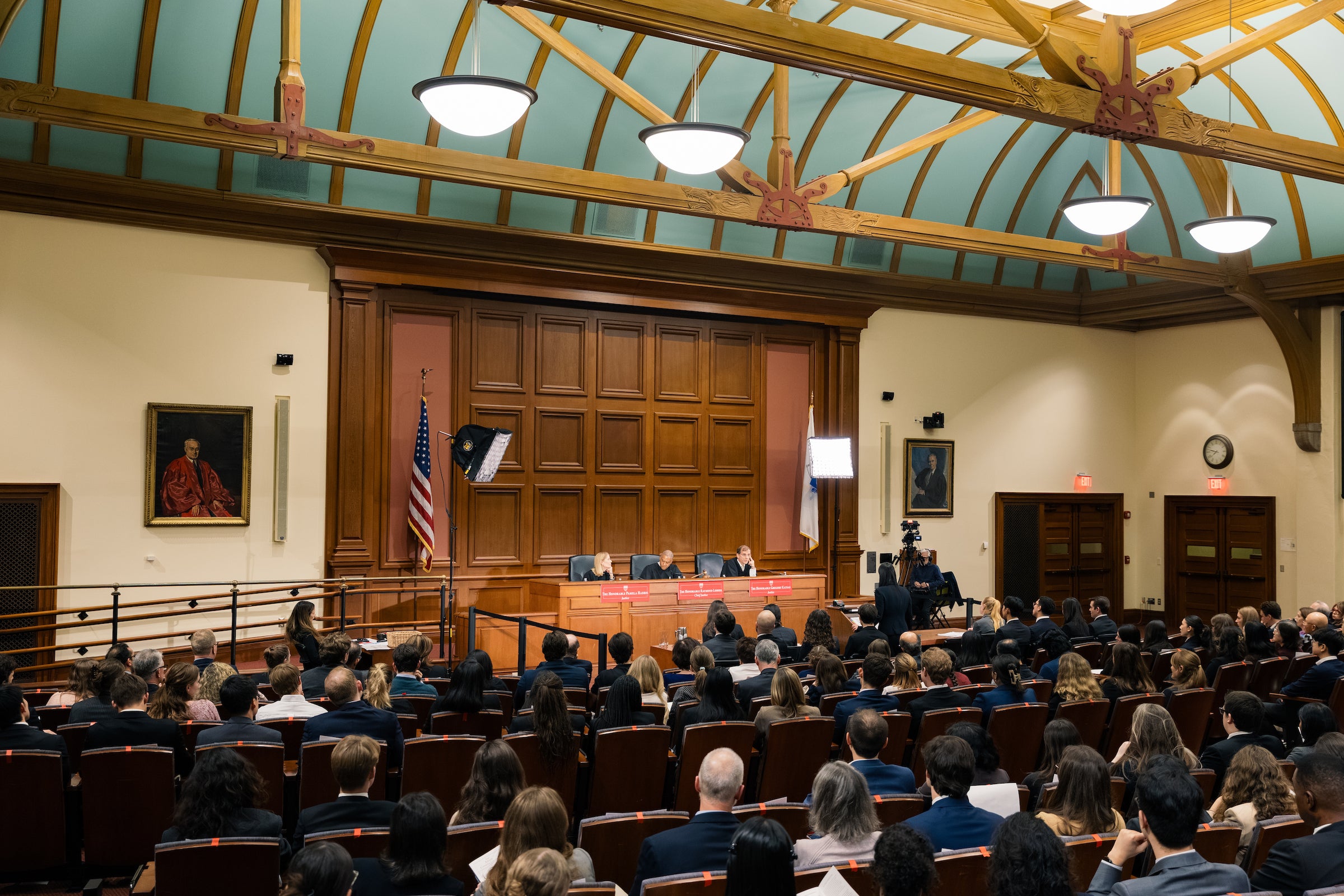
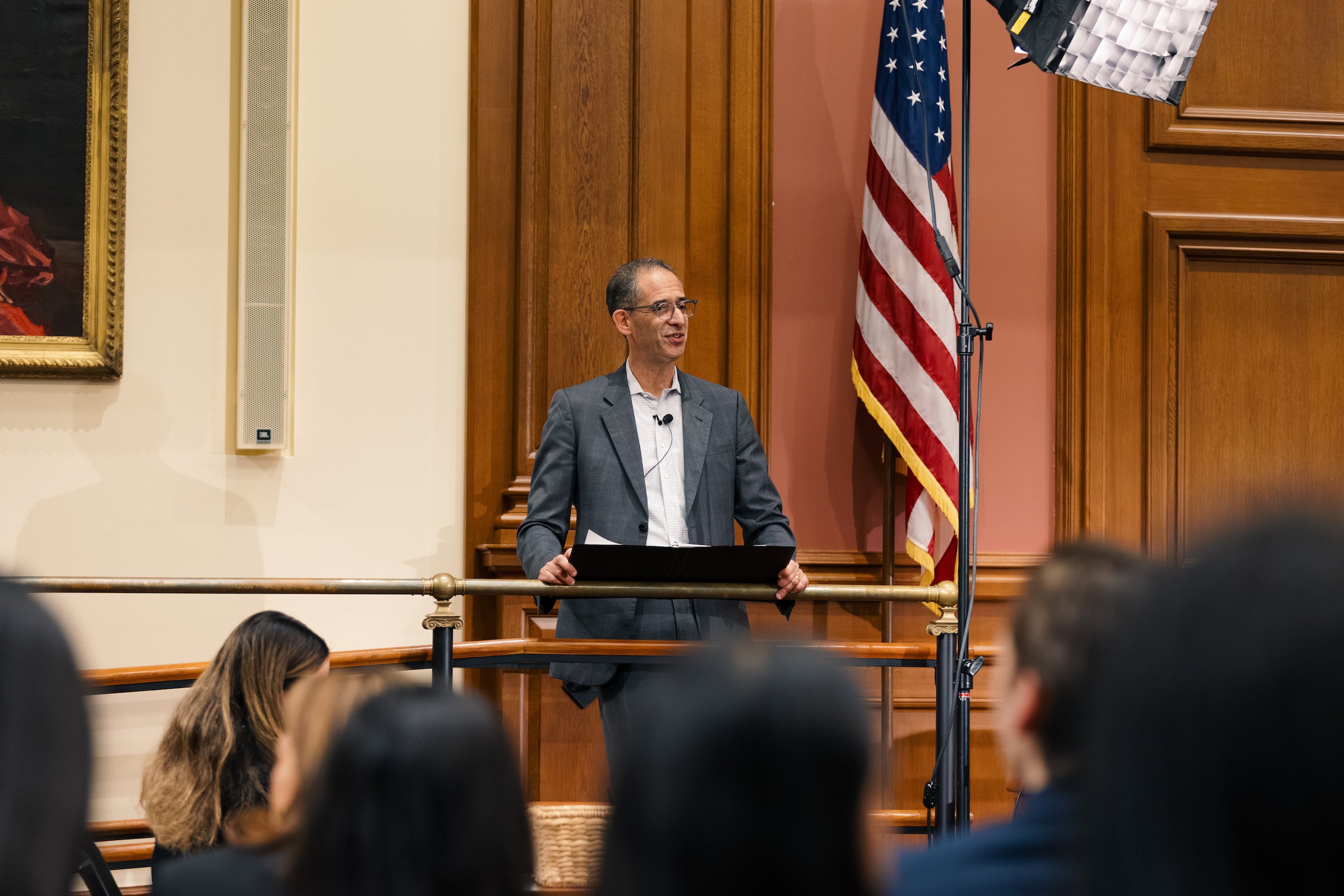
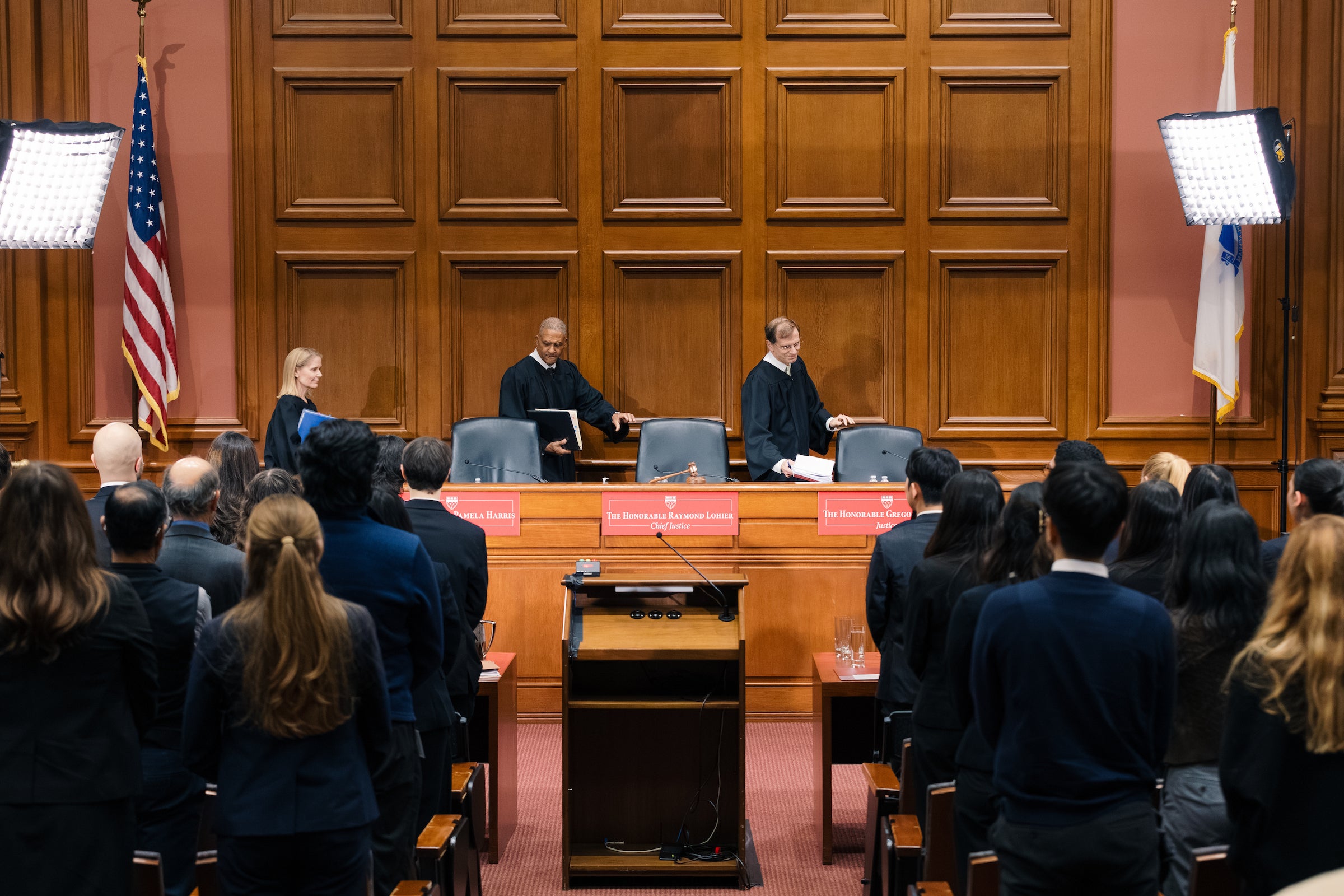
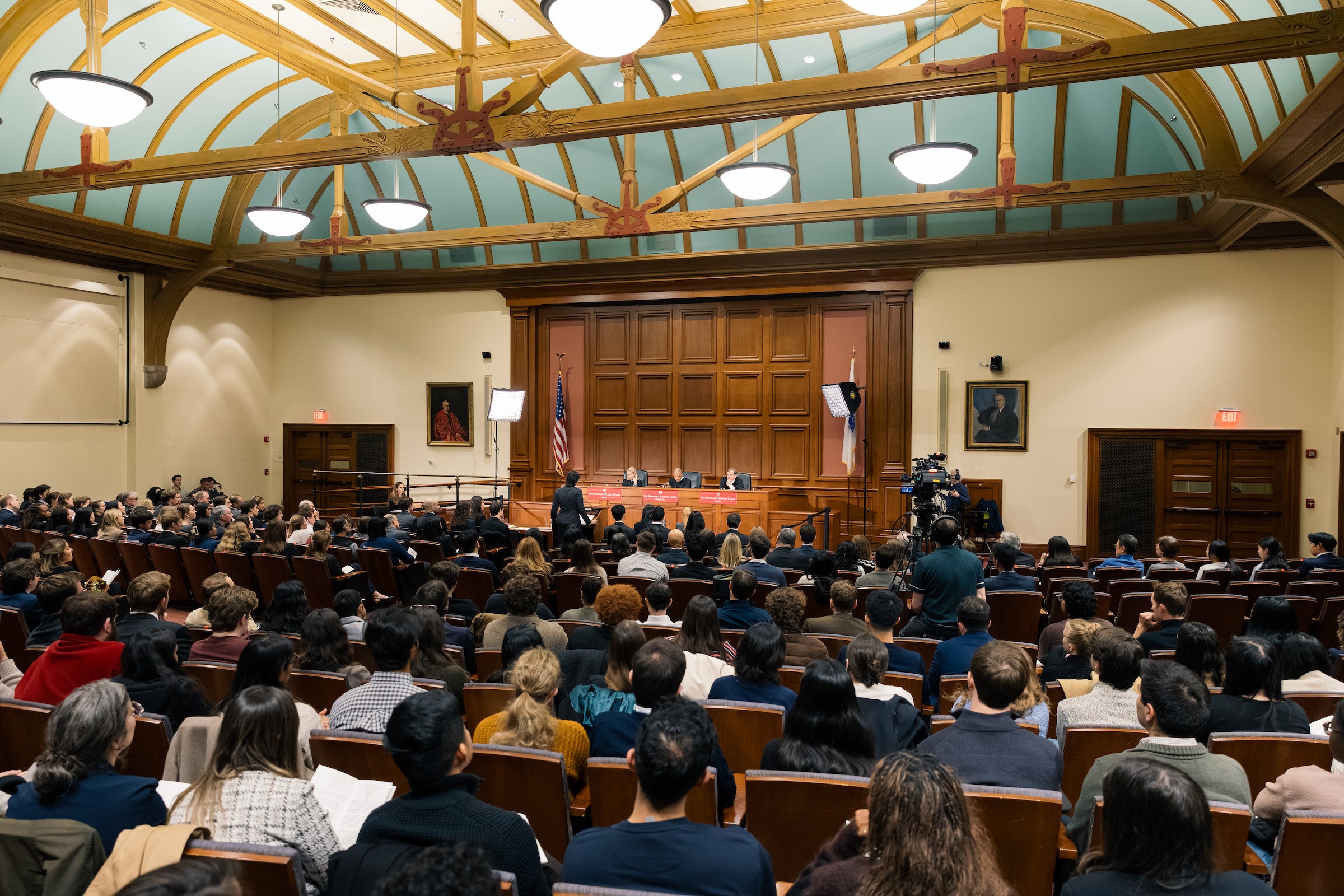
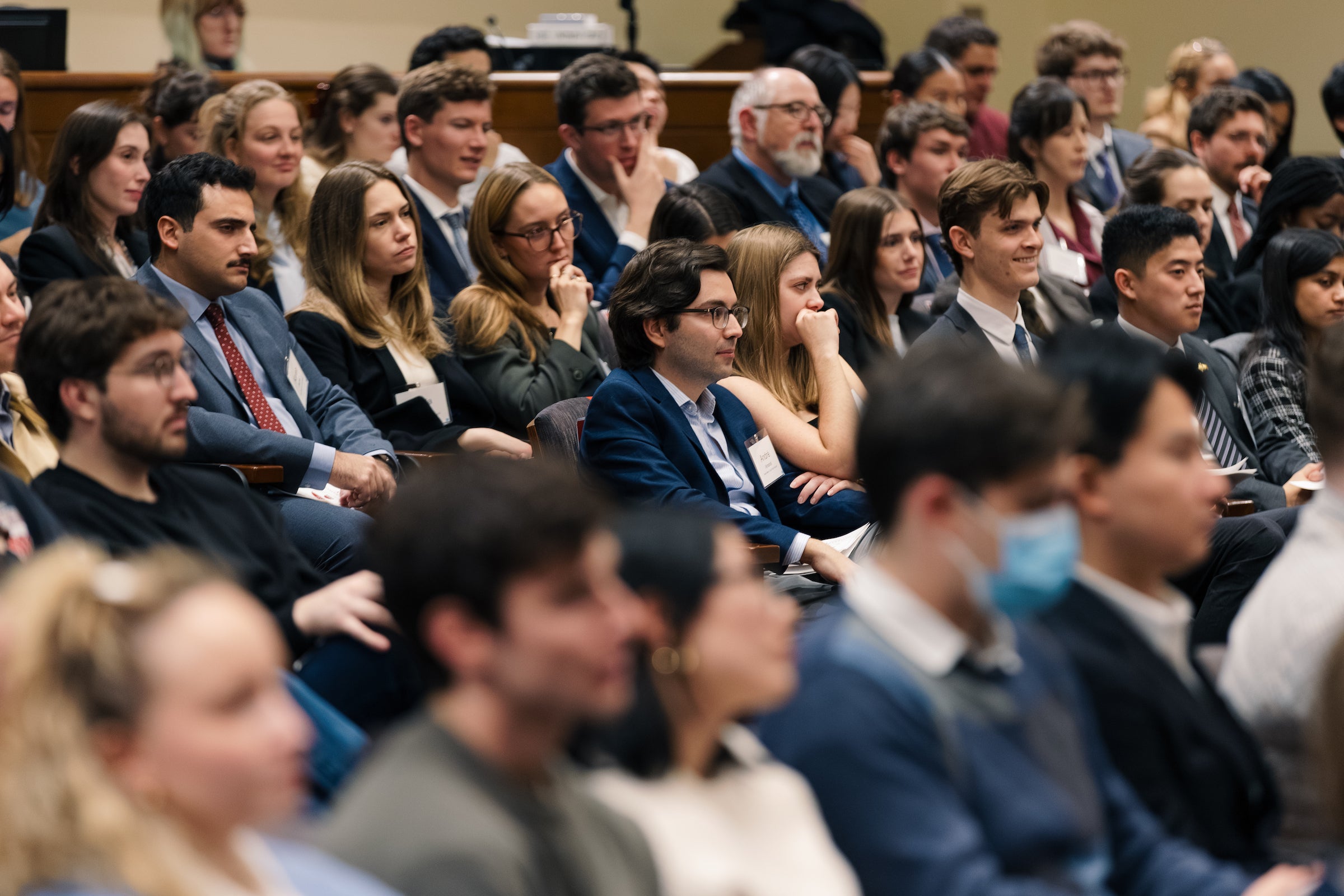
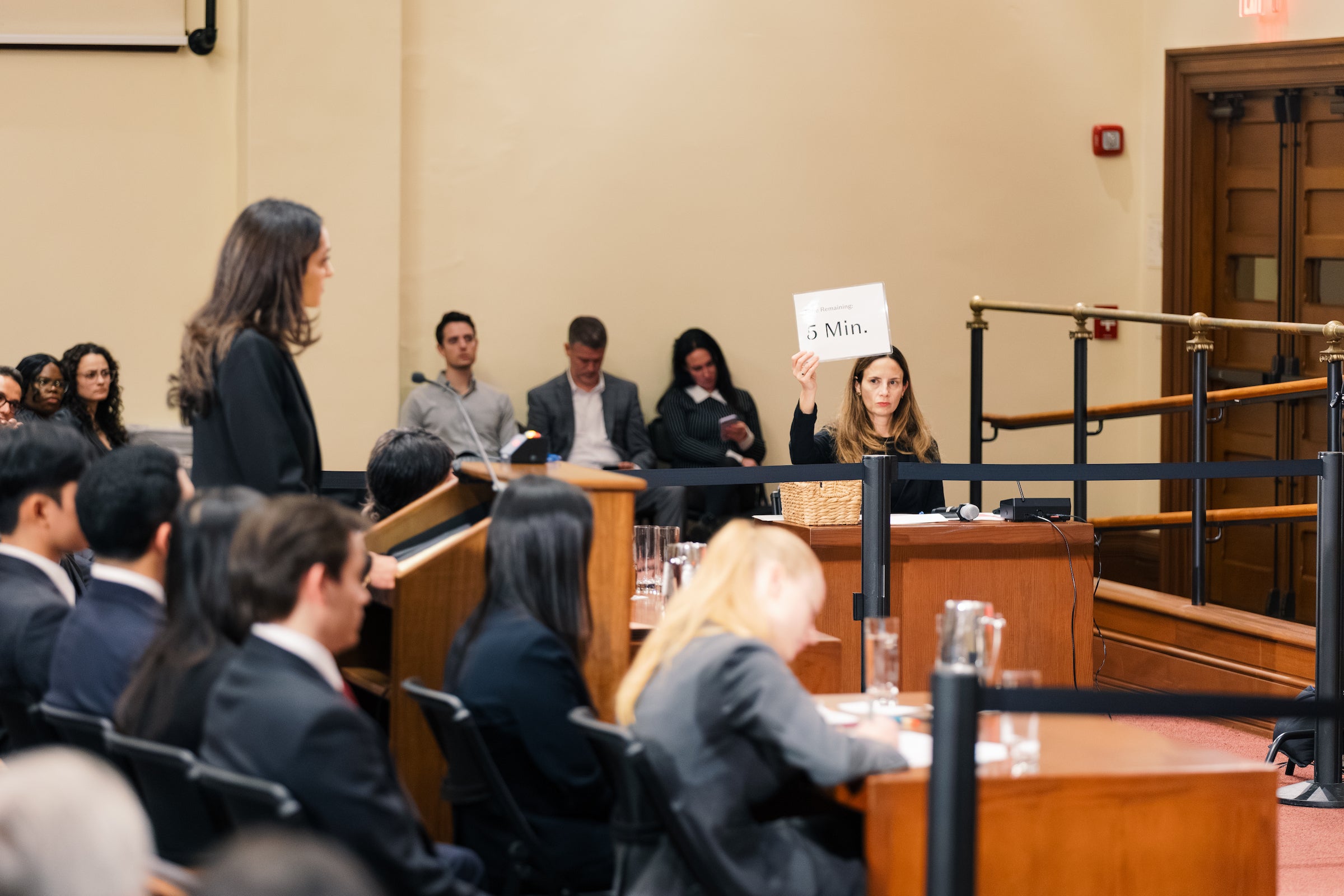
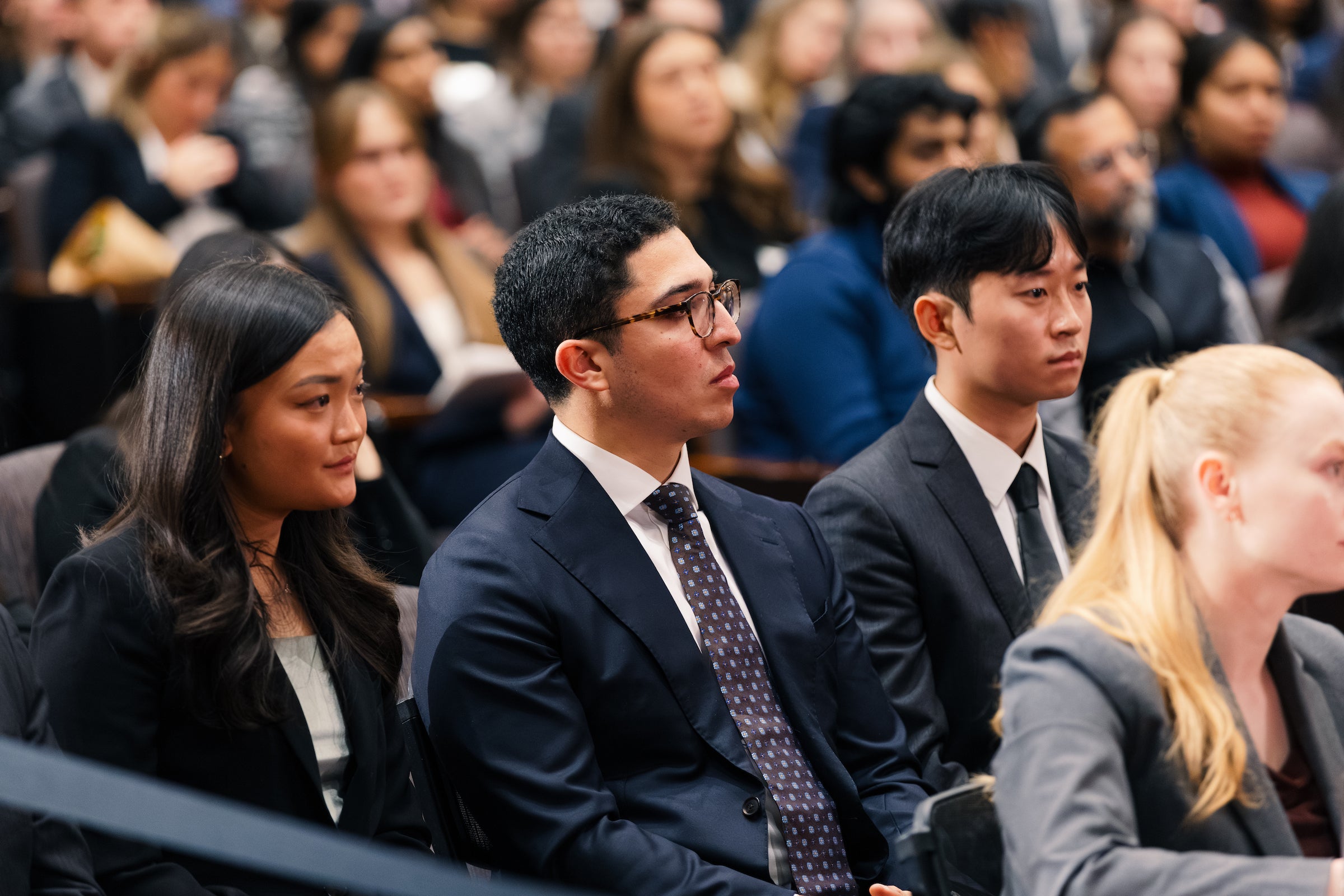
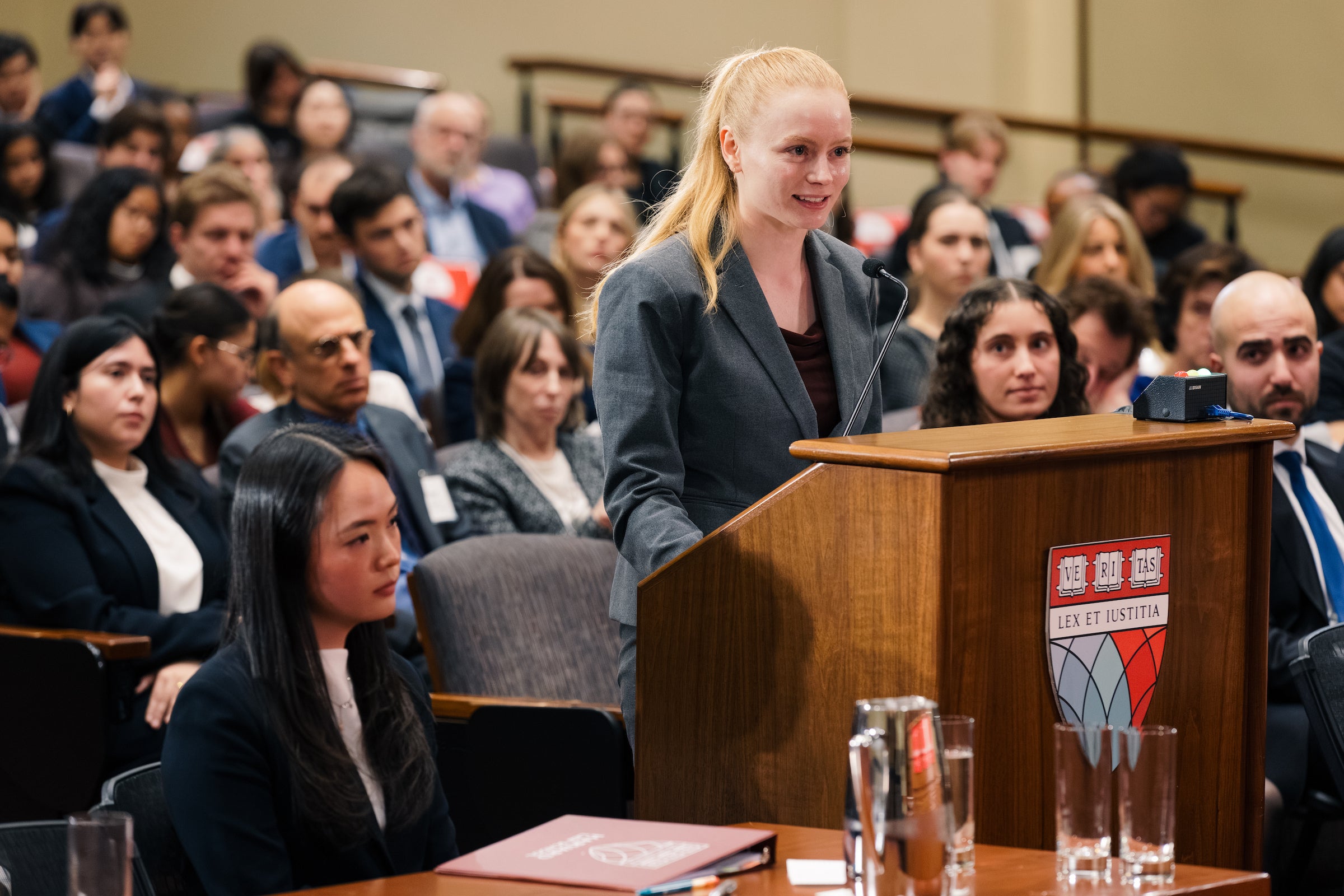
On Nov. 10, two student teams sparred over the Second Amendment and constitutional history during the final round of the 2026 Harvard Law School Ames Moot Court Competition. Established in 1911, it is one of the nation’s most prestigious contests centered on appellate advocacy and brief-writing.
Over the course of two hours, the finalists — whittled down from an original 66 teams — battled over whether a fictional law prohibiting firearms at large park events had historical analogues in the United States. Should judges assess that history primarily by reference to 1791, when the Second Amendment was ratified, or 1868, when the 14th Amendment was ratified?
The hypothetical controversy centered on a prohibition by Ames City, in the State of Ames, against carrying firearms in a public park during any “permitted event” at which more than 1,000 people may be present. The petitioner, an Ames resident named P.G. Wodehouse, is described as a member of the Ames Buffalo Soldiers, a service club named for the Army’s historic African American regiments. Wodehouse wants to bring a gun into park events for self-defense and to help protect others.
In his lawsuit against Ames, Wodehouse asked the court to grant a preliminary injunction — an order that would have temporarily blocked enforcement of the ban against him while his lawsuit proceeded. But a hypothetical district court denied Wodehouse’s request, finding it unlikely that he would succeed in his case, given historical evidence of firearms restrictions dating to around 1868. The ruling was affirmed by the Ames Circuit Court of Appeals.
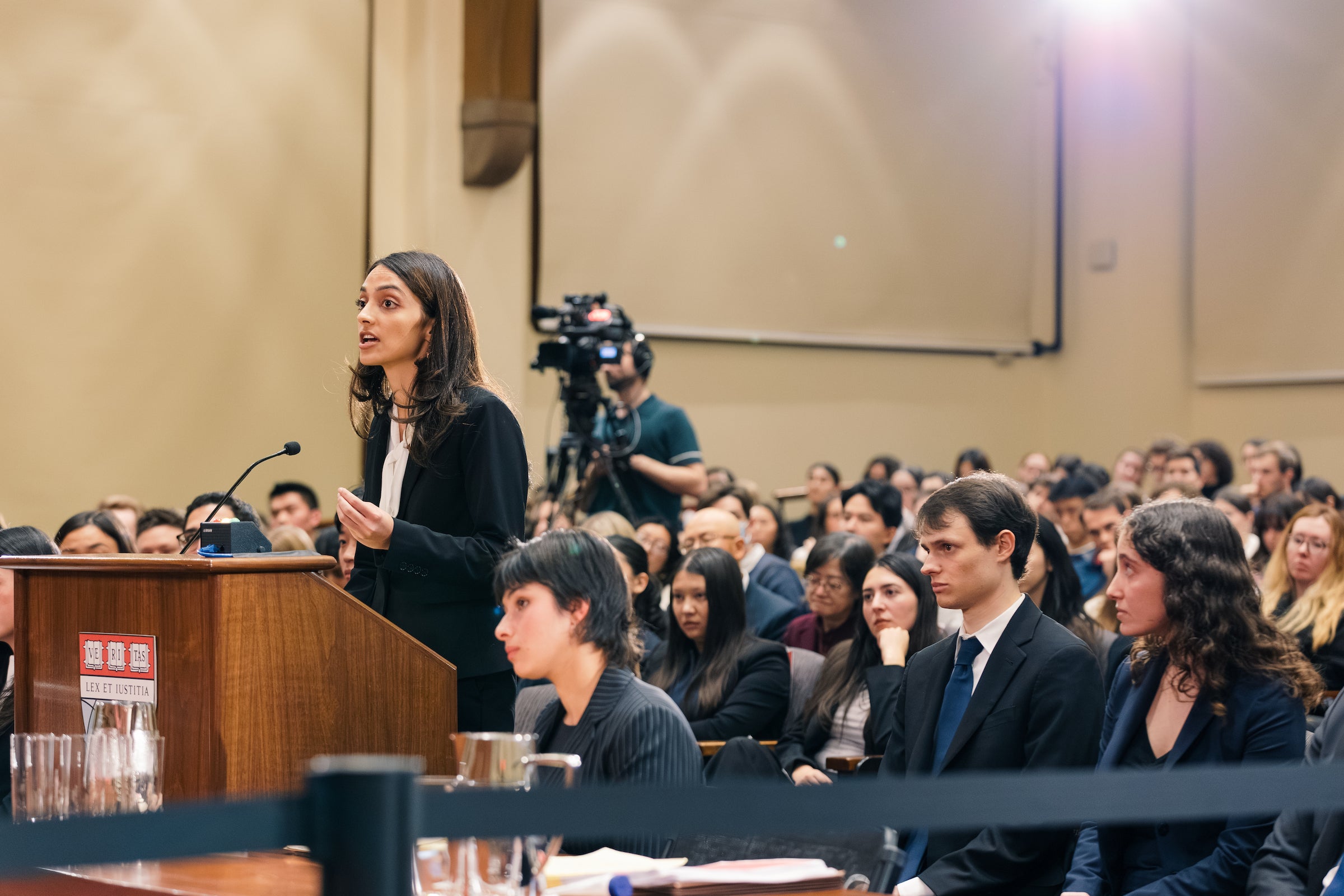
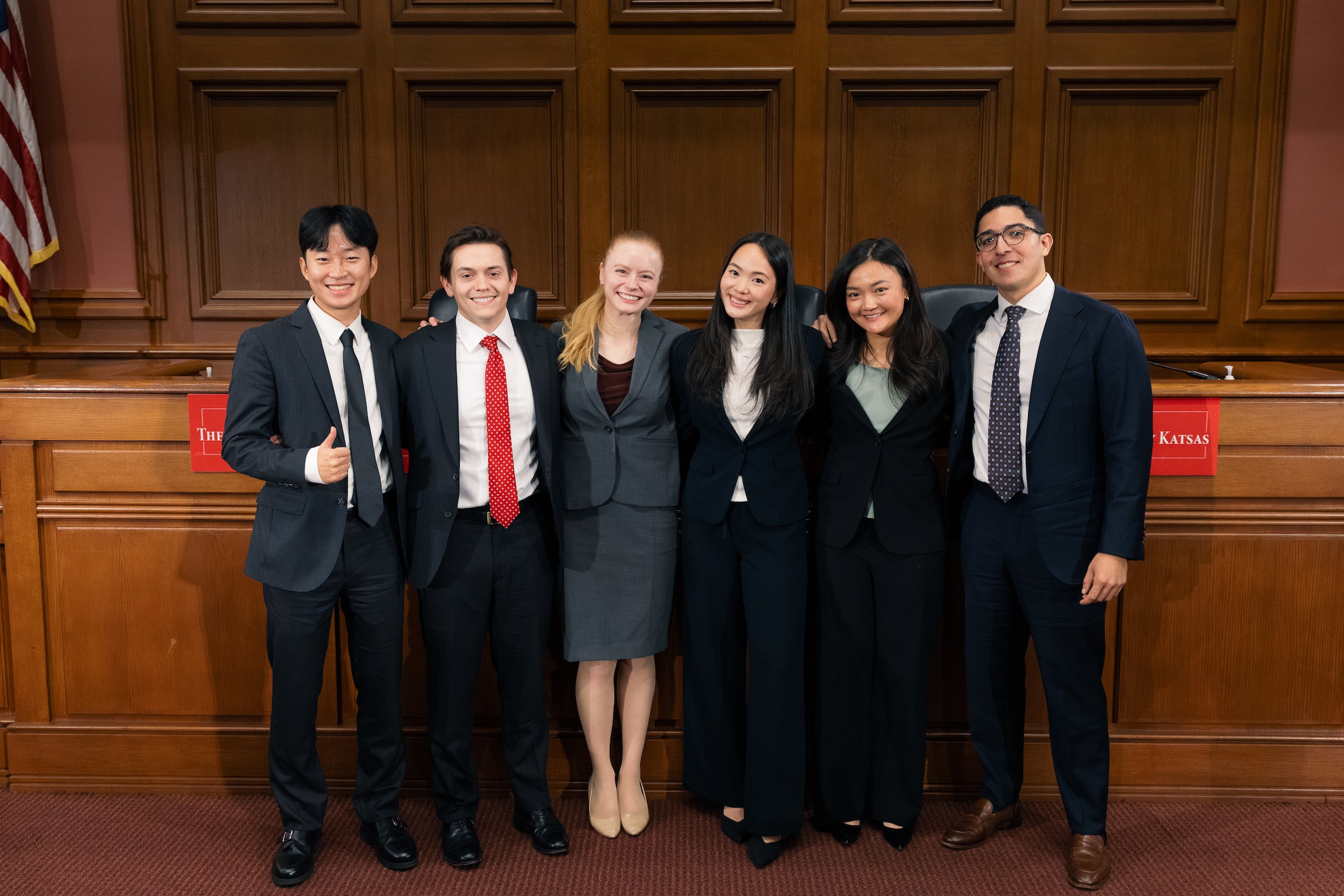
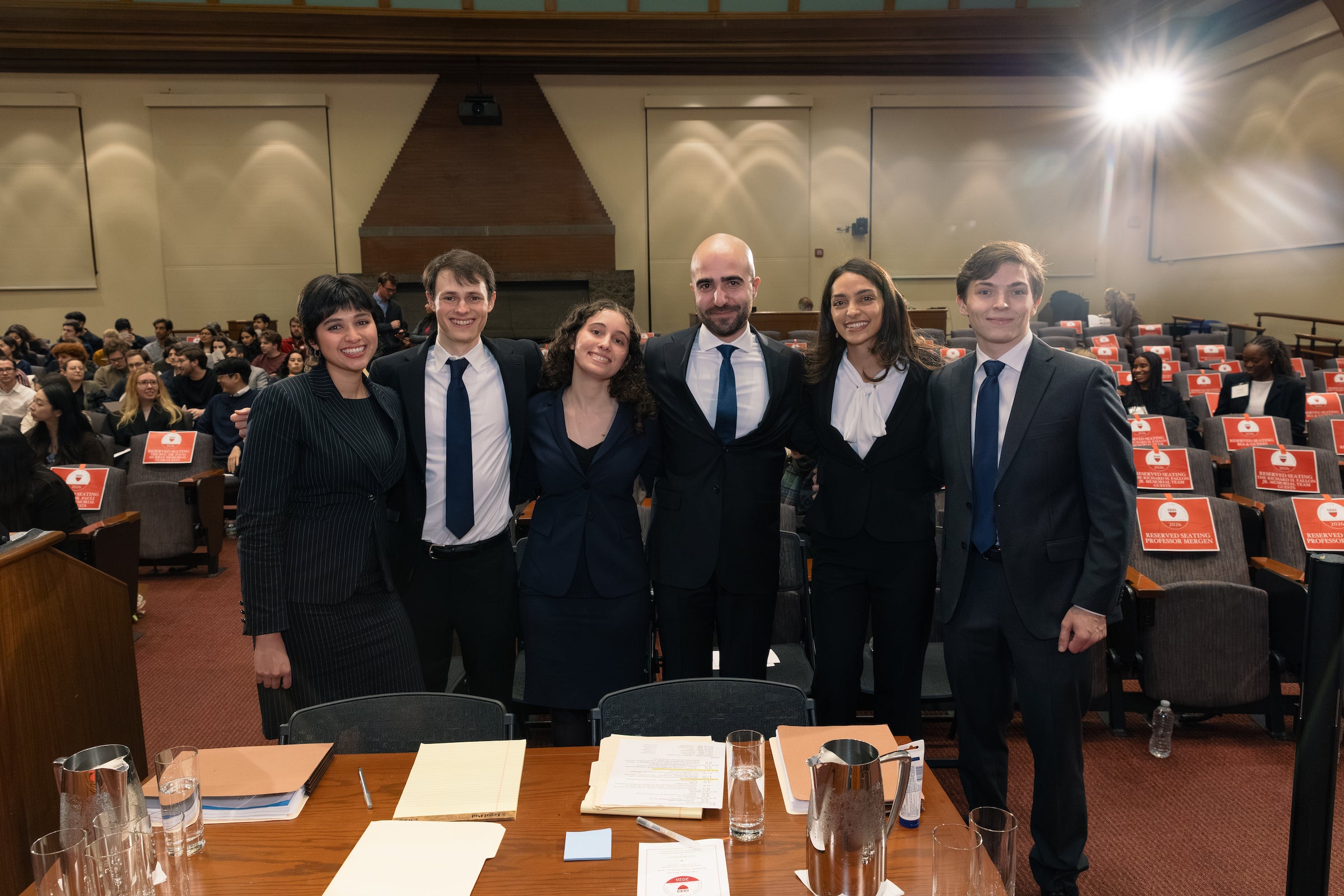
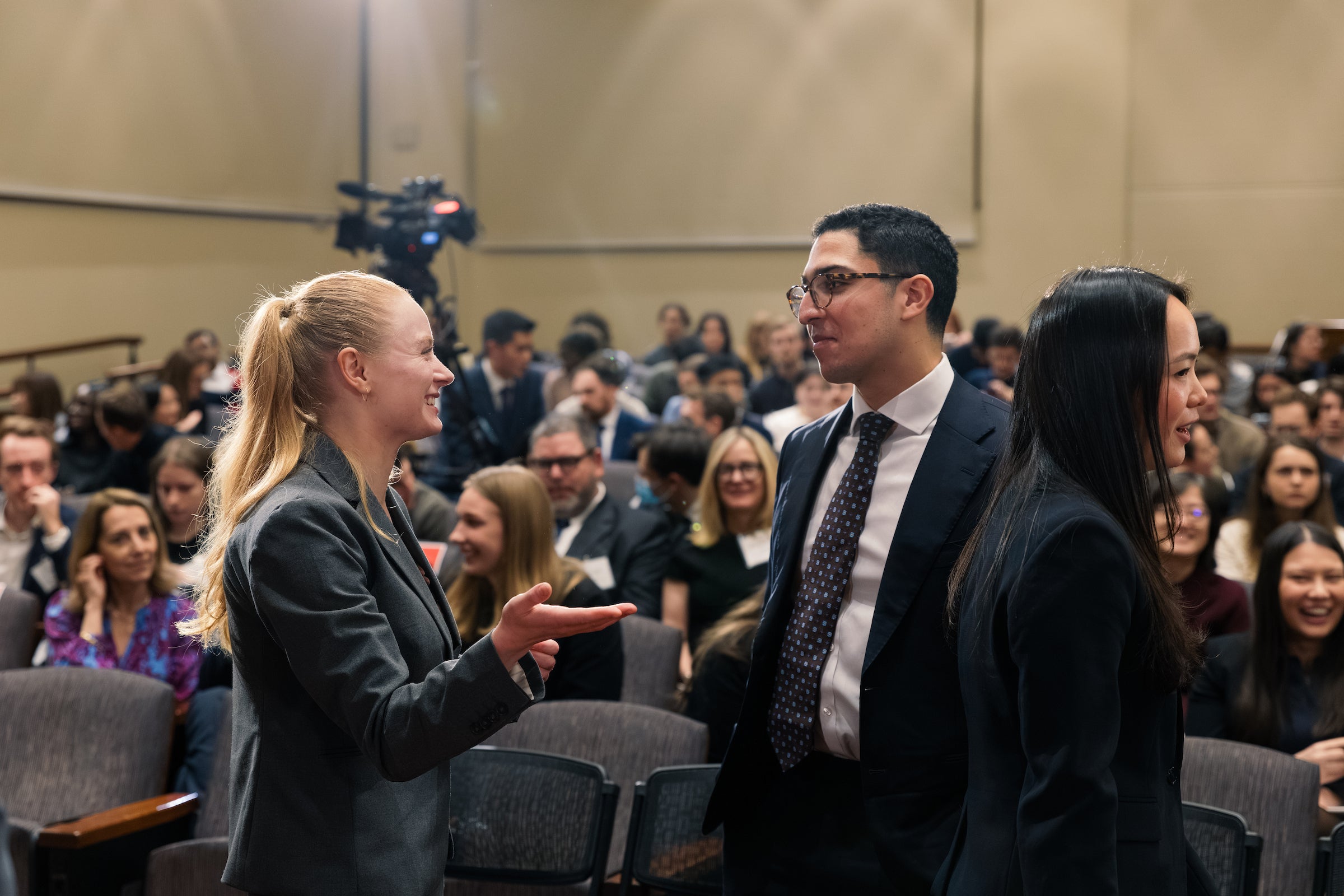
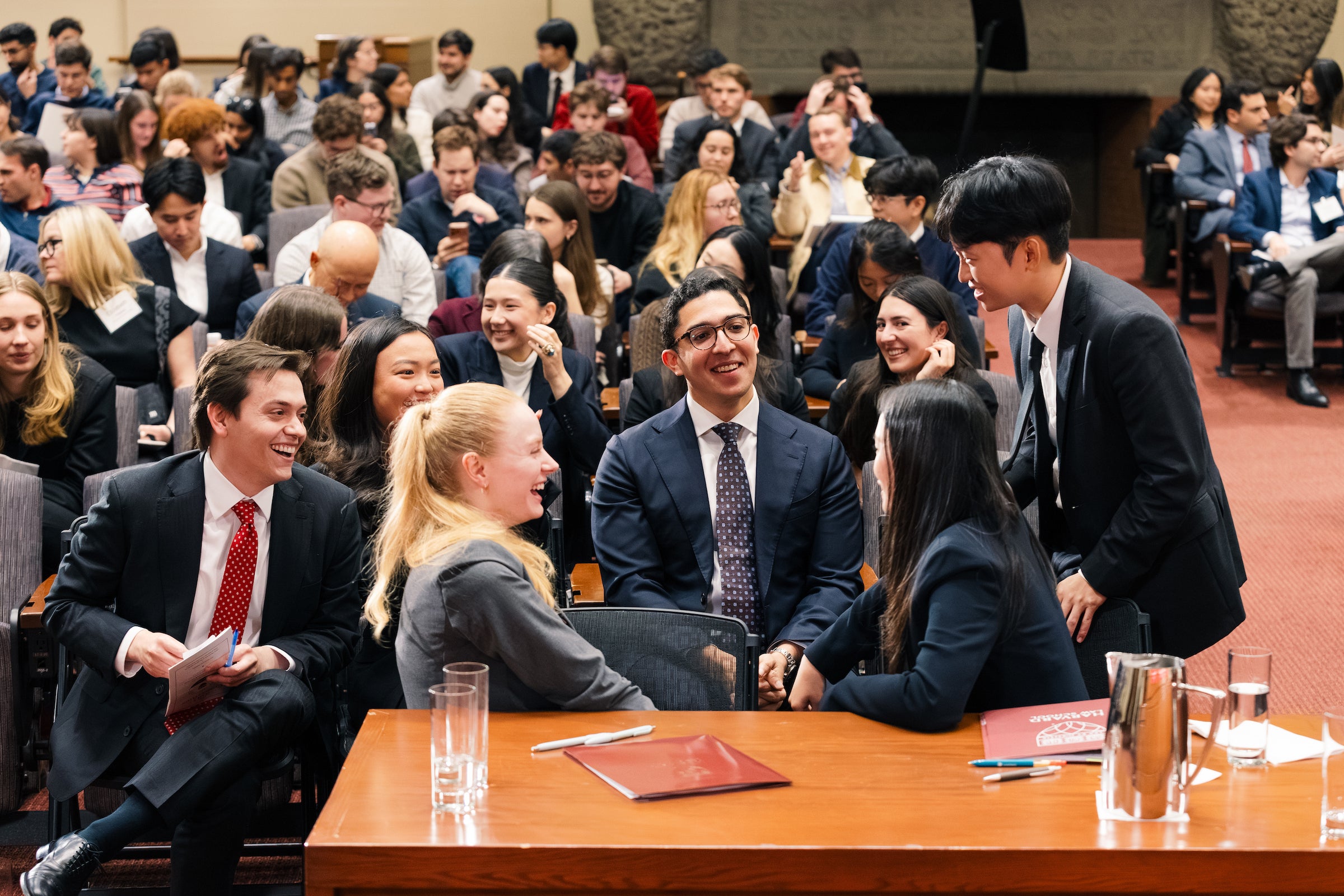
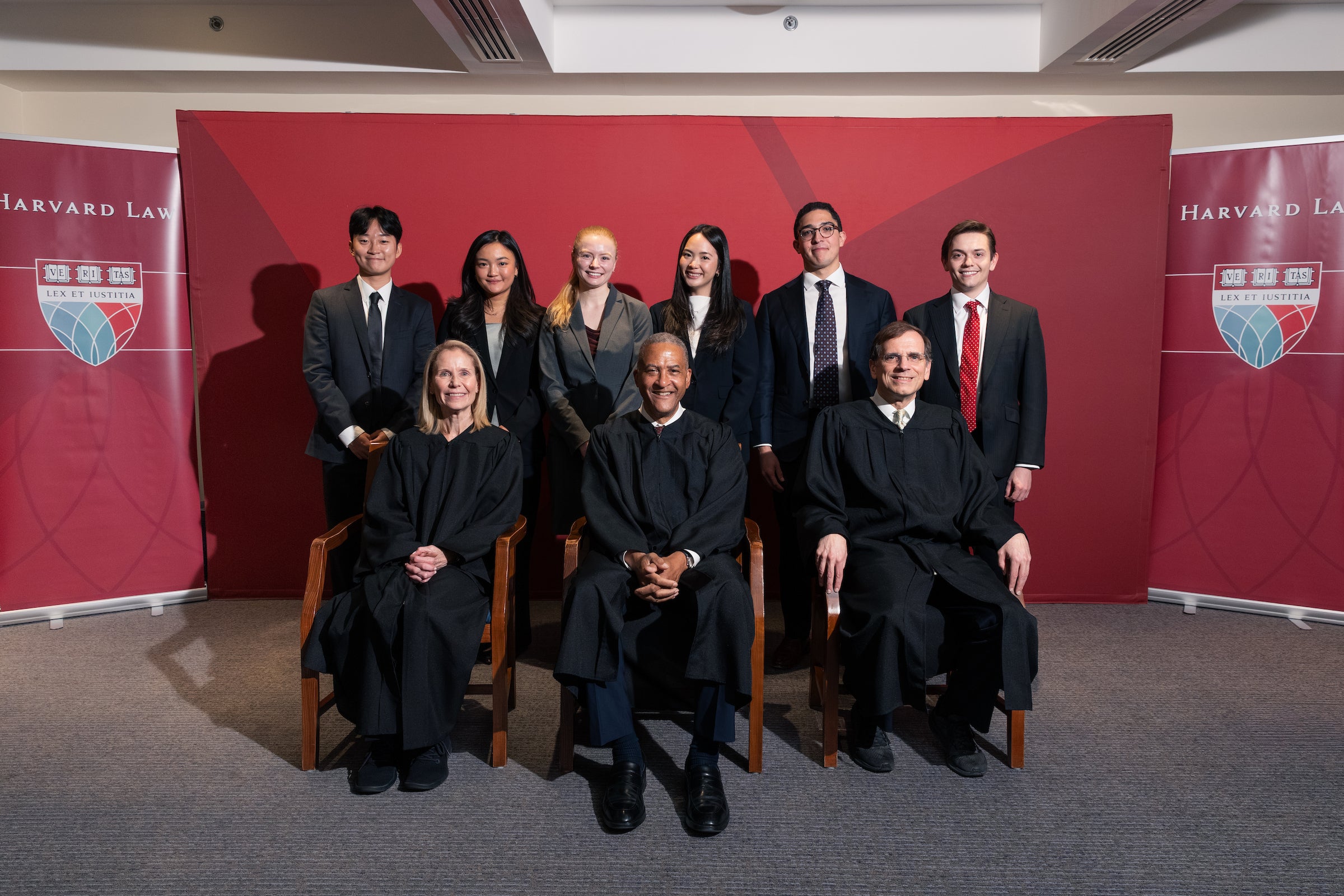
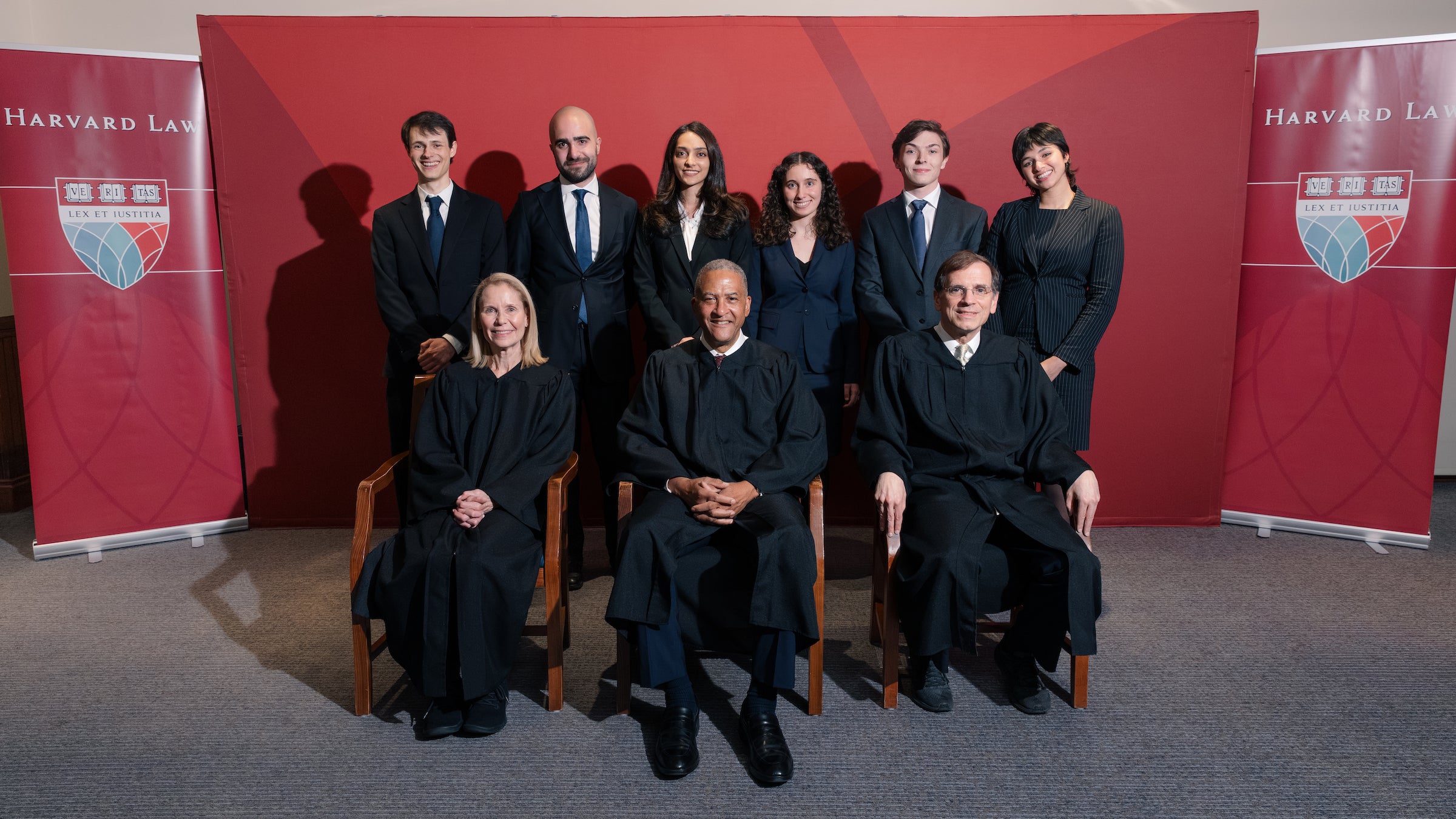
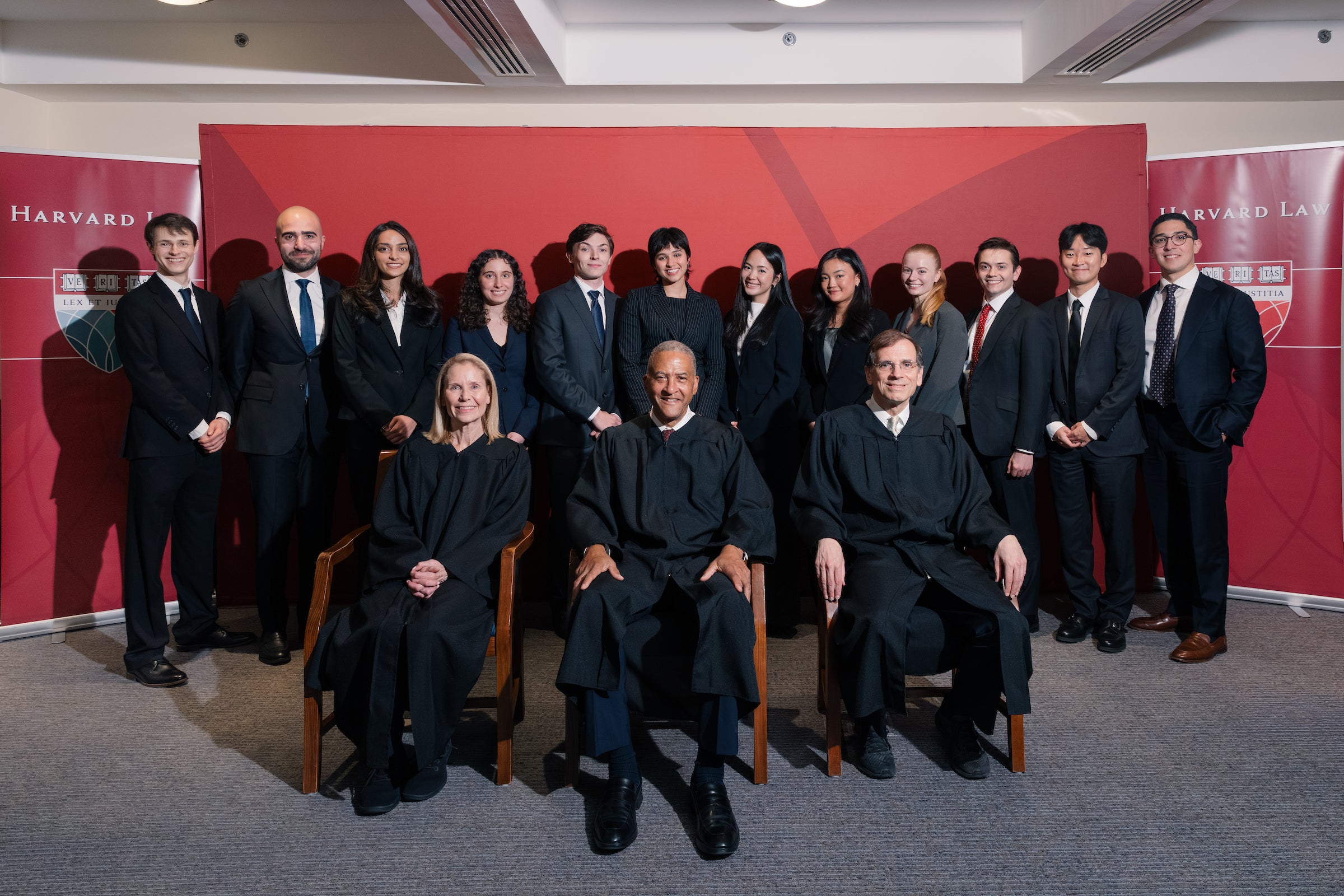
Representing the petitioner, Wodehouse, in his appeal to the mock Supreme Court was the Richard H. Fallon, Jr., Memorial Team, which included Demirkan Coker ’27, Eric Krebs ’27, Ceylan Milor ’27, Brennan Szabo ’27, and oralists Mira Kumar ’27 and Leila Malak ’27.
The fictional City of Ames was represented by the Rev. Dr. Pauli Murray Memorial Team, whose members included Thomas Chang ’27, David Colón ’27, Alex DiMeglio ’27, Serena Zhou ’27, and oralists Kathy Li ’27 and Spencer Thieme ’27.
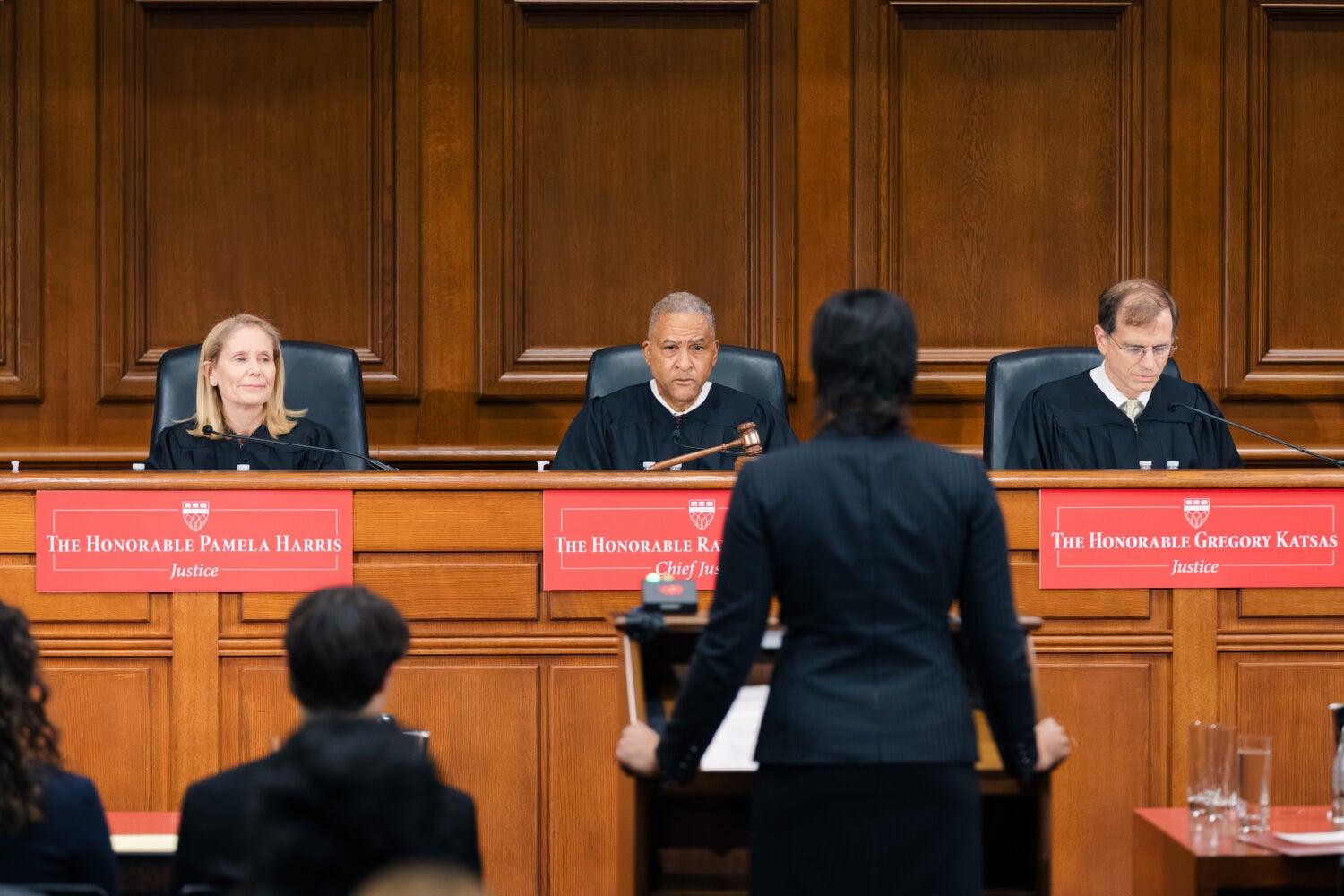
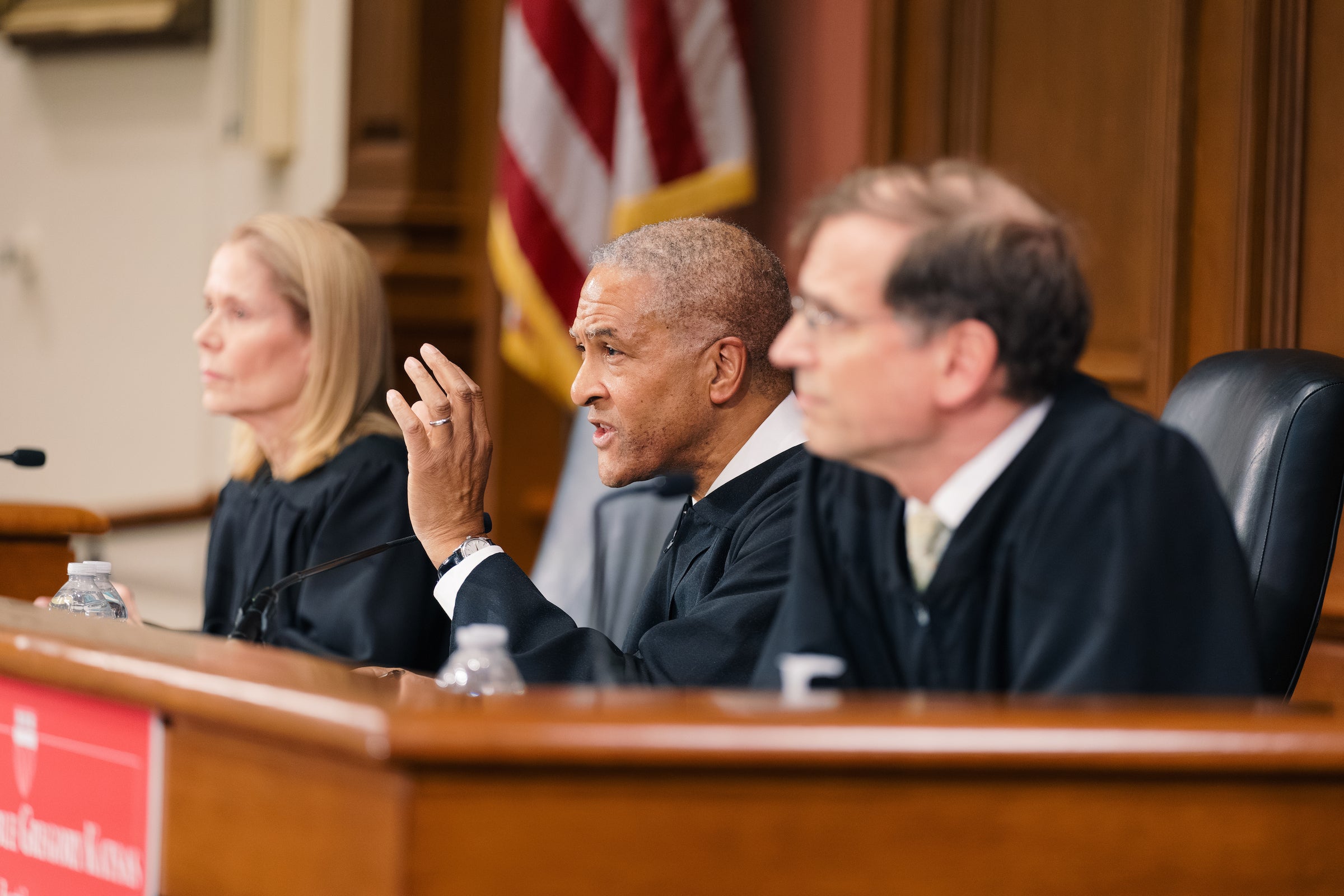
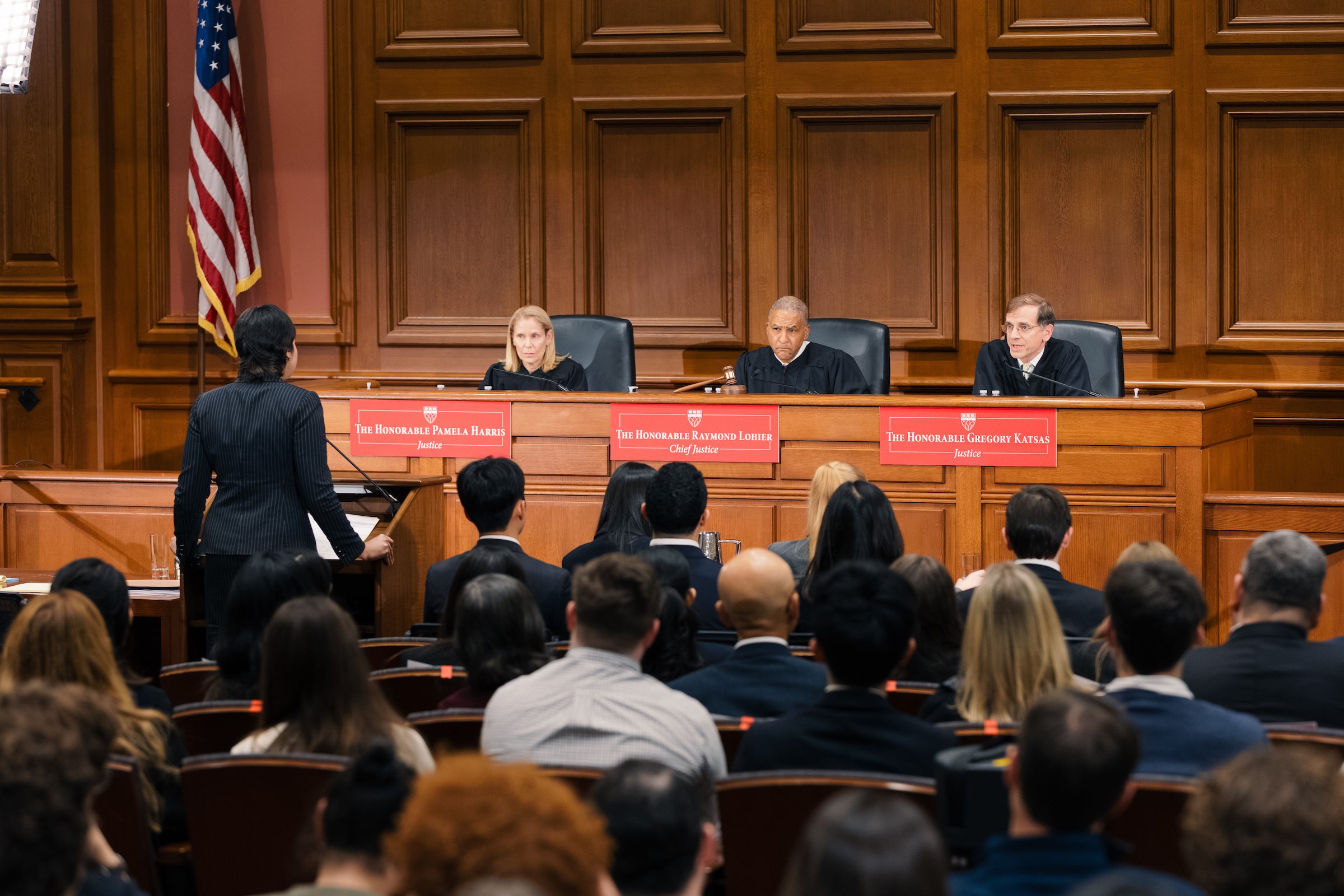
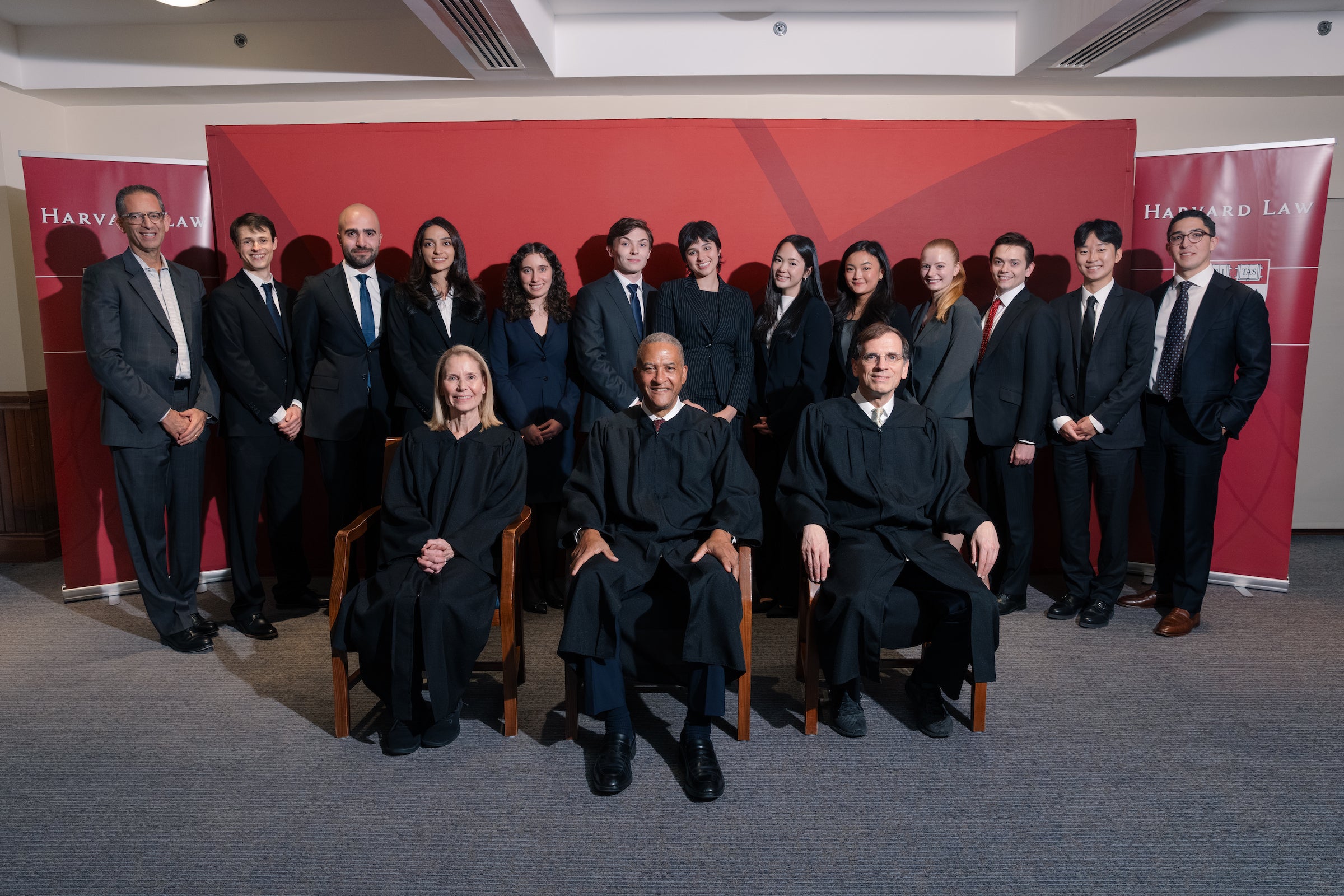
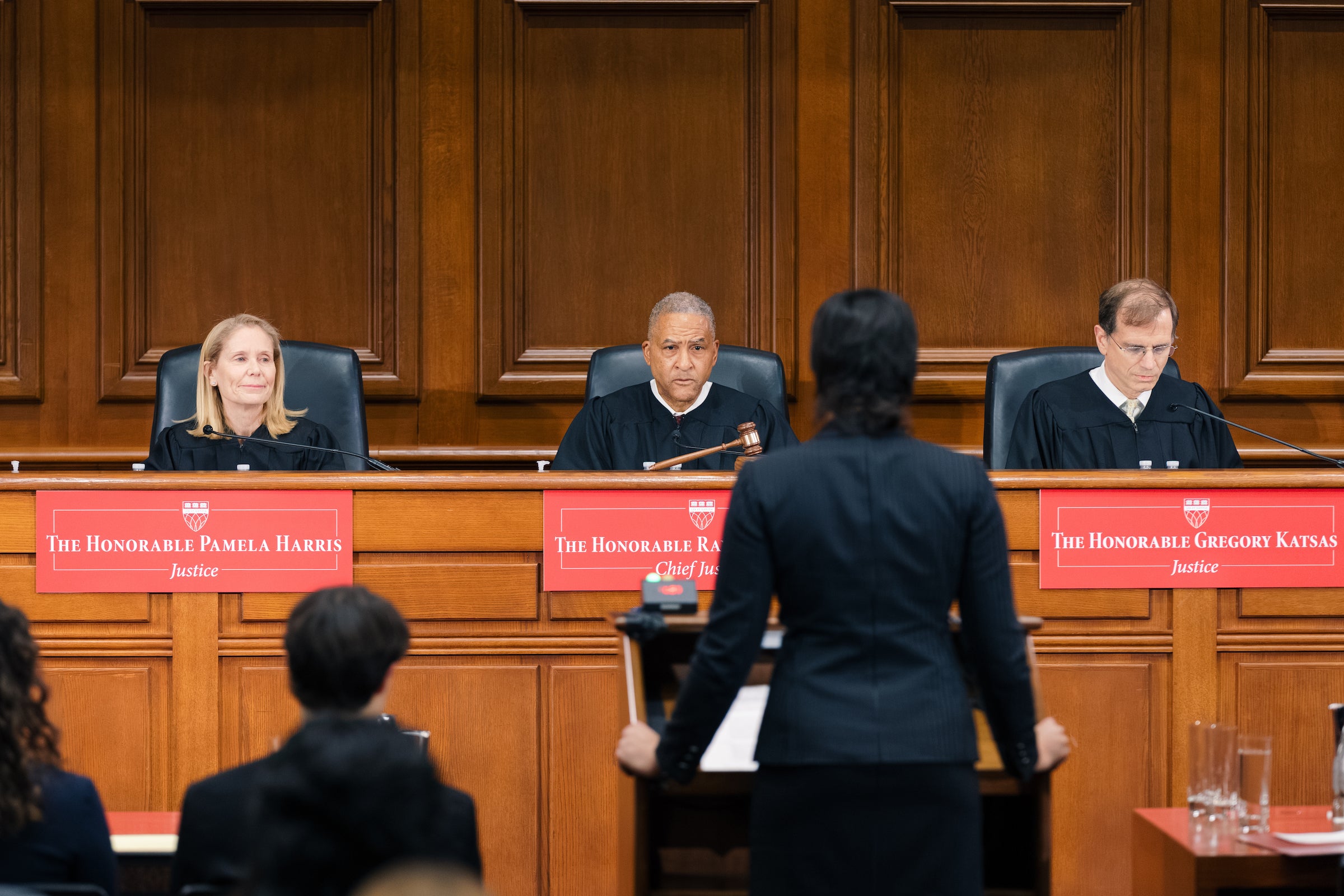
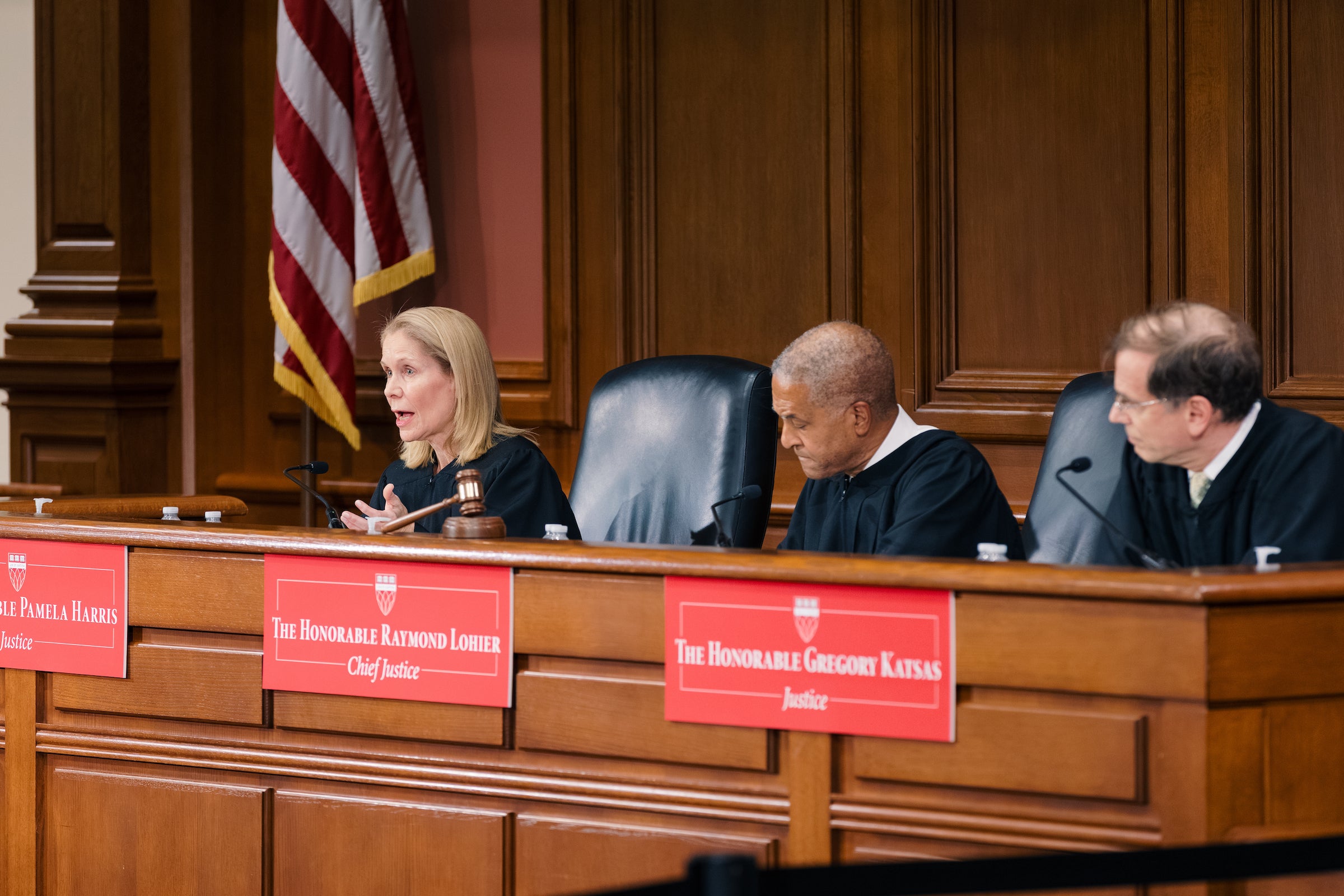
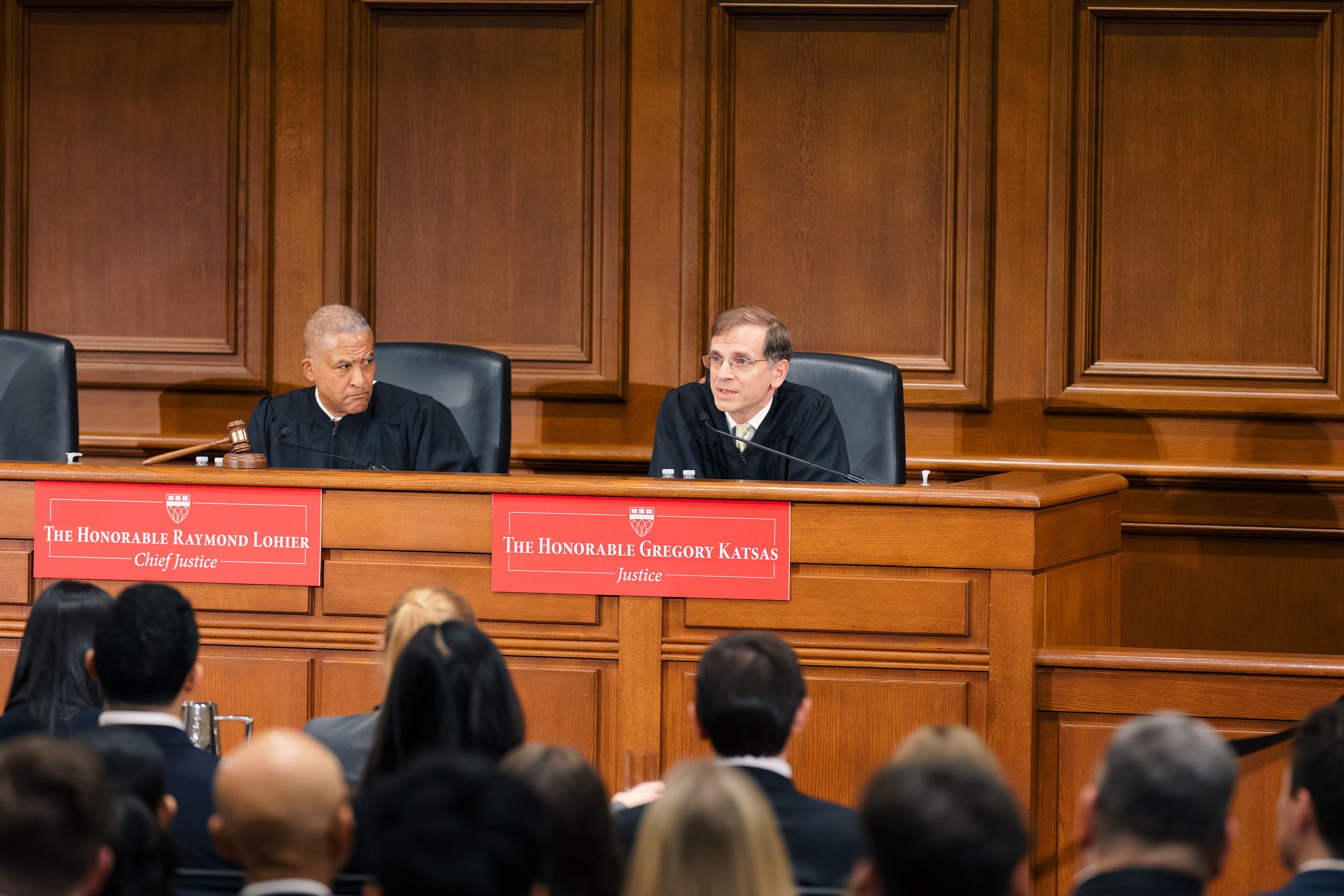
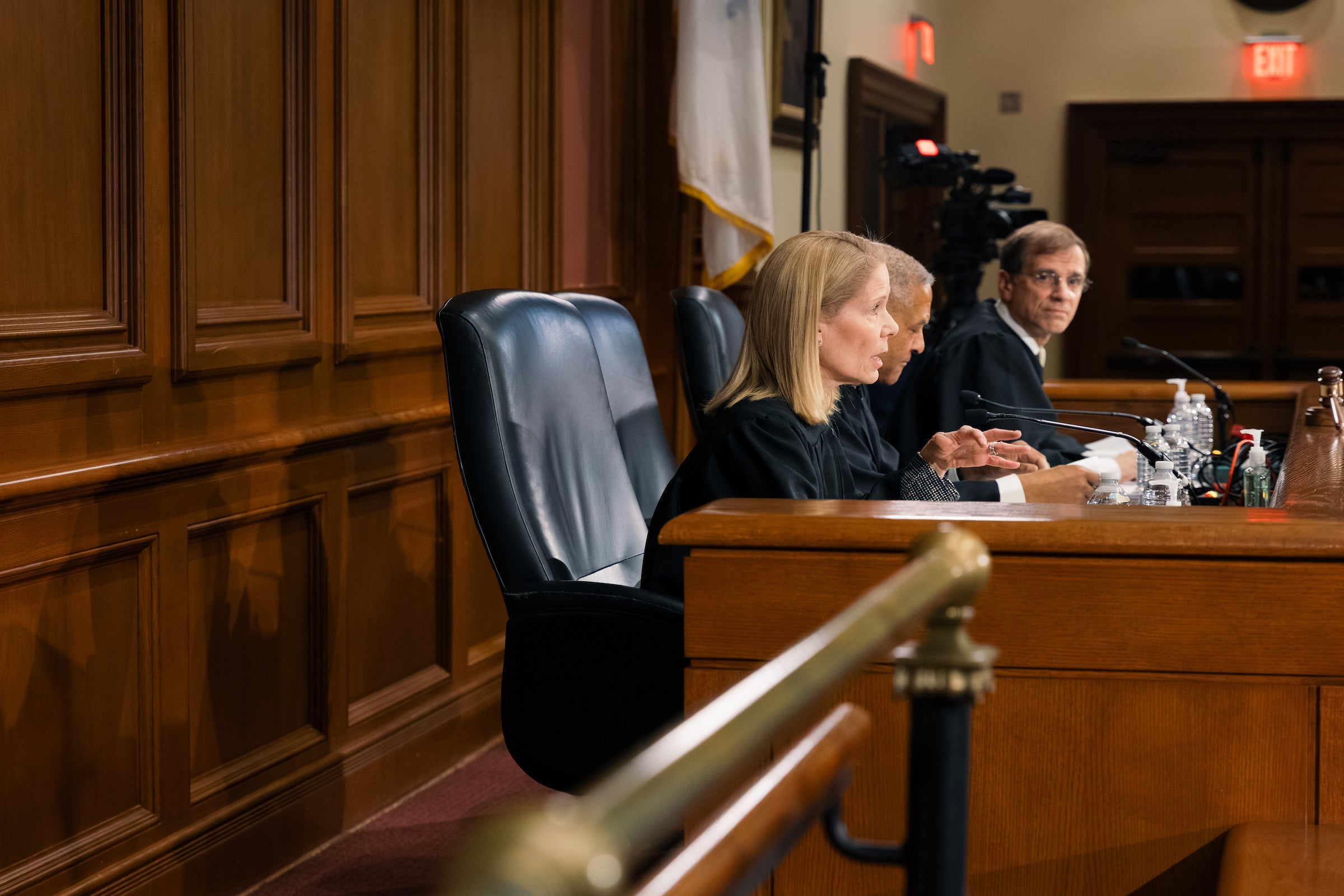
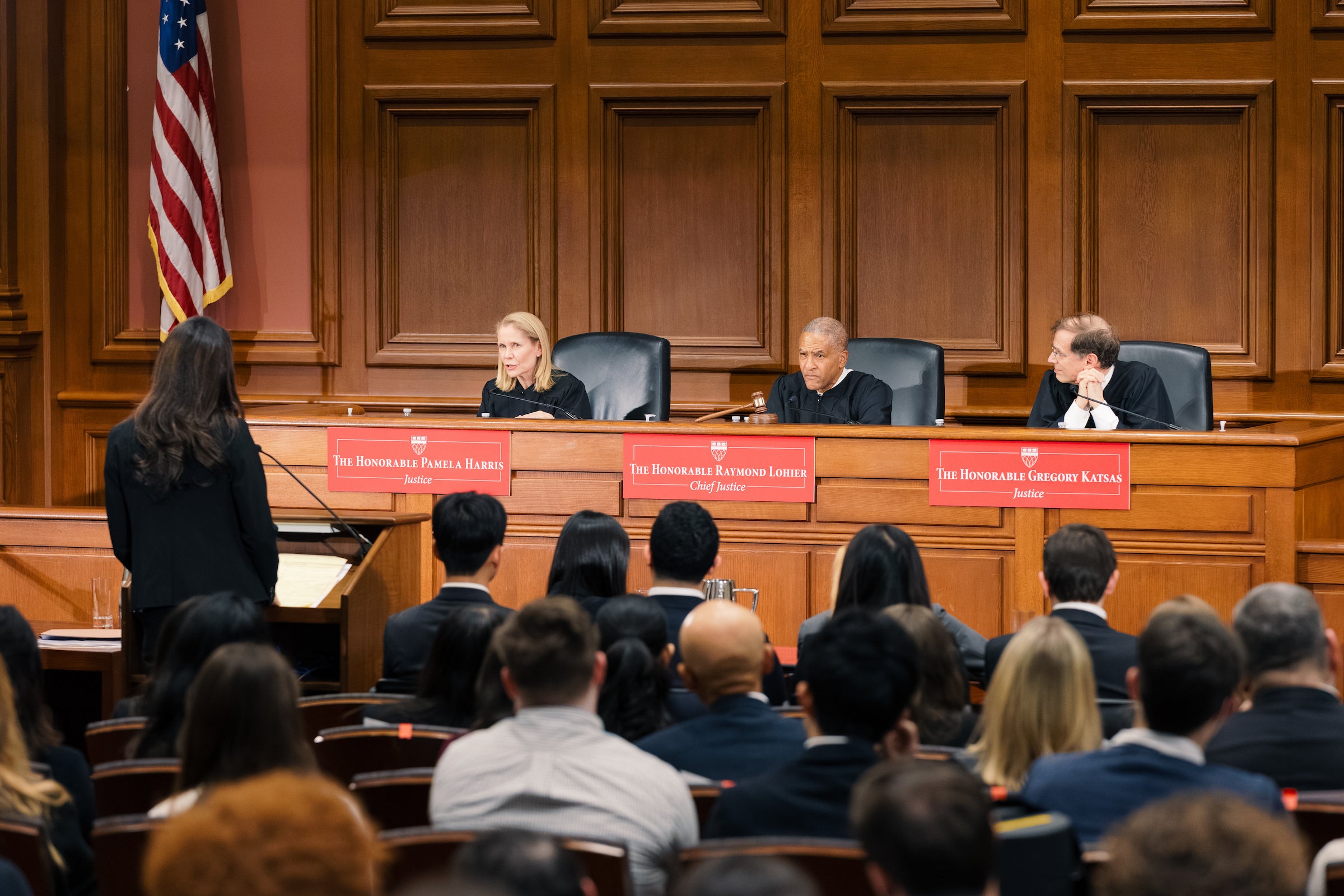
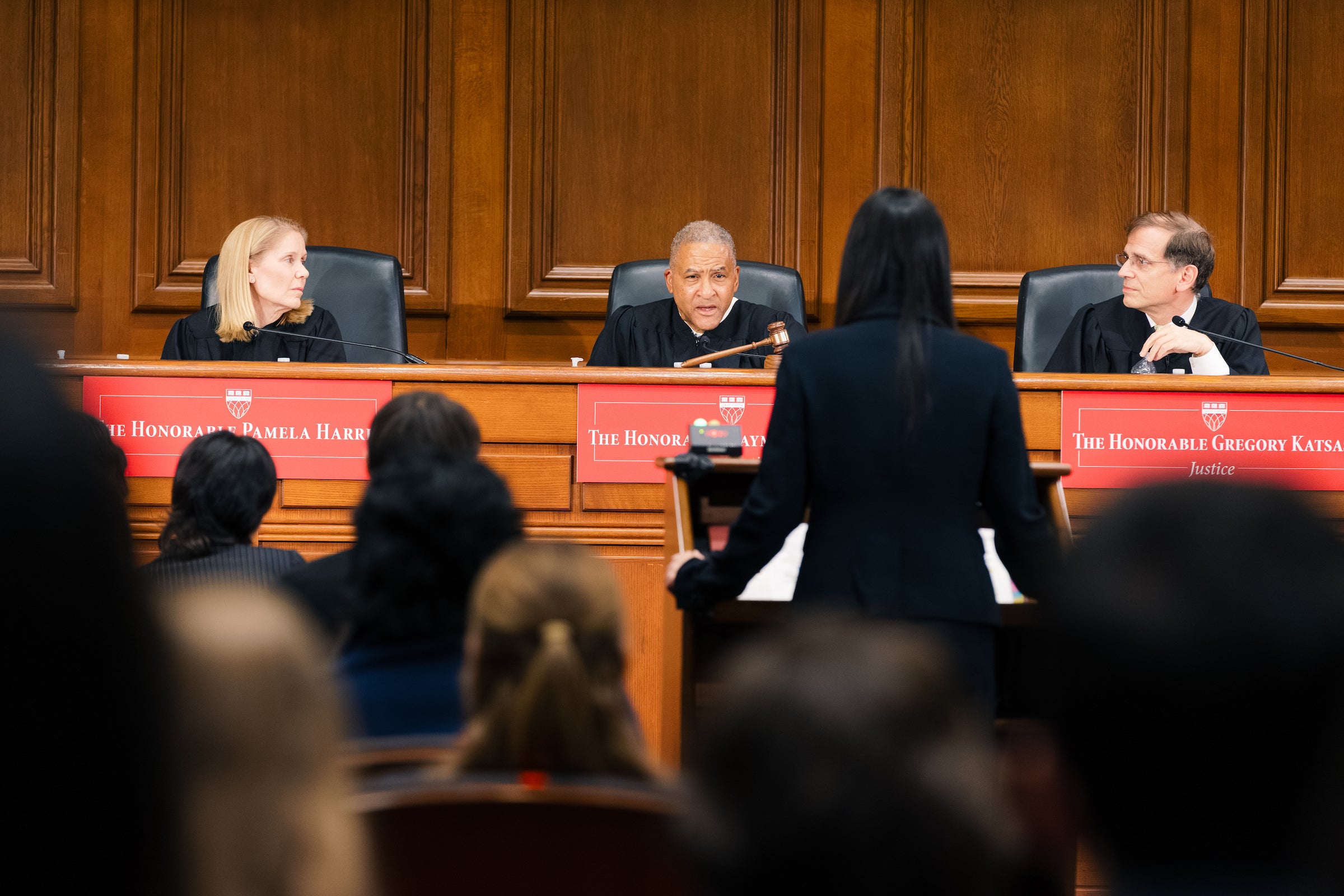
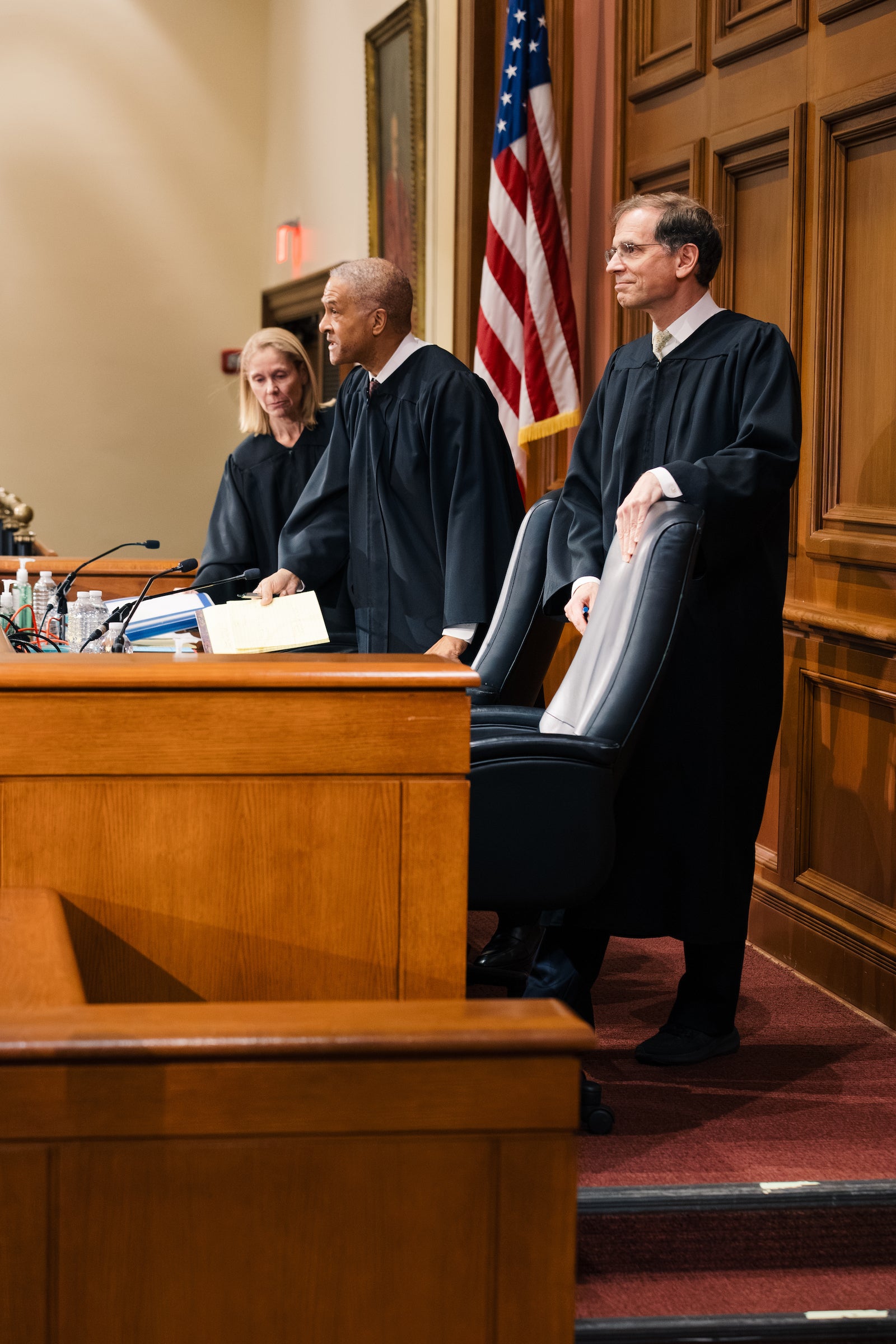
The teams’ oralists faced off before an illustrious panel including Raymond Lohier, chief judge of the United States Court of Appeals for the Second Circuit; Pamela Harris, a judge on the United States Court of Appeals for the Fourth Circuit; and Gregory Katsas ’89, a judge on the United States Court of Appeals for the District of Columbia Circuit.
Petitioners look to the founding
Speaking first on behalf of Wodehouse, Kumar argued that evidence from the 39th Congress, including contemporaneous treatises and newspaper accounts, demonstrates that those who passed and ratified the 14th Amendment intended to apply the Bill of Rights to the states in the same way that the provisions had long bound the federal government. In other words, she argued, the Court should apply the understanding of the right in 1791.
“When the founders ratified the Second Amendment, they preserved their right to keep and bear arms so the people would have it for generations to come,” Kumar said. “The 14th Amendment ensured that no state could violate that same right. So, the State of Ames cannot disarm Mr. Wodehouse by using mid-19th century state restrictions to override the original understanding of the right to bear arms.”
Lohier immediately cut in, asking whether Kumar believed that the Reconstruction Era “provides no evidence, no trail for resolving this particular question” about the 1791 understanding of the right to bear arms.
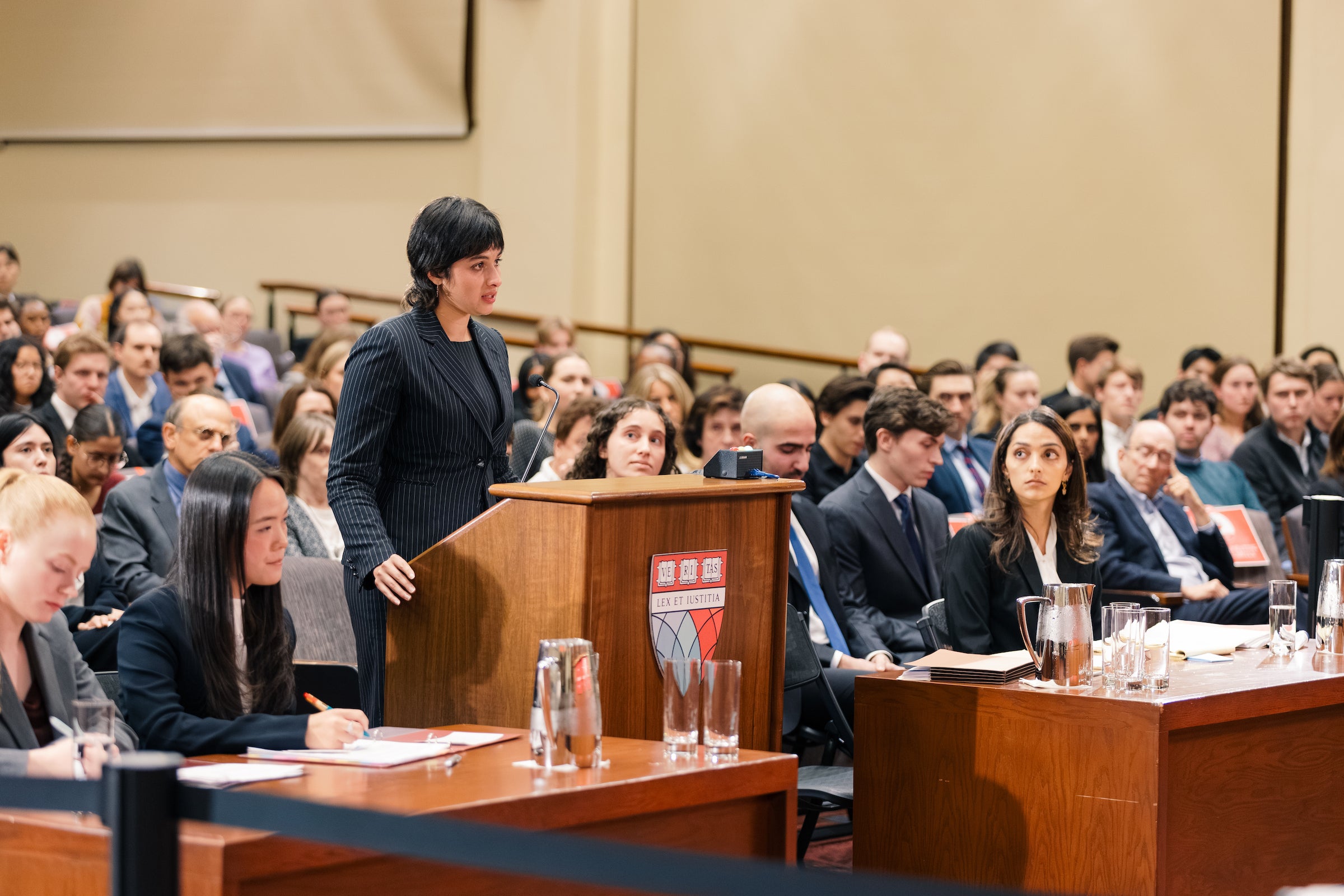
“No, Your Honor, we think it provides this Court with evidence for how to resolve that question,” Kumar replied. “In the decades leading up to the passage of the 14th Amendment, the states had passed laws that contravened the First, Second, and Fourth Amendments, among others. So, the goal was to make the states obey those commands, just like the federal government did.”
Harris was skeptical. “If Bruen instructs us to think about … the principles that underlie this country’s historic tradition of gun regulation, and we have something like the modern public park, which appears to emerge roughly mid-19th century, [is it] not even relevant that those parks were immediately regulated with respect to firearms? It doesn’t bear at all on the question?”
Harris was referring to the Supreme Court’s 2022 decision in New York State Rifle & Pistol Association, Inc. v. Bruen, which held that when the Second Amendment’s plain text covers an individual’s conduct, the government must demonstrate that a firearm regulation is consistent with the nation’s historical tradition of firearm regulation. The Court also reaffirmed that guns may be prohibited in “sensitive places,” such as schools and government buildings. Bruen left unresolved whether 1791 or 1868 should supply the principal historical benchmark.
“Bruen told us that we should be looking at the right that the Second Amendment codified and what the restrictions might be on that right that could be permissible per its public understanding in 1791,” Kumar argued, adding that evidence from the time of the Reconstruction amendments could be used to “confirm [but not] override” that understanding.
Lohier referenced another portion of the Bruen opinion, in which the Court acknowledged that new societal concerns or technologies could require a more nuanced approach, allowing courts to draw analogies to historical regulations when evaluating modern restrictions. Might the emergence after the Bill of Rights was initially adopted of large, landscaped urban parks warrant that more nuanced approach?
“Parks may have gotten bigger, and that could have created some change, but it doesn’t create an unprecedented societal concern,” Kumar replied. “When we look at the law at issue in this case, for example, it’s a law that absolutely could have been passed at the founding.”
Next, Malak contended that the lower courts had erred in not issuing a preliminary injunction against the city, which would have allowed Wodehouse to exercise his right to bear arms while his case proceeded through the courts.
“For years, P.G. Wodehouse lawfully exercised his constitutional right to protect himself and his community at public assemblies in Fairview Park,” Malak said, adding that the Ames law “criminalizes that constitutionally protected activity.”
Lohier broke in, asking whether there were many historical analogues to 1,000-person, permitted events in public parks at the time of the nation’s founding.
“The founding era certainly had crowded events in parks,” Malak replied. “Here, what we’re looking at is whether the founding generation would have expected that at those kinds of events, at those kinds of public crowded gatherings, they would have had their Second Amendment rights constitutionally stripped from them. And the government does not satisfy its burden of identifying founding era evidence that indicates that’s the case.”
Katsas asked Malak to assume that the Reconstruction Era was the relevant benchmark.
“If we’re assessing this by reference to 1868, it seems like there are a lot of park regulations that are even broader than this one,” he continued. “You have Franklin Park in Boston, Central Park in New York, Fairmount Park in Philadelphia, all of the great parks of the leading northeastern cities, and these [gun] ordinances are popping up all over the place.”
“Even if this court chose 1868 as its primary benchmark, [the Ames law] would still be likely unconstitutional under the Bruen test,” Malak argued. “That’s because the vast majority of the laws the government cites — these park laws — came decades after 1868’s ratification of the 14th Amendment.”
Malak also pointed to the Court’s 1876 decision in United States v. Cruikshank, which “explicitly released the states of any obligation to comply with the Second Amendment,” she said. “These laws, coming from a time when the states were not obligated to comply with the individual right to bear arms, are on very, very shaky ground to limit the right today.”
(Following ratification of the 14th Amendment, the Supreme Court gradually applied most protections in the Bill of Rights to state and local governments on a case-by-case basis. It did not recognize the Second Amendment as enforceable against those governments until 2010.)
But can the law account for the difference in degree between a “colonial era person with his musket walking around the park,” Katsas asked, and “someone with an AK-47 in a 10,000-person concert in Central Park” today?
Perhaps the government can use a broader level of generality for its legal analogues when dealing with a “new set of events that couldn’t have occurred at the founding,” Malak conceded.
“But here at the founding, Boston Common was not some latter-day Garden of Eden,” she added. “There were numerous assemblies that occurred in Boston Common around the time of the Revolution, and the founders saw it as necessary to protect those assemblies to encode a right to carry arms.”
Harris asked whether Malak had considered Bruen’s “sensitive places” doctrine, which allows courts to recognize additional locations where firearms may be prohibited by drawing analogies to historical restrictions in places such as schools and government buildings.
“Your Honor, the court can add new places to the sensitive place list, but those places must be new,” Malak said.
The city makes its case
But Li, representing the city, argued that the lower courts had gotten their decisions right.
“The Ames Circuit correctly prioritized Reconstruction Era evidence in this case, and this court should affirm for two independent reasons,” Li contended. “First, focusing on 1868 is the only way to answer the originalist question: How did the people understand the right when they adopted it? And second, at a minimum, 1868 evidence should control in this case because this case implicates the kind of unprecedented societal concern that Bruen says warrants a more nuanced approach to drawing meaning from history.”
But Lohier noted that the 14th Amendment was ratified in part to protect African Americans from the abuses of state governments. Might “stripping these club members, who are not only themselves Black, but focused on protecting Black people as they and others protest against racial inequality … [be] contrary to the spirit of the 14th Amendment”?
Li agreed that the amendment’s purpose was to secure constitutional rights for Black Americans. But its ratifiers didn’t simply “copy and paste the understandings of their ancestors from nearly 100 years ago,” she argued.
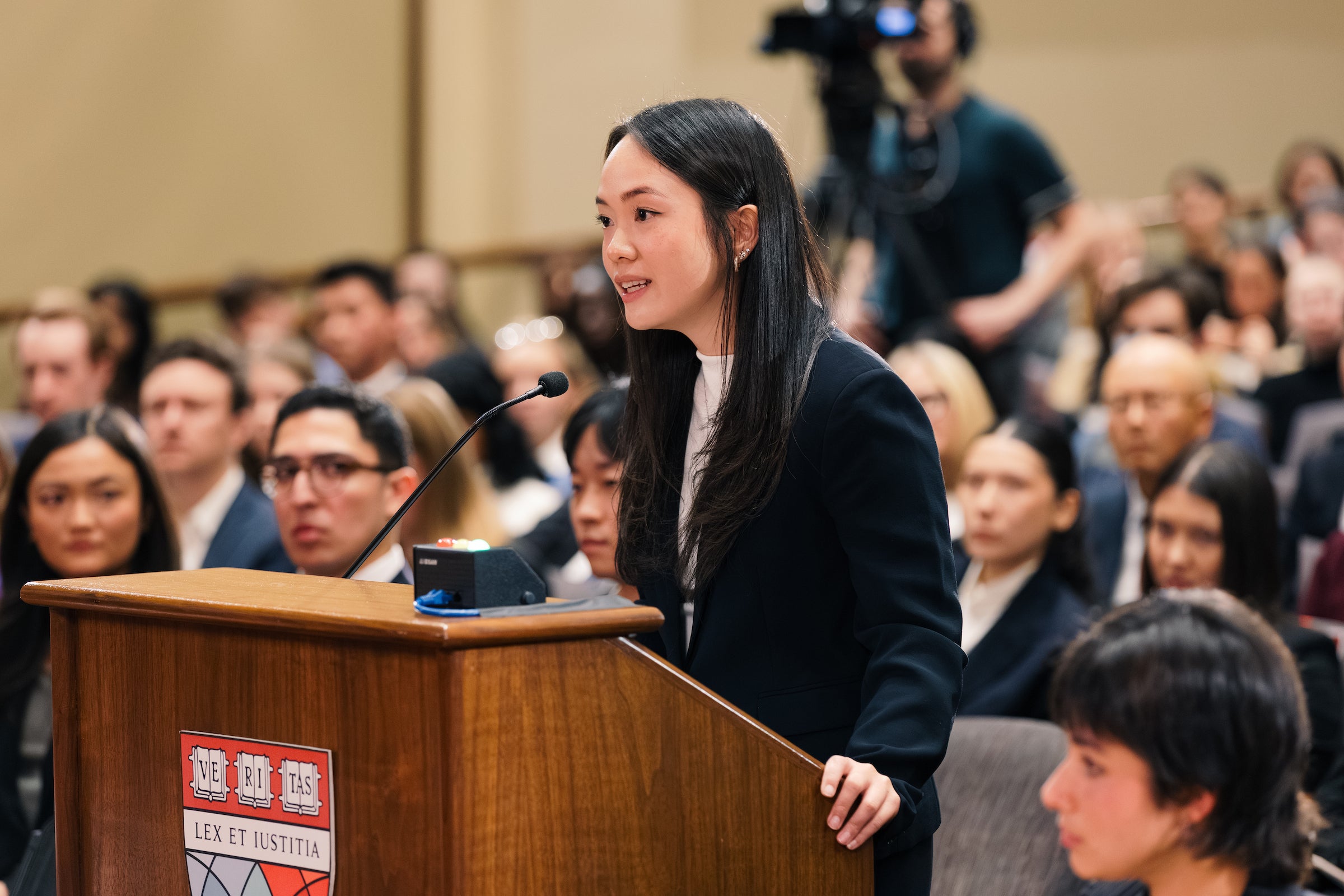
“They understood that Black Americans needed an individual constitutional right to bear arms because Black Americans faced a particularly acute threat of private aggression from Klansmen and from Confederate sympathizers that could be lurking on the other side of the door,” Li said. But the public “also understood that an arms-bearing citizenry does pose some serious risks.”
One such risk, she added, was the danger guns posed to civic life in the Reconstruction Era South. “I think that’s why we see a host of sensitive place type regulations proliferating during the mid- to late-19th century. I think the sensitive places jurisprudence that this court has recognized is a great example of the balance the people struck in 1868.”
Katsas pushed back, noting that prior Court opinions have confirmed that a “Bill of Rights provision either is incorporated or it’s not, and if it’s incorporated, it applies with the same scope and force to the states as it does to the federal government.”
Would that mean that for the respondent to prevail, the “14th Amendment narrows the scope of the right as to the federal government” as well, Katsas asked?
Li agreed that the question in the case is “which single historical benchmark against both sovereigns makes the most sense, and to what extent?”
But she disputed the suggestion that her position “necessarily narrows the right” to bear arms.
“We believe that the 14th Amendment, when it was adopted by the 1868 public, that public had its own substantive understanding of the right,” she said. “Now, to the extent that this court is hesitant to apply an 1868 benchmark against the federal government, you would have to weigh that against the deep problems that come with applying a 1791 benchmark against the states.”
Harris asked whether Li’s argument would change if large public parks had emerged at a different point in history.
“Our argument about the unprecedented societal concern is operating under the assumption that even if this court didn’t resolve the ultimate benchmark question today, and that 1868 isn’t the benchmark in all cases, at least when you have a case like this that implicates an unprecedented societal concern, Bruen says there needs to be a more nuanced approach to drawing meaning from history,” Li replied.
Li’s teammate, Thieme, then faced the judges, arguing that the lower court had properly denied Wodehouse’s request for a preliminary injunction.
“First, he’s unlikely to succeed on the merits because two independent historic regulatory traditions support the constitutionality of [the Ames law],” Thieme argued. “Second, he’s unlikely to be harmed in the interim, preceding a merits decision. Third, the public interest, and fourth, the balance of the equities, all weigh against issuing interim relief here.”
Referring again to the “sensitive places” doctrine under Bruen, Harris wondered how Thieme justified adding parks to the existing list. “How do you analogize a park to a polling place or a government building or courthouse?”
“It might be difficult to analogize a park to that, but I think it could be very fair to analogize a permitted event happening in a park to that,” Thieme argued. “We can think of the fact that these permitted events are where individuals are exercising their First Amendment rights. They’re places that the government is providing its own security at, providing policing at, and I don’t think there’s much that makes it all that different than a general government building.”
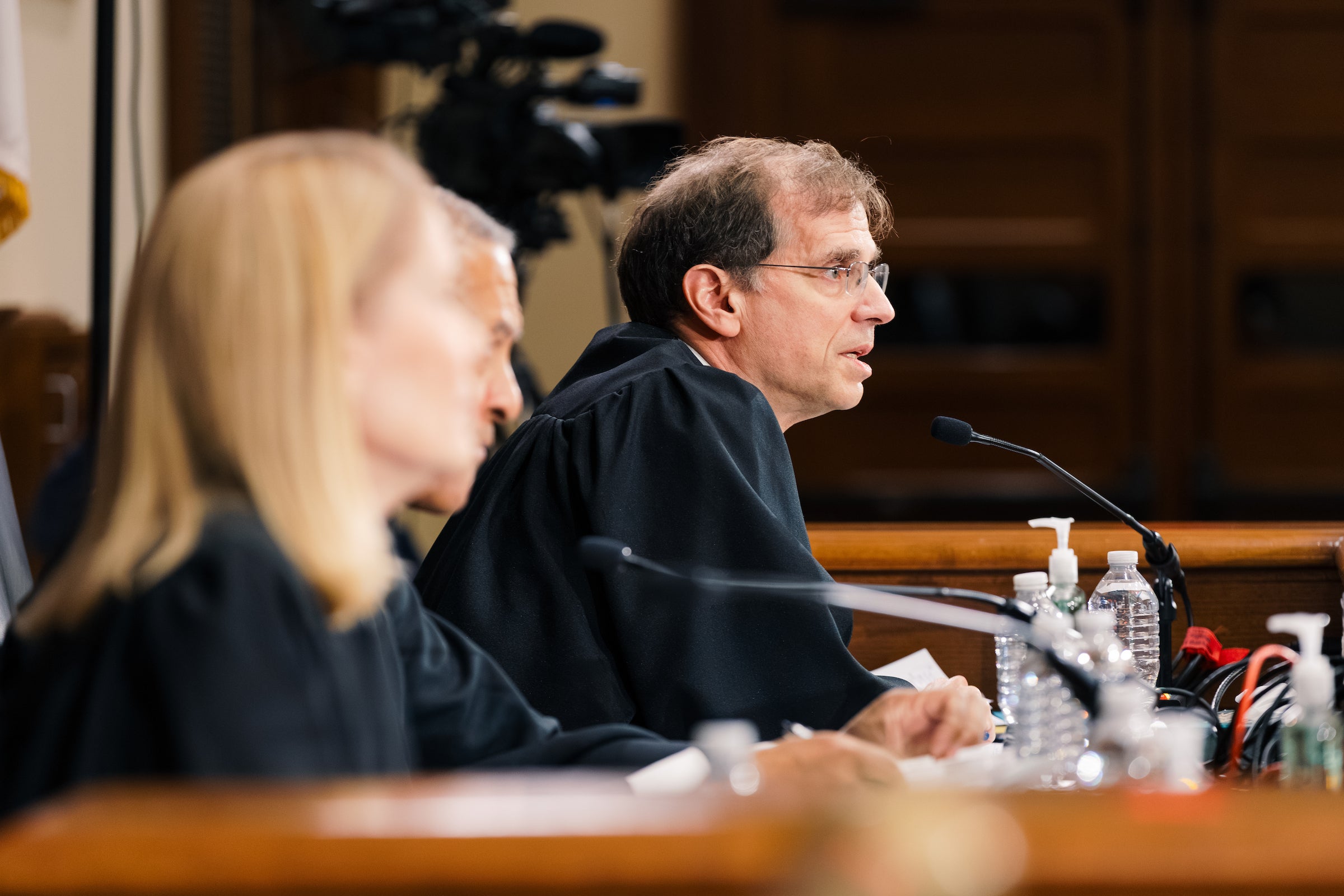
“This is starting to look a little gerrymandered, to pick up what you want to pick up and exclude what you want to exclude,” Katsas interjected. “What is the relevance for Second Amendment purposes of the fact that one can think of the events [in the park] as [implicating the] First Amendment … as opposed to a concert?”
The Court hasn’t fully articulated much about what it means to be a “sensitive place,” Thieme replied. But what it has said, she argued, implies an “important civic function is happening in those places, there’s state-provided security, and there’s a heightened risk of the threats that a firearm could pose there and we think that this is consistent with that.”
Katsas pointed out that in the respondents’ written brief, they had discussed the modern city park as a “respite from urbanization” and a place for civic life to flourish.
“What is the relevance of any of that to the Second Amendment inquiry? And if that’s how you distinguish Central Park from Boston Common, you’re on thin ice,” Katsas said.
But Thieme argued that the brief’s account of the country’s changing physical landscape supported a “more nuanced approach” to historical evidence. After all, she added, “There were cattle grazing on the Boston Common until the mid-1800s.”
Katsas had one more question for Thieme about the injunction itself. “It’s often said that loss of First Amendment rights for even a very small amount of time is an irreparable injury. Wouldn’t we be making the Second Amendment a second-class right if we didn’t apply the same principle here?” he asked.
Referring to First Amendment doctrine, Thieme said the Court has made “clear that that harm has to actually be likely, not mere[ly] possible.”
Wodehouse hadn’t specified any event he wanted to attend at which he couldn’t carry his firearm, she said. “It’s not clear that such an event is going to happen before a final merits decision, and so it wouldn’t make sense to issue a preliminary injunction if there’s nothing to enjoin.”
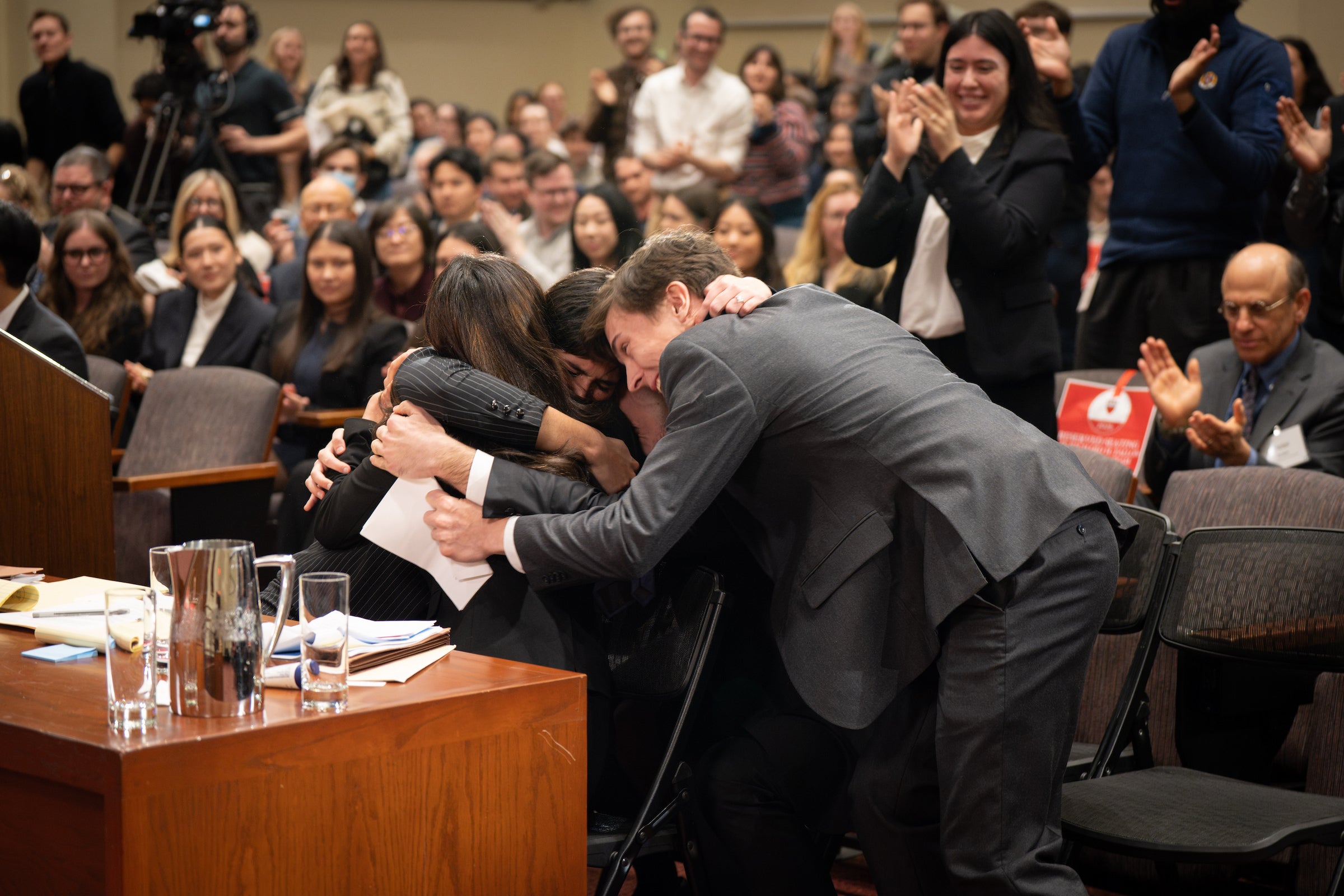
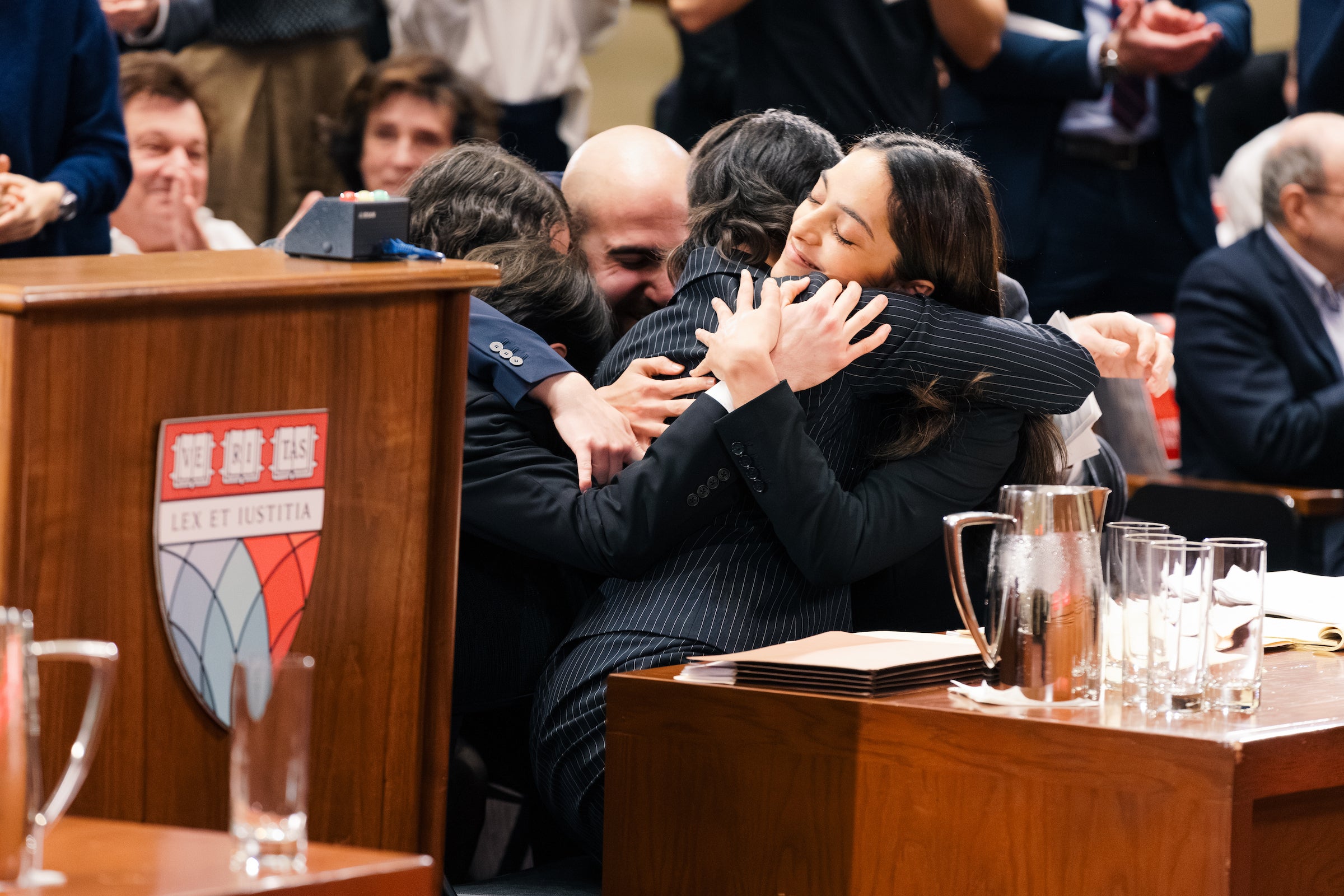
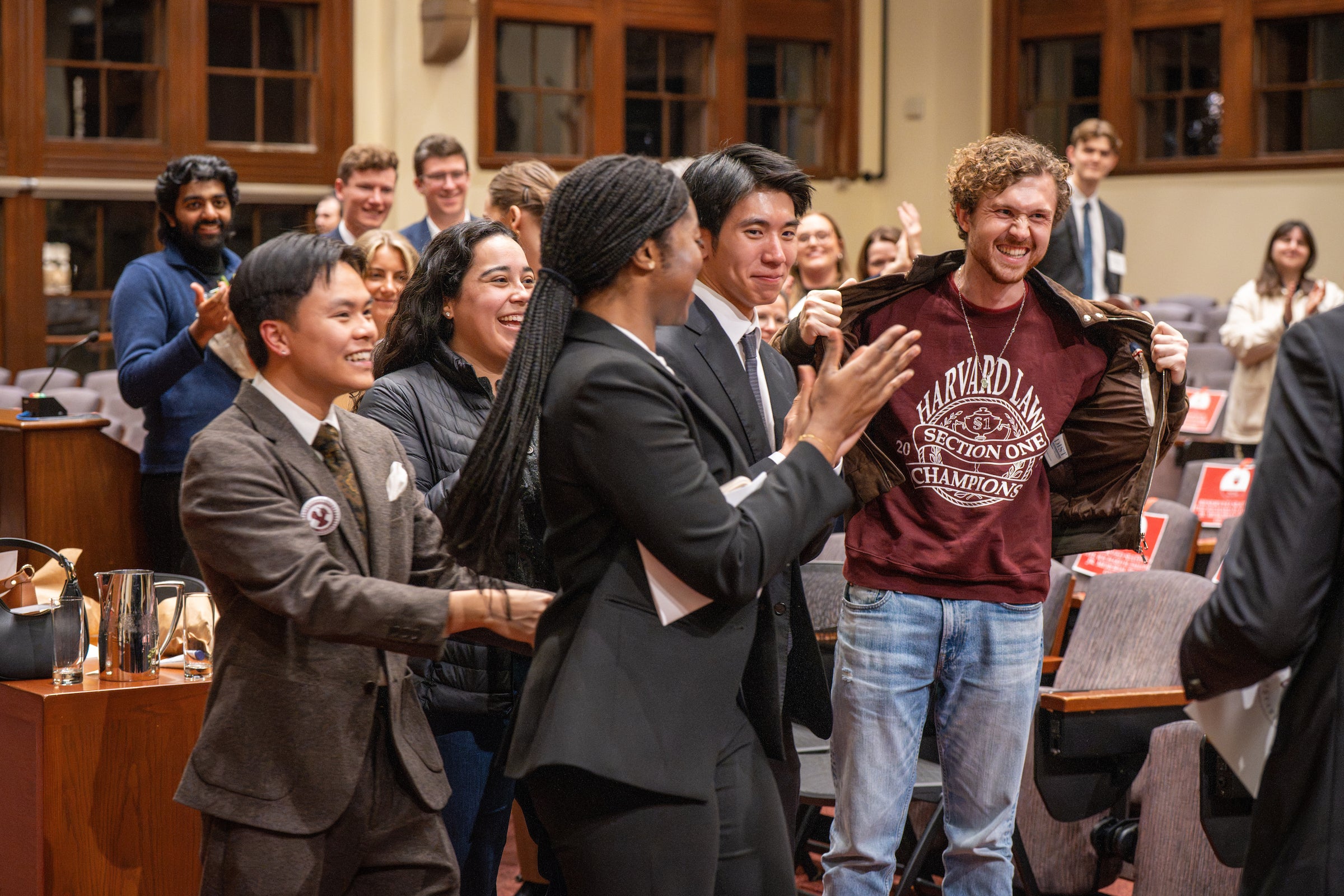
Crowning the winners
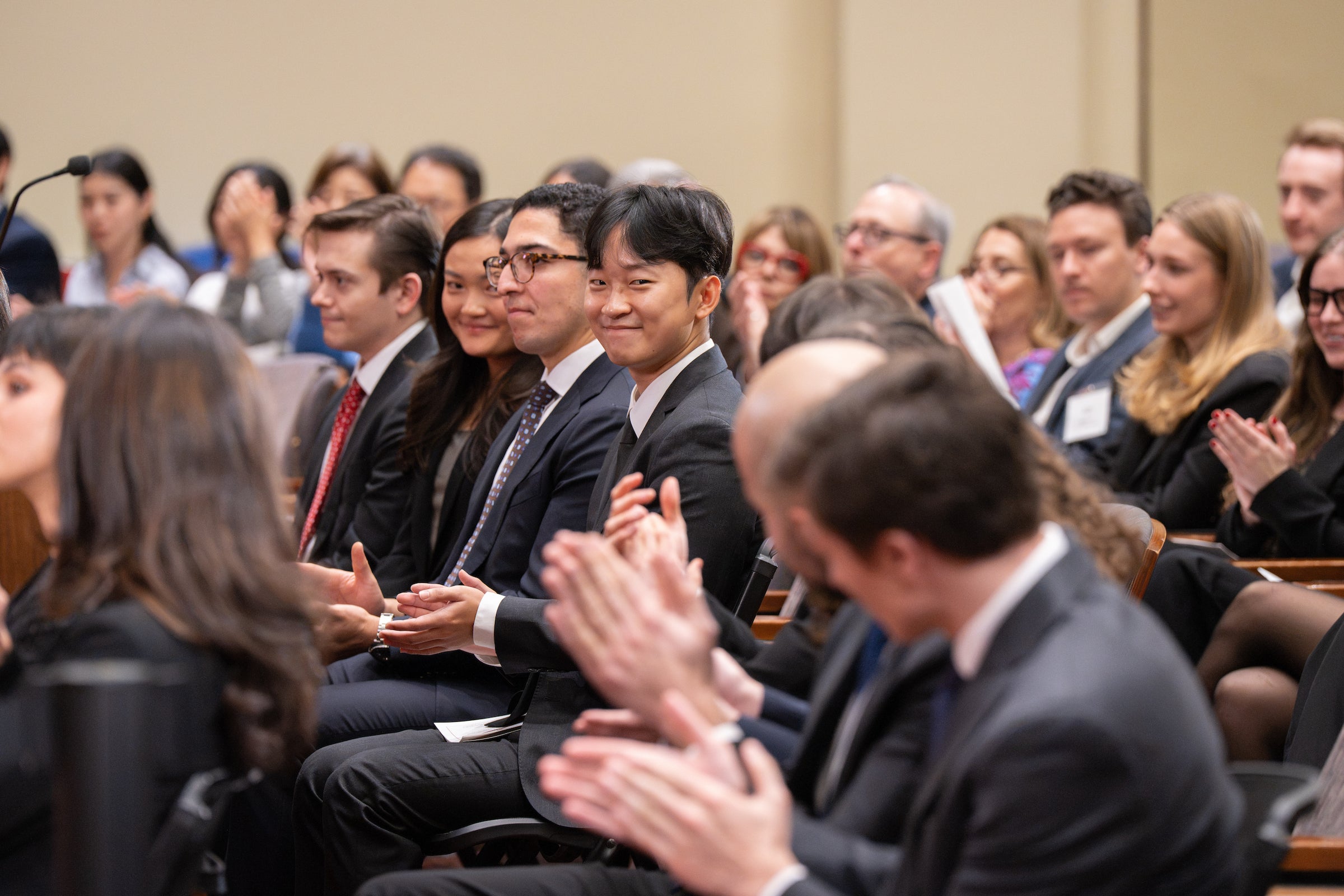
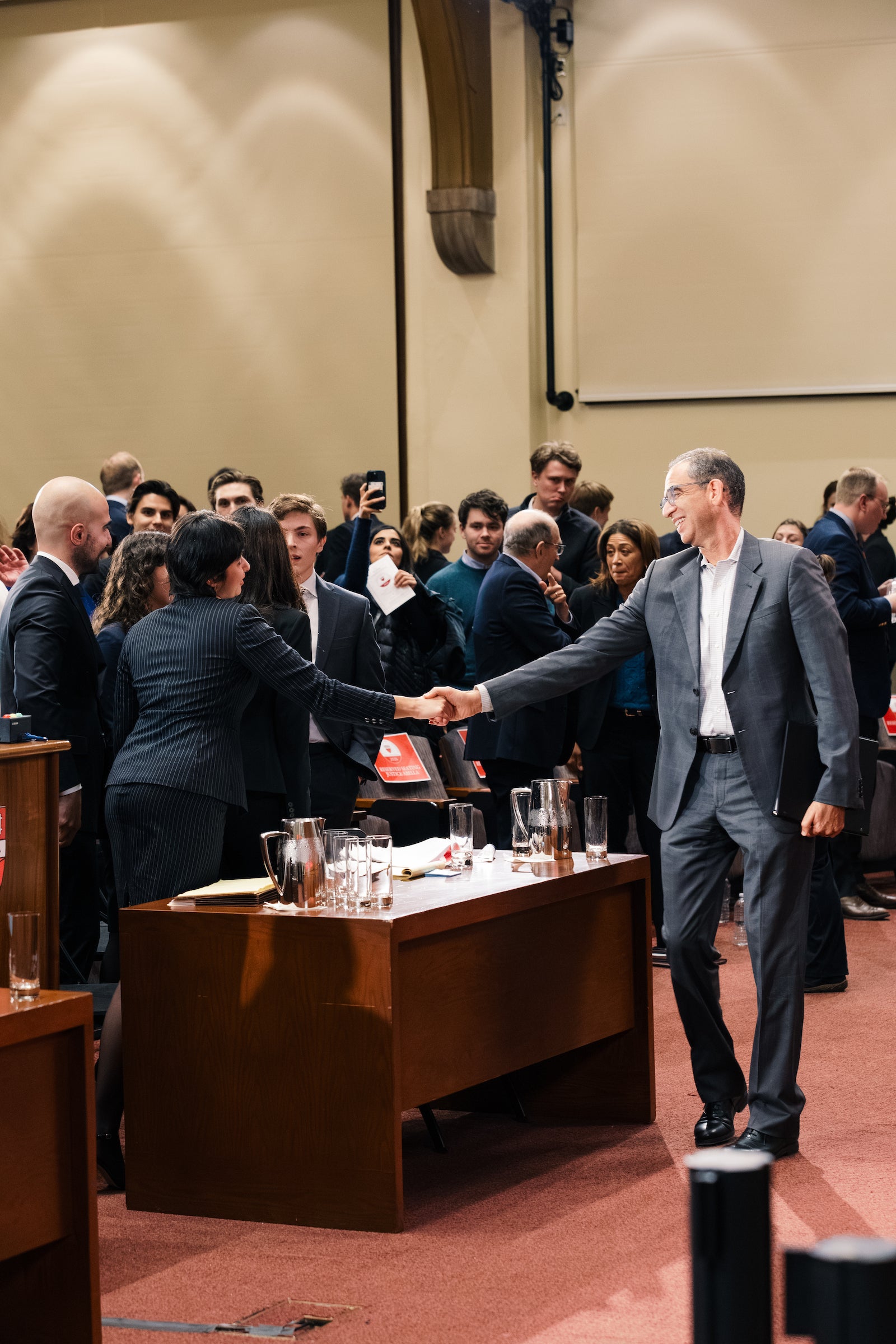
After both sides rested, the judges retired to deliberate. When they returned, Lohier commended the “wonderful, wonderful, wonderful advocates for their exceptional oral arguments.”
“It makes me extremely hopeful about our profession,” he added.
Harris, who said that she finds Bruen questions “really hard” to adjudicate, praised both teams for their written and oral advocacy. “You’re all so good that we didn’t have to be nervous that we’re going to push you too hard,” she added.
Katsas also applauded the advocates on both sides. “I was an appellate litigator before I went on the bench. I did a lot of arguments in my day. I wish I were as good as you all when I was in law school, and I wish I were as good as you all when I went on the bench.”
But while the quality of the advocacy made “our job as judges very hard,” Katsas added, it was time to name the winners.
The panel awarded best brief to the respondents, the Rev. Dr. Pauli Murray Memorial Team.
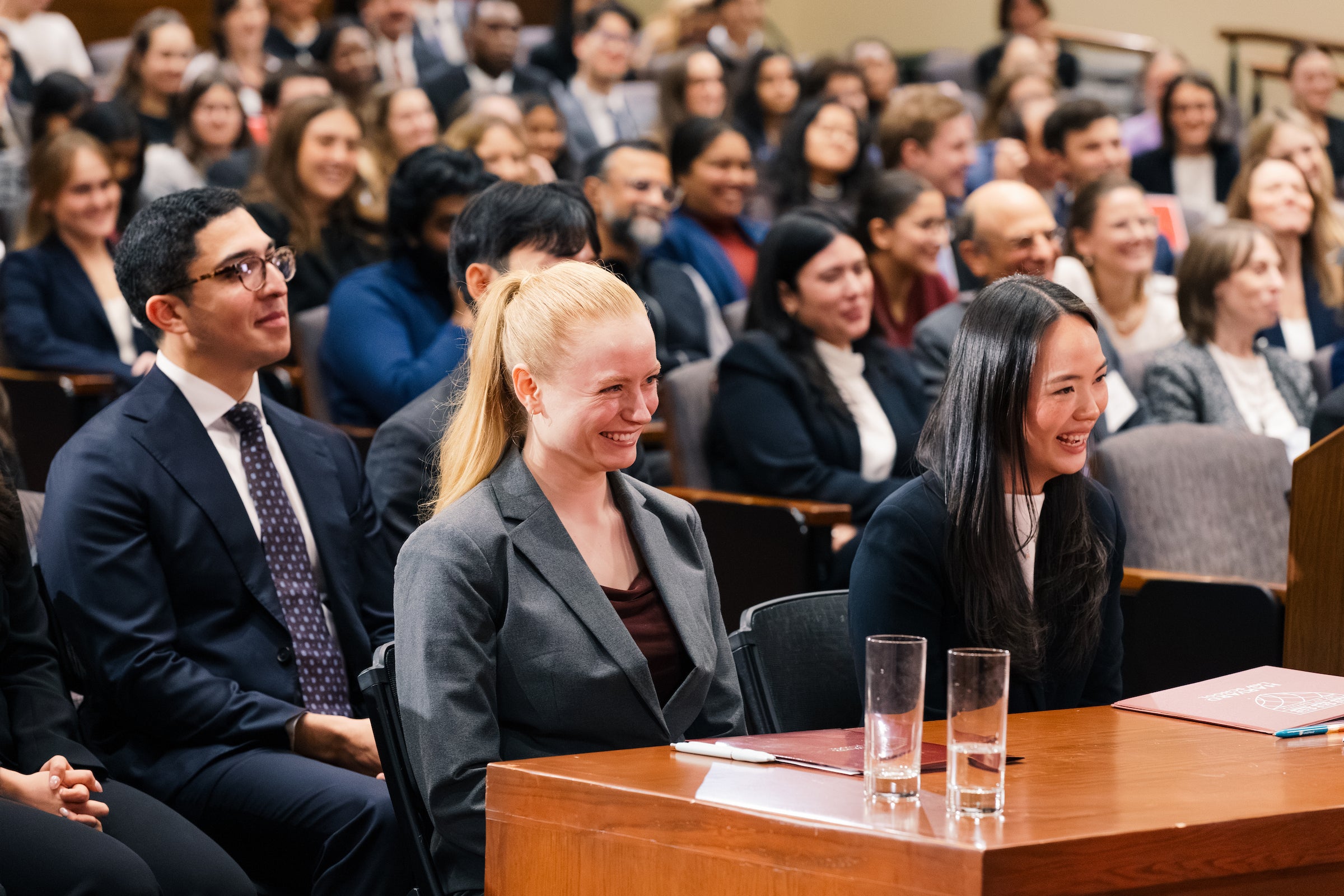
“The Rev. Dr. Pauli Murray Memorial team has a unique approach to brief-writing, one we call democracy. All six members of the Ames team gather around a television screen, onto which the brief is projected. We then read, debate, and vote on every single word. No comma makes its way into the brief without the approval of all six. The brief was, in the truest sense, a collective undertaking: six minds, six voices, and not a single word that belonged to only one of us,” Chang told Harvard Law Today. “Excruciating? Undoubtedly. Effective? Apparently so. We were incredibly grateful to see our collective efforts recognized with the Best Brief award. But we will remember most fondly the spirit of teamwork, charity, and excellence that defined our time working together. In many ways, the experience brought to life something Rev. Dr. Pauli Murray once observed: ‘What is often called exceptional ability is nothing more than persistent endeavor.’”
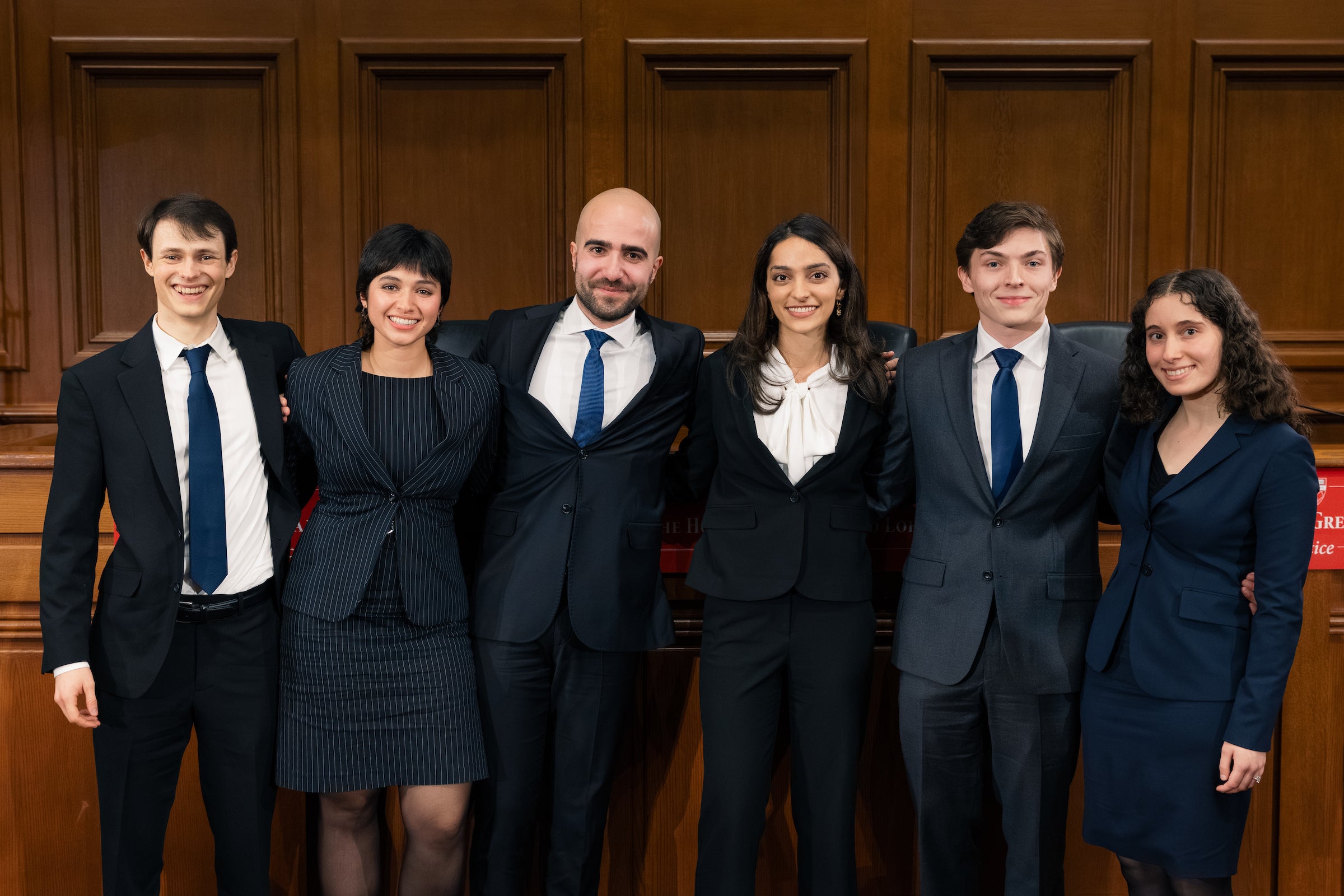
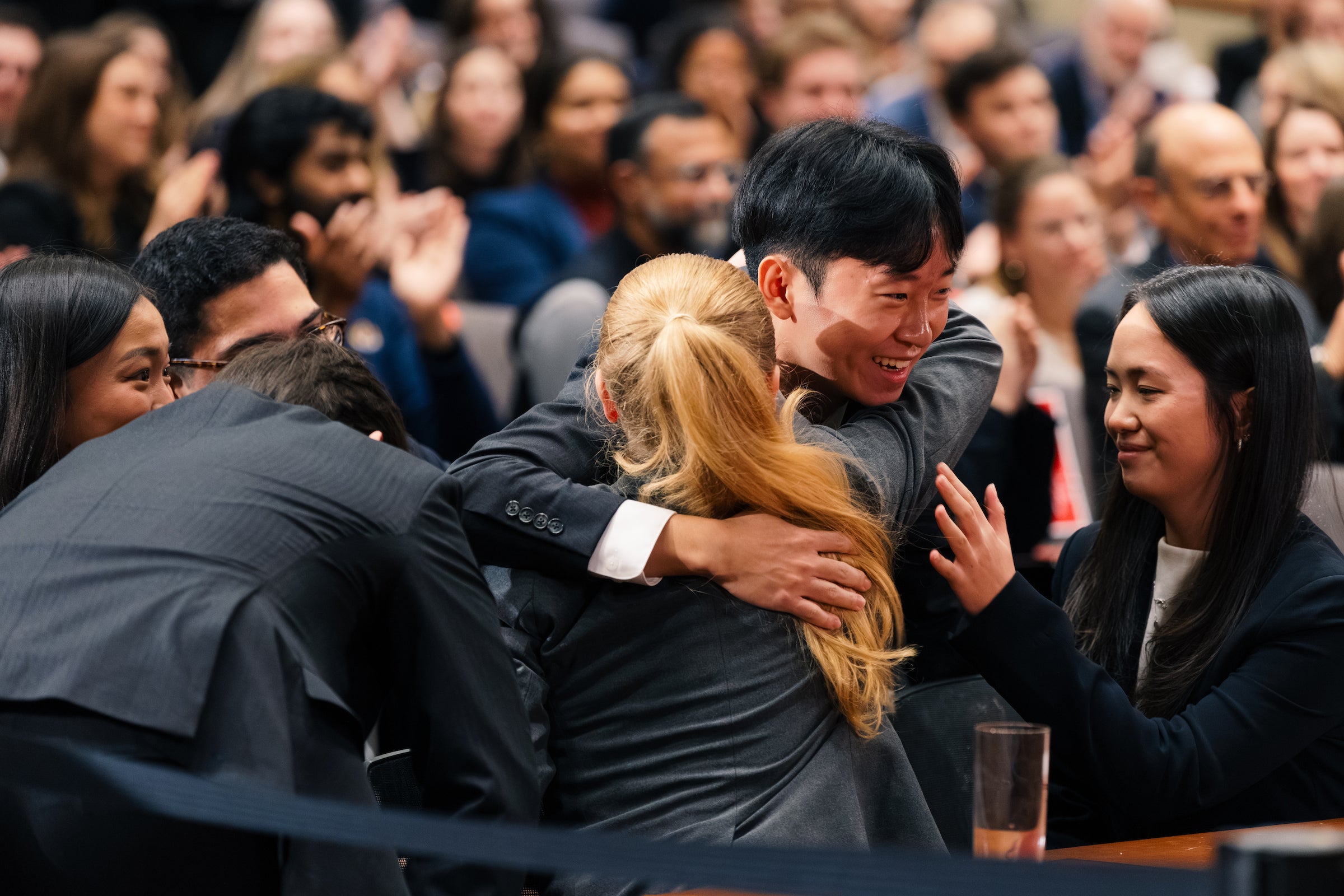
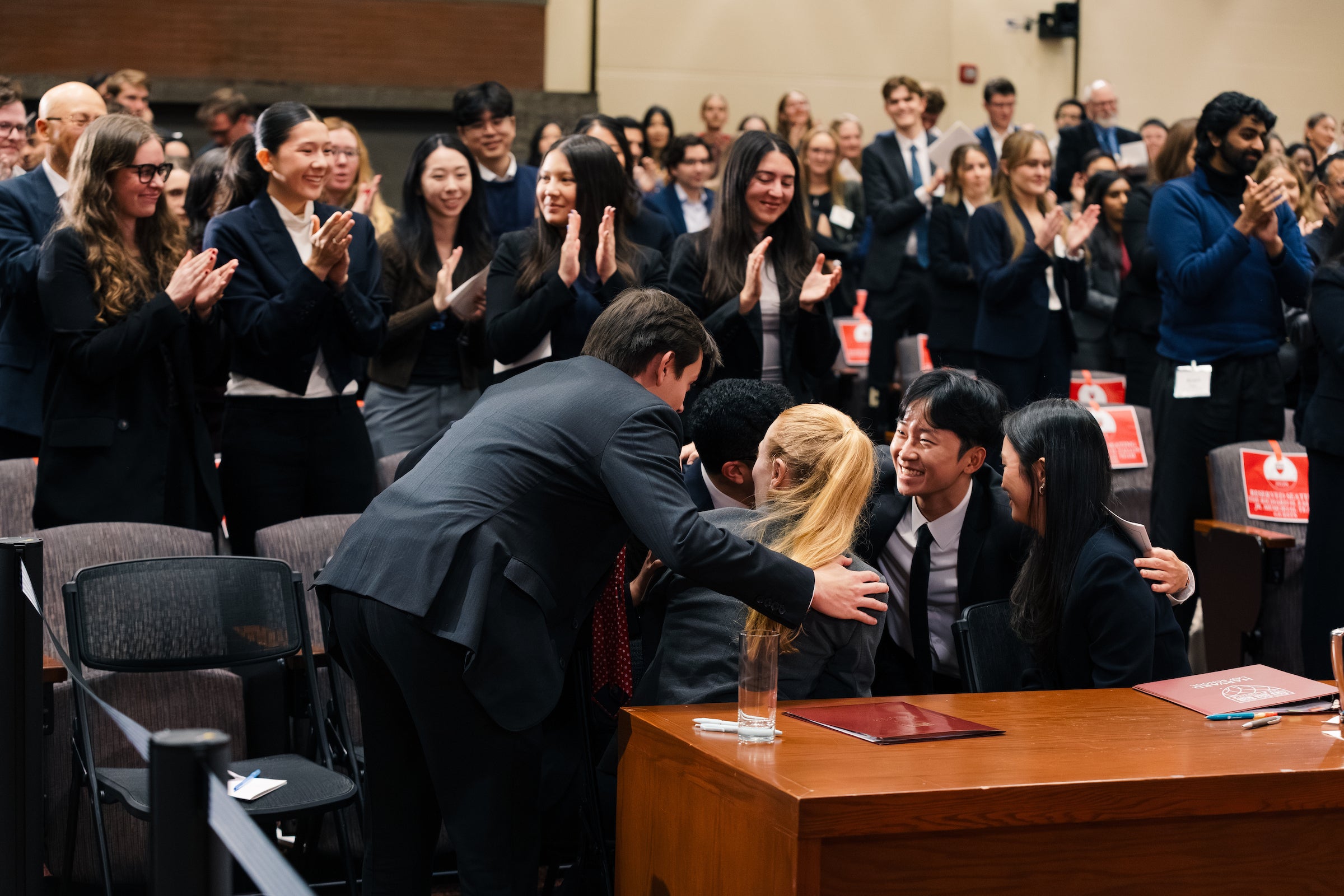
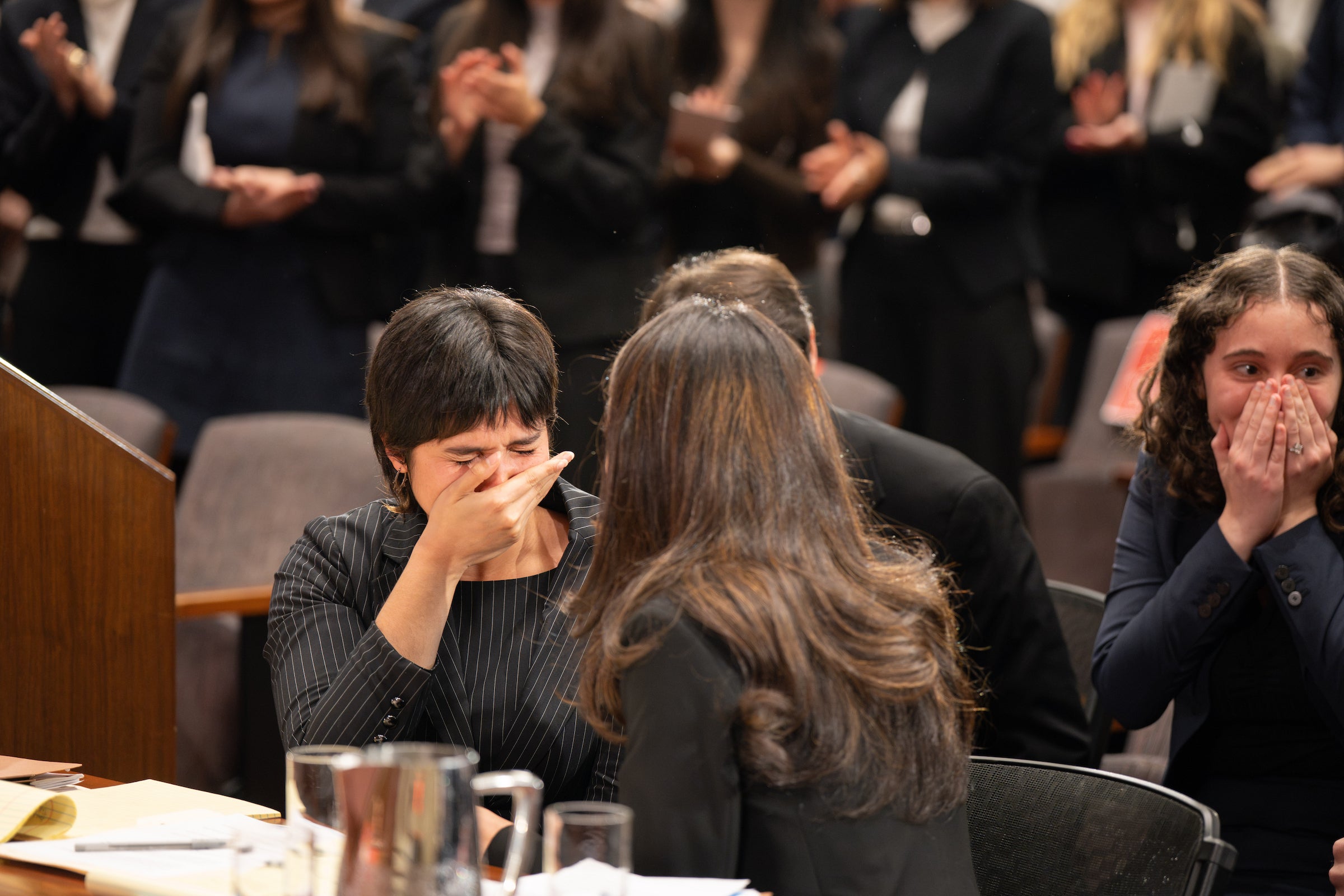
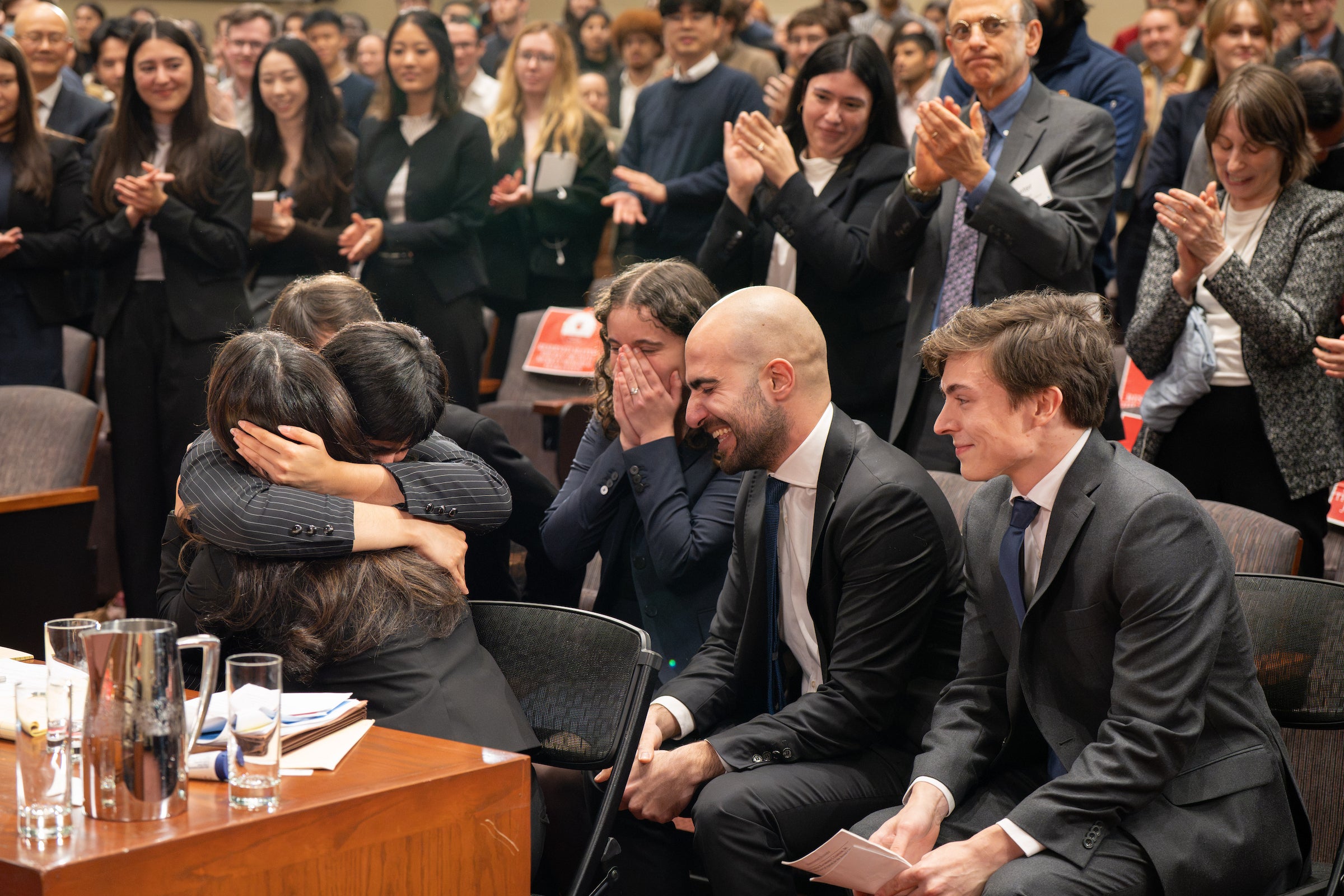
The Richard H. Fallon, Jr., Memorial Team was named best overall team.
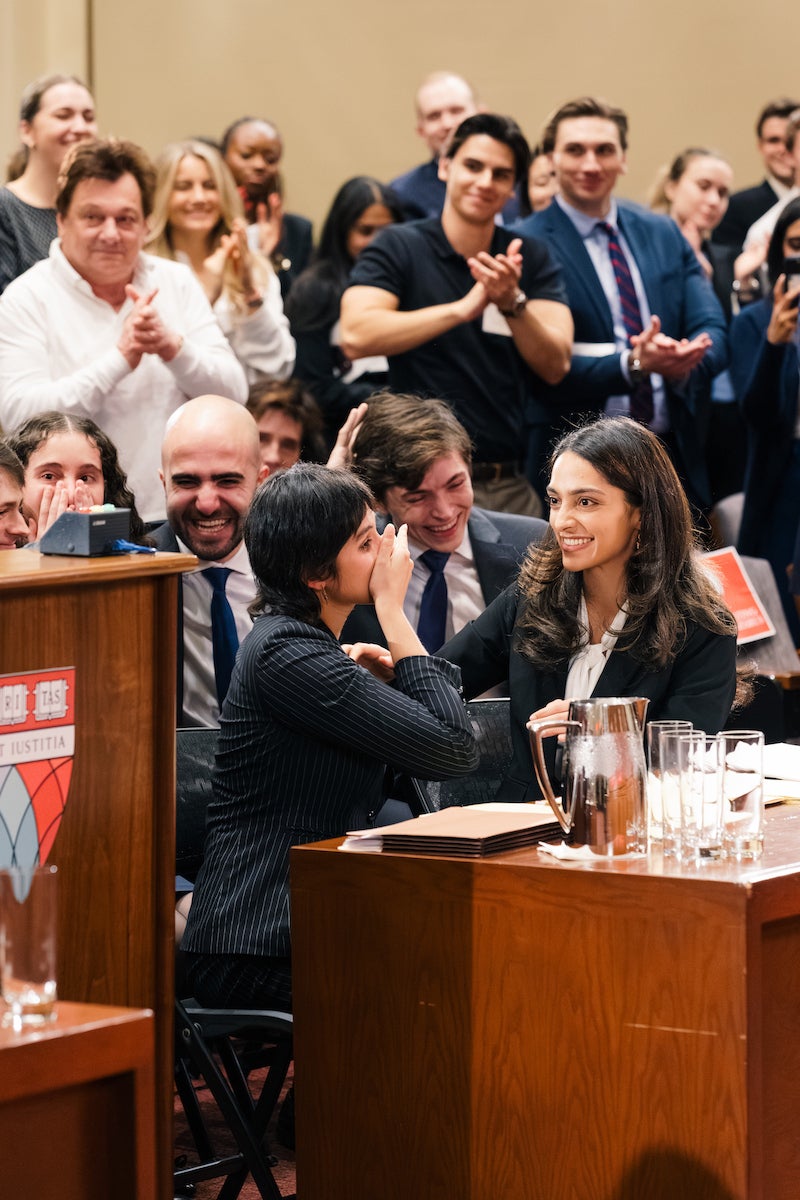
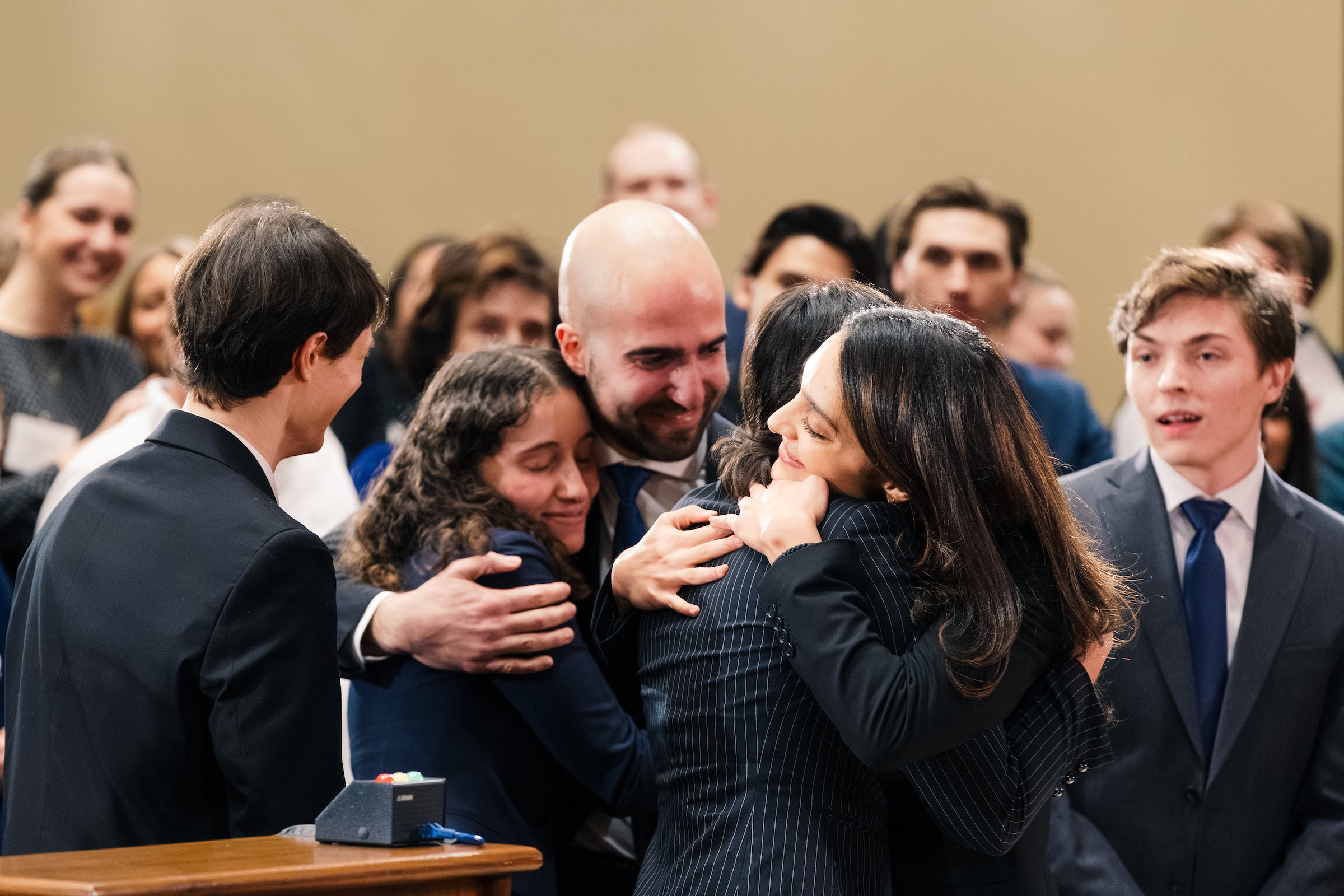
“Ames was transformative for all of us as writers, advocates, and friends. We are thrilled and humbled to see our hard work as a team come to fruition,” said Malak on behalf of the Richard H. Fallon, Jr., Memorial Team.
Kumar, from the Richard Fallon Team, was crowned best oralist.
“I am honored to have been selected as best oralist and grateful for all the hard work my team put in to prepare both oralists for the final,” Kumar told Harvard Law Today. “I absolutely loved having the opportunity to argue in the final. It has been a joy to discover my passion for oral argument through the Ames competition. And, because oral argument is a group endeavor, my teammates’ ideas and feedback were integral to this moment. I have learned so much from my friends, from the judges, and from this process.”
Watch the trial
See the full Ames photo gallery
Want to stay up to date with Harvard Law Today? Sign up for our weekly newsletter.