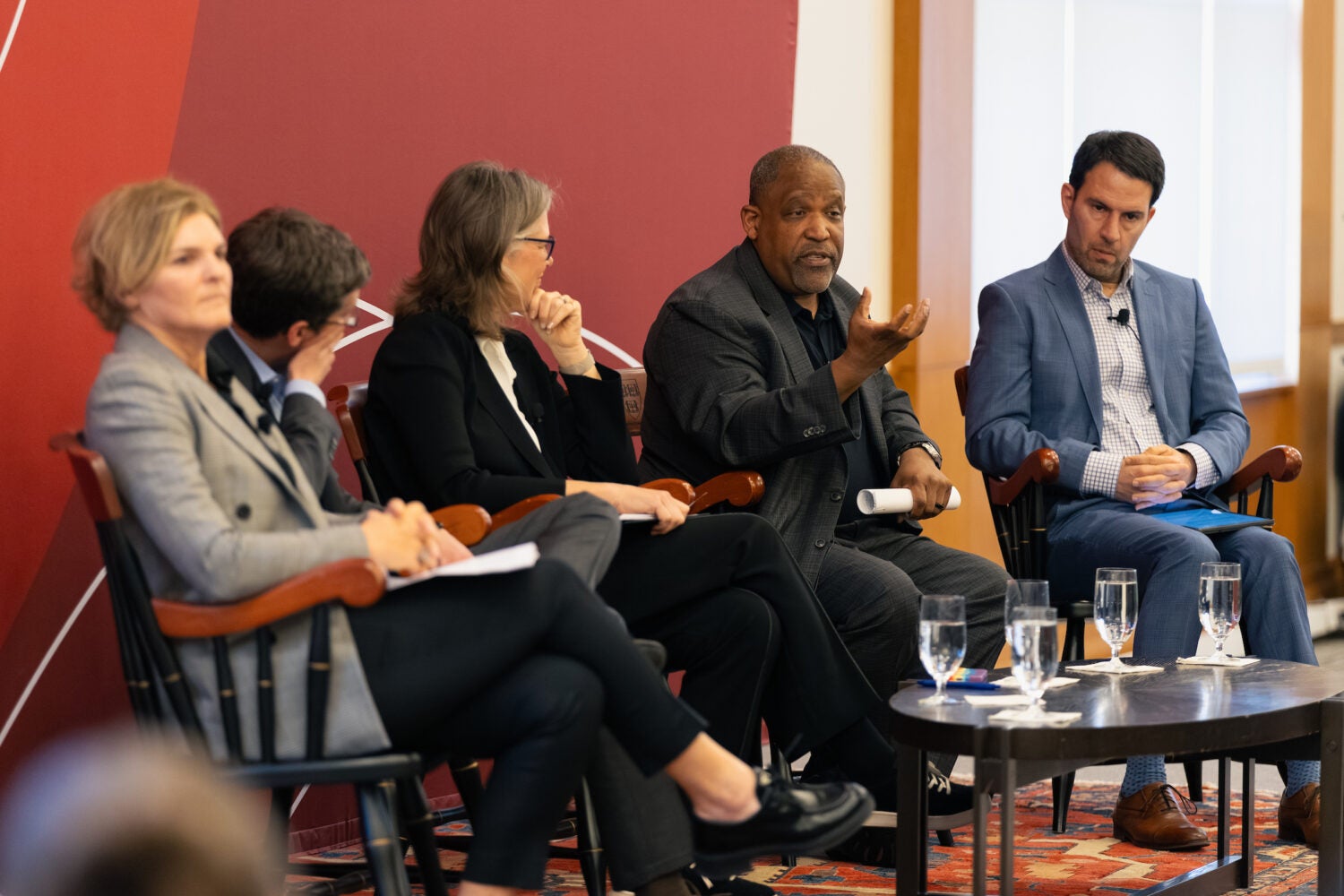
America is a country built on debate, not diktat — but the cultural and social frameworks that facilitate productive discourse are disappearing, warns Sheila Heen ’93, the Thaddeus R. Beal Professor of Practice at Harvard Law School.
“Our government is set up to put persuasive power, or negotiation, at the center as the engine of democracy,” said Heen, speaking at an event on April 7. “The problem we are in right now, is that there are three foundational conditions to successful negotiation, each of which are eroding or being undermined.”
Heen’s remarks came during the second in a series of discussions hosted by Harvard Law School in commemoration of the 250th anniversary of the Declaration of Independence. The first event, held on March 24, centered on issues of law and governance. The series is expected to resume in fall 2026.
Moderated by Nicholas Stephanopoulos, the Kirkland & Ellis Professor of Law, the April panel also included talks by professors Ronald Sullivan Jr. ’94, Jody Freeman LL.M. ’91 S.J.D. ’95, and Benjamin Eidelson, each of whom contributed essays that will be published in a forthcoming volume.
Heen contended that, in drafting the United States Constitution, the framers took pains to fashion a federal government requiring negotiation and compromise — by citizens and their leaders alike — rather than one based on unilateral control. The charter was carefully crafted to disperse power, she added.
“Congress and the president have to persuade each other to pass bills and budgets,” she said. “If either of their actions get challenged, they have to persuade courts that they didn’t overstep. Litigants have to persuade judges or juries, and juries have to persuade each other to come up with a verdict. The whole election process is one big negotiation.”
“America’s problems cannot be solved by force.”
Sheila Heen
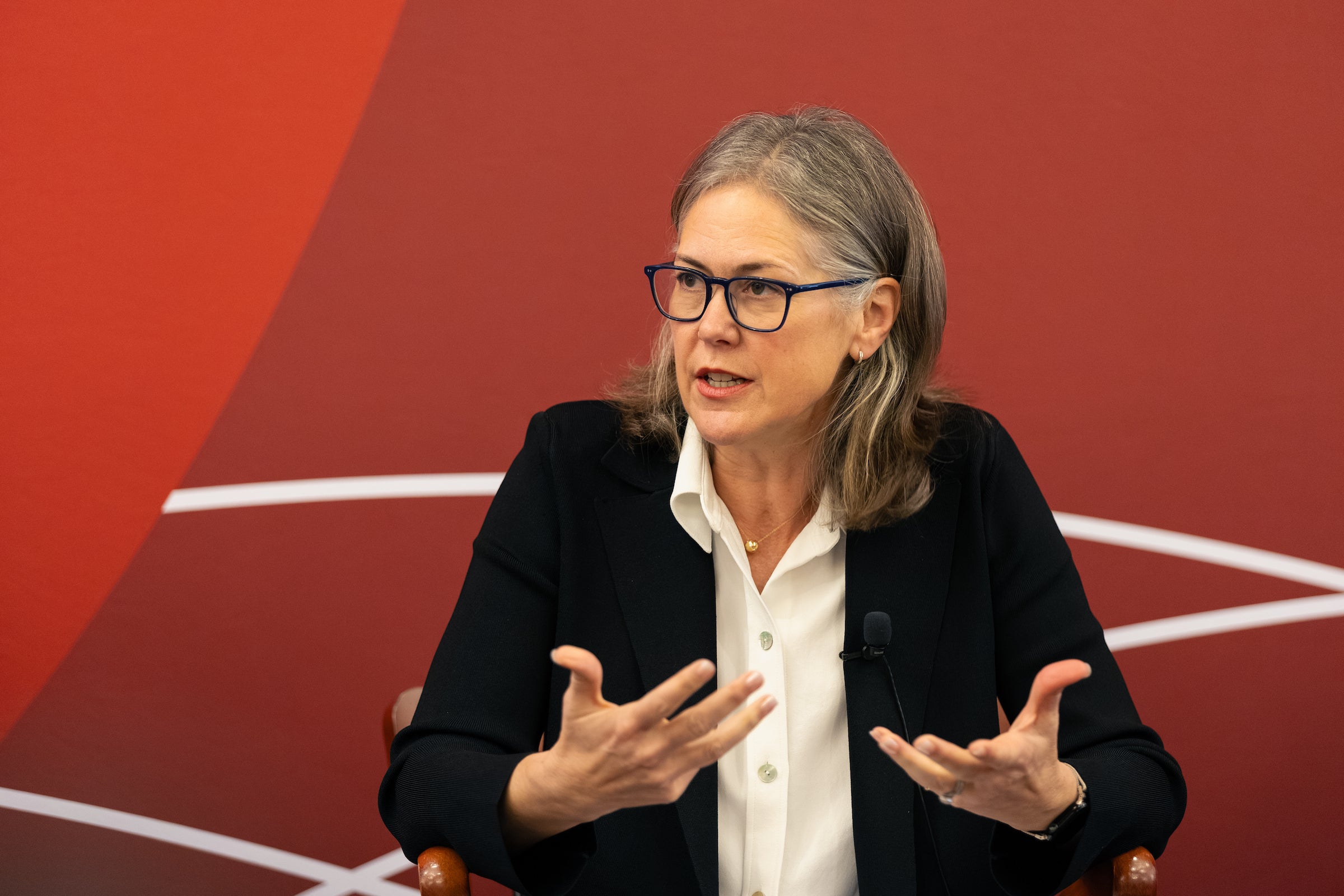
Heen sees peril in the erosion of three key conditions necessary to successful negotiations. The first, she argued, is that people must be able to tell who the decision-makers are — and who else is trying to influence the debate. “Right now, it is almost impossible to determine who all those players are,” Heen said.
In addition to money flowing from secretive SuperPACs, Heen explained, “a lot of our public discourse has moved online where unverified accounts and bots,” some of which are not even based in the United States, “are saying extreme things and pushing fake news.”
“These are the loudest voices at our table, and we have no control and no knowledge of who those voices belong to and whether they should even be at our democratic table,” she said.
Heen also worried that people are increasingly less willing or interested in engaging with those with different views, leading to inaccurate perceptions of the other side’s beliefs. Ideological polarization “has only grown moderately,” she said, while “affective polarization, the degree to which we dislike and distrust each other and see the other side, whatever side that is, as a danger to our nation, has grown exponentially.”
And that has led to the final erosion, in Heen’s view: the ability of negotiators — such as members of Congress — to work together to find common ground. “Each side is incented to reach for as much unilateral power as possible,” she said.
The good news, according to Heen, is that most Americans feel strongly about our foundational ideals, including the need to collectively solve pressing problems. But to do that, we must restore the conditions that make engagement possible, she suggested.
“Persuasive power is actually the hedge against and protects us from the use of illicit, illegal, and unconstitutional unilateral power,” she said. “America’s problems cannot be solved by force.”
Democracy is ‘always already in progress’
Like Heen, Ronald S. Sullivan Jr., the Jesse Climenko Clinical Professor of Law, saw the degradation of long-accepted norms as central to some of America’s toughest contemporary struggles.
Sullivan focused on three values — virtue, engagement, and humility — the restoration of which he believed could be the deciding factor between a country that slides into irrelevance and one that endures and prospers.
“We’ve lost this notion of a civic virtue, doing something because it’s good for the public, as opposed to it is good for me,” Sullivan said. “Civic virtue is an old idea and a simple notion, that we as citizens have to subordinate, sometimes, our individual interests in favor of the public good. The founding generation, with all their warts, understood or almost assumed that to be the case — that virtuous people would elect virtuous leaders, and those leaders would do virtuous things.”
Americans also need to engage — to step up and join the process of democracy, which is “always already in progress,” he said. “Citizens need to make this democracy work.”
“Martin Luther King wrote in many of his speeches that the moral arc of the universe is long, but it bends toward justice. His work shows us that what he actually meant is that we must bend this arc toward justice,” Sullivan said. “It’s not going to happen by itself.”
“This democratic tradition … can change, it can evolve. Its shape can be altered. But we have to do it now.”
Ronald Sullivan Jr.
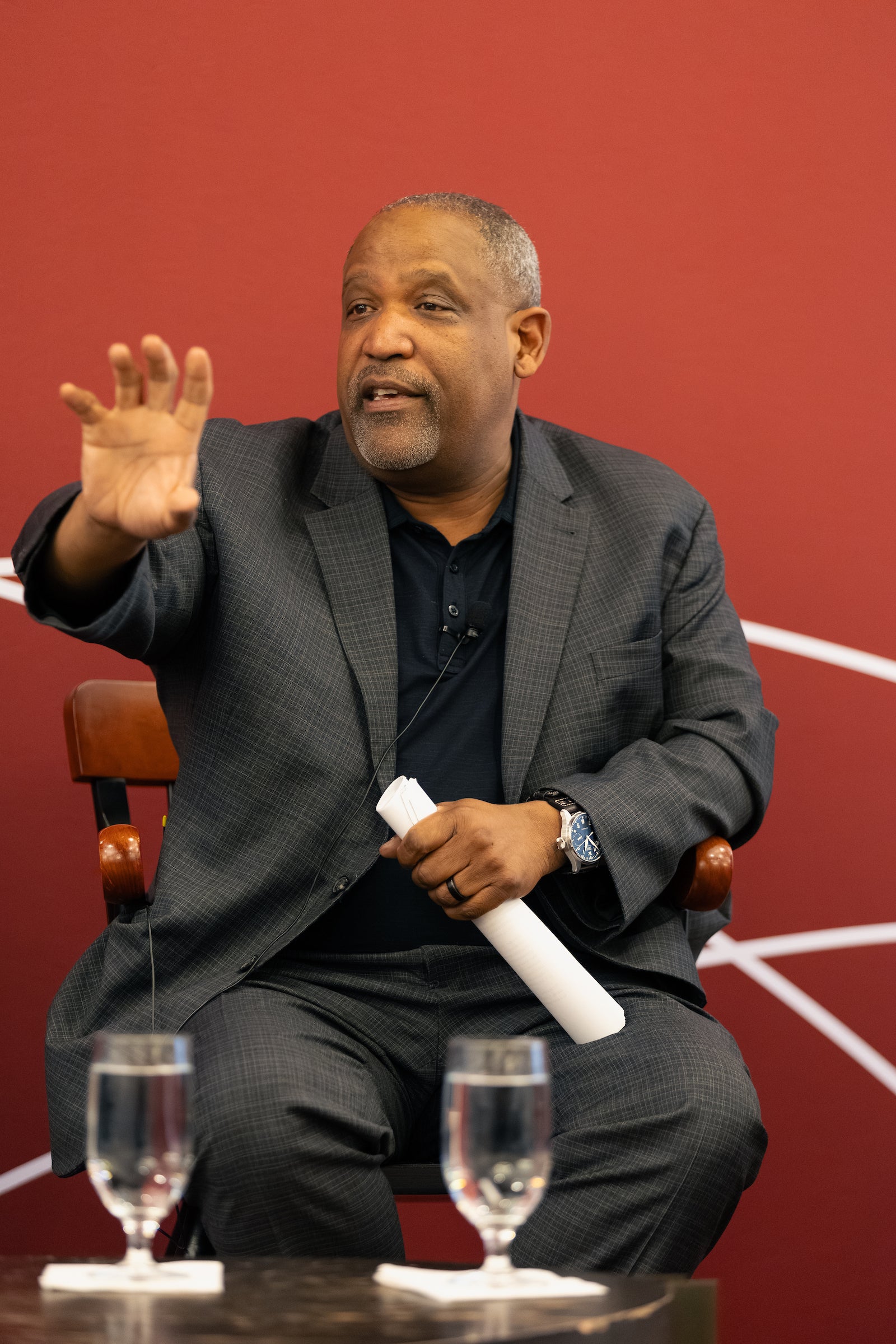
And all of this will require something else, he added: humility. “The humility to know that we don’t have this thing right in the present moment.”
“When we think that we’ve got it right, when we think that we figured out everything, when we think that we have this precise calculus, that’s when we get in trouble,” he added. “That’s when the democracy becomes a museum and not this living thing.”
These virtues are currently at risk, Sullivan suggested. People are less likely to approach one another with an open mind and heart. They are less likely to engage with one another and with the democratic process. And, he added, “if our leadership cannot subordinate their individual interests to something akin to a public good, then I don’t have anything optimistic to say.”
But if, instead of accepting antipathy or apathy, Americans demand more of our leaders and ourselves, we can restore the conditions necessary for our nation to flourish, Sullivan suggested.
“The beautiful thing about this democratic tradition is that it can change, it can evolve,” he said. “Its shape can be altered. But we have to do it now.”
A government ‘substantially transformed’
Jody Freeman, the Archibald Cox Professor of Law, took a different approach in her remarks, focusing not on the erosion of principles, but of the American government itself.
“The federal government, over the last 14 months, has been substantially transformed in ways that may be difficult, if not impossible, to reverse, and that transformation has not, at least so far, shown signs of being good for the American people,” she said.
To Freeman, the dismissal or firing of hundreds of thousands of federal civil servants, and the dismantling of agencies “charged by Congress in law with important tasks” constitute “monumental changes” — ones she said the Supreme Court has “largely allowed … to proceed.”
The federal government has “lost, in a very short time, substantial expertise and capacity,” Freeman argued. “And so far, the promised cost savings, which was the stated goal of this project, have not materialized.”
“The federal government … has been substantially transformed in ways that may be difficult, if not impossible, to reverse, and that transformation has not, at least so far, shown signs of being good for the American people.”
Jody Freeman
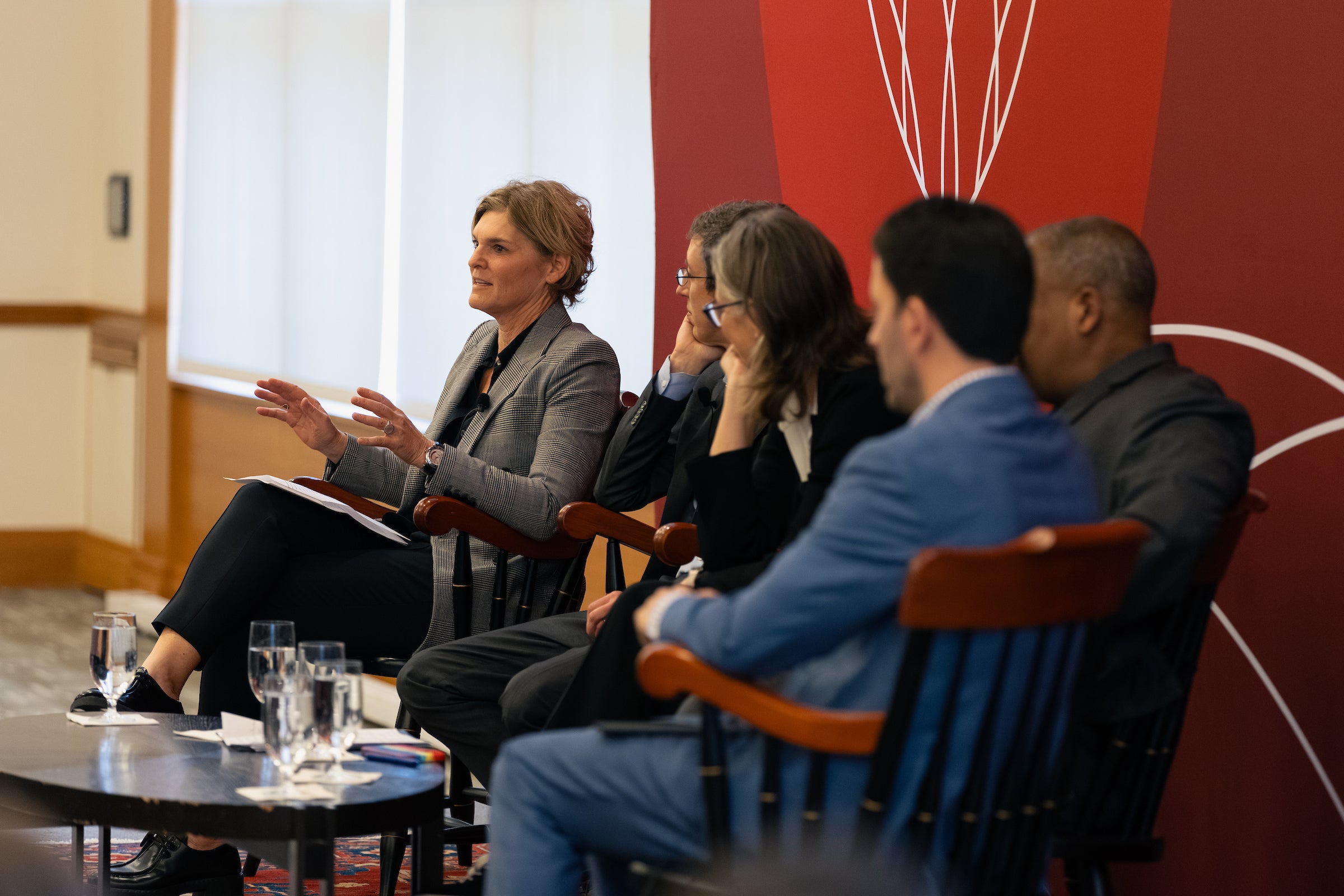
She pointed to the Department of Justice as one particularly stark example: “It is a shadow of its former self. Scores of career prosecutors and investigators resigned rather than follow orders they regarded as unethical, contrary to law or department policy, or unsupported by facts and evidence.”
Other agencies, such as those tasked with protecting the air, water, food and drug supply, or organizing disaster response, are now “less objective, less competent, less expert, less professional than at any time in modern history,” Freeman added.
And while presidents have often asserted some amount of control over the bureaucracy, Freeman said, it is now more nakedly partisan than any other time in the modern era “since we transitioned from a patronage system to the American system of federal workers.”
She acknowledged that some in the audience might be thinking that the federal government was due for a “little shaking up,” and she agreed with reforming the civil service to make it more efficient, deliver better outcomes, and cut waste and fraud.
“I’m 100 percent in for that project,” she said. But, she added, “this project, over the last 15 months, has not been that.”
Instead, she said, there has been “no strategy, none of the claimed results, and a massive drain of expertise that could come back to affect us in the long term.”
Nonetheless, Freeman concluded that there was one bright spot. “At the height of what might be, for some of us, despair about many developments in our culture, our society, our democracy, our politics, there is also tremendous opportunity to contribute to a better, more inclusive, more virtuous, and more loving society. To engage, improve and rebuild.”
Against a ‘scorecard mentality’
Professor of Law Ben Eidelson also worried about the decline of American institutions — and harkened back to an old idea about the law to show what has changed.
He began by referencing a saying by Thomas Reed Powell LL.B. 1904, a legal scholar and Harvard Law professor in the decades straddling World War II. “‘If you think that you can think about a thing inextricably attached to something else without thinking of the thing which it is attached to, then you have a legal mind,’” Eidelson said, quoting Powell.
Although perhaps intended as a joke at lawyers’ expense, Eidelson said he nonetheless viewed the quote as accurately capturing one aspect of their work.
“The essence of it is a kind of selective attention” to an issue, he said — an attempt to isolate ideas that may seem inextricably linked. For example, the question of whether someone’s words are protected by the First Amendment is separate from whether the speech is, in fact, true.
“It’s the ability to think of things in a respect, as opposed to just ‘net-net’ — as a gestalt,” he explained.
But what does this skill — so important to being a lawyer, in Eidelson’s view — have to do with contemporary society? “I think that capacity for nuance and restraint and separating considerations that count, and considerations that don’t, is central to what is under assault.”
“[The capacity] for nuance and restraint and separating considerations that count, and considerations that don’t, is central to what is under assault.”
Benjamin Eidelson
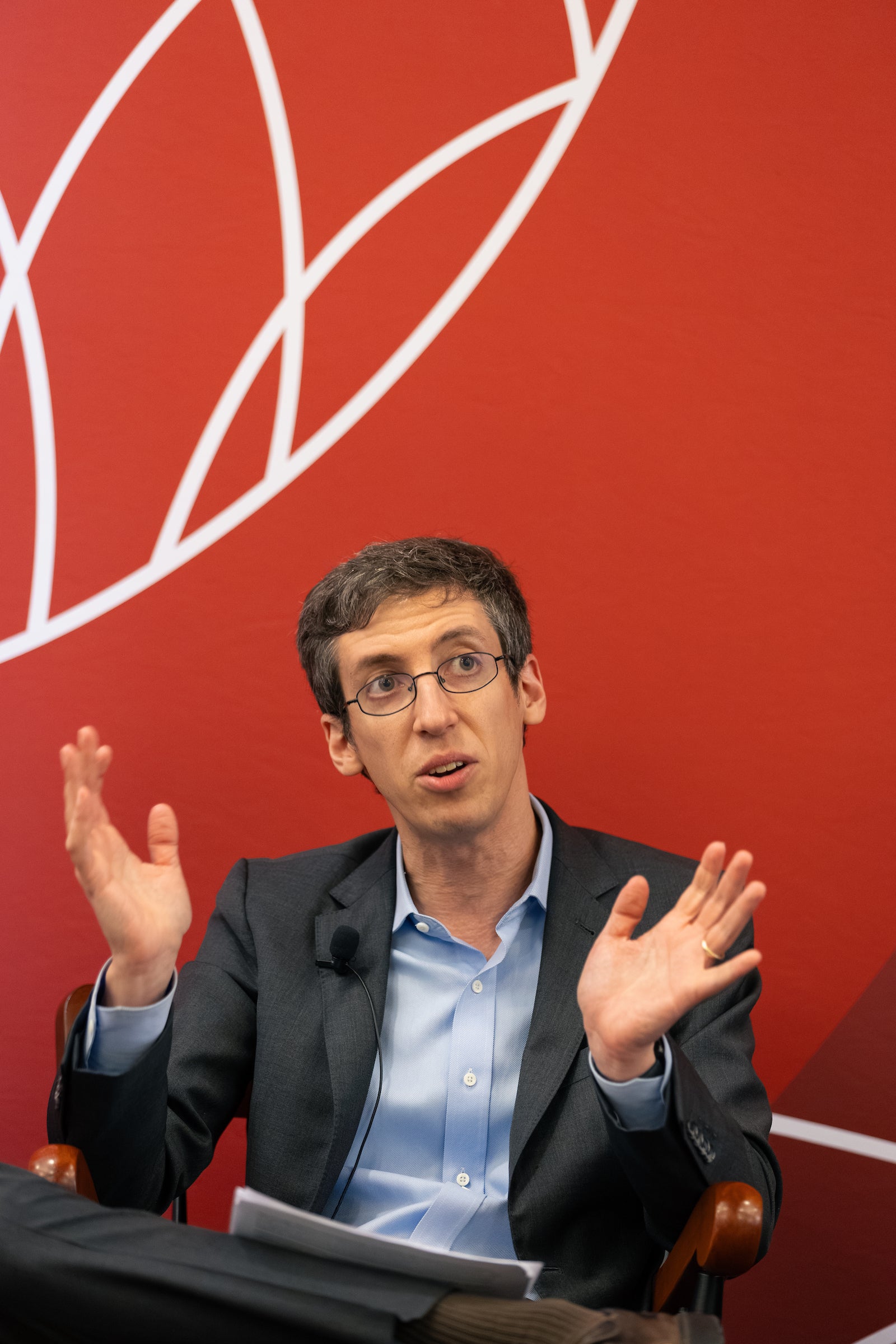
By way of example, Eidelson pointed to the Department of Justice, which, as Freeman had noted, has lost thousands of employees in the past year. Instead of being concerned with its own internal priorities, the department is now more “nakedly partisan,” conflating its own mission with the “greater good, at least as seen by a particular person and movement.”
Eidelson worried that this attitude — an unwillingness to separate “the legality of something from whether you think it’s good policy” — could poison other aspects of American life.
He warned against the wholesale adoption of such a “scorecard mentality,” wherein each issue is examined solely from the perspective of whether it’s good for one’s preferred political party. This, he argued, ultimately results in a situation where everyone feels they must act in such a way or lose out — a prisoner’s dilemma on a societal scale.
“It’s a cultural thing,” Eidelson said. “Everybody’s ability to engage with each other in the kind of granular, nuanced, subtle ways that I’m valorizing here depends on other people’s ability to do so.”
Want to stay up to date with Harvard Law Today? Sign up for our weekly newsletter.