Did the authors of the Bill of Rights intend to spell out what Americans’ fundamental rights meant or simply affirm rights whose meaning would continue to be debated?
According to Jud Campbell, a legal historian and professor at Stanford Law School, the first 10 amendments to the 1787 charter were drafted not as new rights, but as affirmations of existing natural and customary rights — entitlements predating the United States of America.
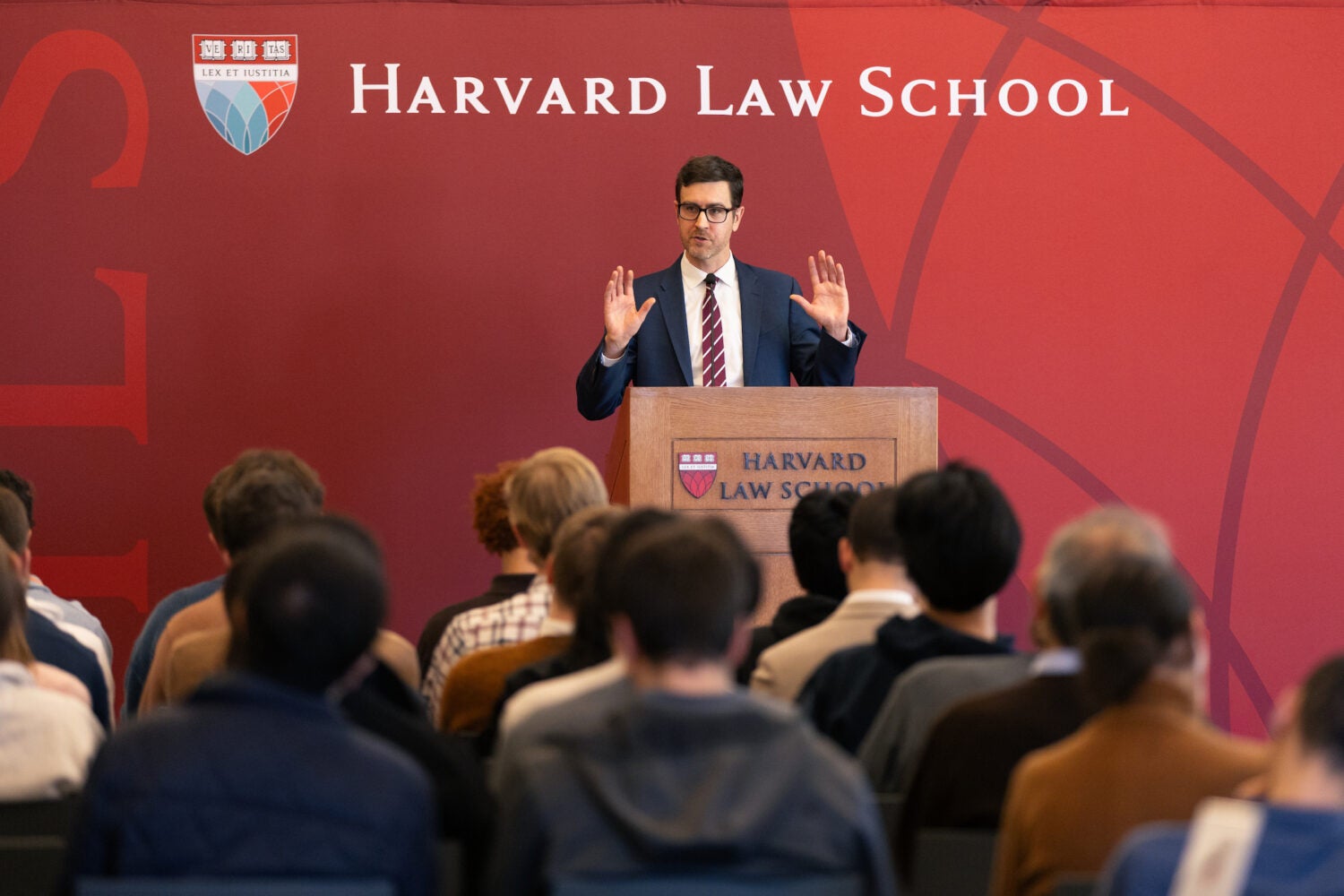
Delivering the annual Scalia Lecture at Harvard Law School on October 19, Campbell argued that the authors of the Bill of Rights do not seem to have considered their text as legally determinate — that is, that the amendments contained an answer for every legal question within their scope.
Instead, he suggested an alternate possibility: “Perhaps they had a different understanding of the relationship between fundamental rights and constitutional text,” said Campbell, who is the author of the Harvard Law Review article “Determining Rights.”
That history challenges some assumptions about originalism, a judicial approach influential on today’s Supreme Court that seeks to interpret the Constitution according to its original meaning. Campbell also cast doubt on the underlying reasoning of recent Supreme Court decisions on controversial issues like free speech, gun rights, and religious expression.
“Today, the Supreme Court treats constitutional rights as having the same meaning that they had in 1791, and in cases like [New York State Rifle & Pistol Association v.] Bruen, it has insisted that the content of those rights is presumptively delineated by the text of the Bill of Rights,” he said of the Court’s 2022 decision on the right to carry a handgun in public.
“This method partially transforms the Bill of Rights into the sort of instrument that the Anti-Federalists wanted — one that textually specifies constitutional meaning, and that cuts off opportunities for popularly elected representatives to determine the people’s rights,” he said, referring to founders like George Mason who opposed the Constitution’s ratification unless it were amended to enumerate Americans’ fundamental rights.
More strikingly, Campbell also argued that the amendments’ framers anticipated that the power to determine the limits of these rights would be exercised not only by judges but also through democratic politics.
“Retained natural rights were generally viewed as legally underdeterminate, and it was up to the people themselves, through their representatives, to determine their content,” he said.
‘Natural rights’ before the Constitution
To illuminate how differently America’s founding generation thought about fundamental rights, Campbell began by explaining social contract theory — which postulates that people accept limits on their natural freedoms in exchange for the protection of a government — and how it influenced early leaders’ understanding of law.
“As the thinking went, we can better understand constitutional principles that justify and limit governmental power by reconstructing why people would create a government in the first place,” said Campbell. “People in a state of nature had God-given natural rights, which were innate human capacities — things like thinking, praying, speaking, listening to a lecture, and so on, limited by principles of natural law.”
These “natural” rights were retained in the “imagined social contract,” he said, even as “individuals sacrificed a degree of control over their rights up to the political society, generally allowing the political society to regulate those rights in promotion of their common good.”

While rights were written down in earlier documents such as the Magna Carta, the English Bill of Rights, or state constitutions, “these instruments were understood in a declaratory way, simply reaffirming rights that were grounded in customary law, in natural law, and in the social compact,” he added.
In debating the new Constitution’s merits, Federalist and Anti-Federalist politicians both tended to agree that “basic rights of citizenship did not come from written constitutions,” Campbell said. But the latter group, believed that it was important to enumerate these rights within the national charter to limit federal power in the fledgling country.
Pro-ratification Federalists, however, thought that adding a Bill of Rights was unnecessary, given that these liberties were “pre-constitutionally recognized,” and, moreover, that it would be difficult to reduce them to writing, Campbell said.
Why the Federalists embraced a Bill of Rights
To address Anti-Federalists’ demands, James Madison and his allies relented, though they were not interested in reopening debates about federal authority, Campbell said. The Bill of Rights they introduced generally did not contain new textually specified limits on the government’s power, but rather “was simply declaring rights that were already implicitly secured.”
Madison, often referred to as the “Father of the Constitution,” also wanted to avoid another potential pitfall that he had previously encountered: that, in listing what a right entails, an amendment might imply greater federal power — not less.
“Enumerating a right could imply that federal power was otherwise expansive enough to interfere with that right,” he said. “Expressly stating that Congress could not create prior restraints on publishers, for example, could suggest that the federal government had a general power to restrict expression.”
The Bill of Rights that ultimately emerged was at least as much a Federalist accomplishment as an Anti-Federalist one, he said. “The Federalists in the First Congress had created a Federalist Bill of Rights, a document that advanced Federalist priorities and reflected a Federalist perspective on the nature of rights and their relationship to constitutional text.”
Campbell said that some Anti-Federalists were left dissatisfied with the amendments. But, he added, “Perhaps the Anti-Federalists would take some comfort in knowing that a couple of centuries later, we would come to see constitutional rights in a more textually delineated way.”
What the founders’ understanding means for originalism today
Today, judges often rely on originalist reasoning to interpret fundamental rights. In Bruen, for example, the Supreme Court’s majority struck down New York’s requirement that applicants for gun licenses show a special need to carry a handgun in public, finding insufficient support for the restriction in the nation’s historical tradition of firearm regulation.
But such an approach leaves little room for the framers’ understanding of these rights — one that gave the people, through their elected representatives, a role in determining their scope, Campbell suggested.
“An originalist approach to the Bill of Rights is essentially a response to the breakdown in older ideas of general fundamental rights,” he said. “What if the Federalists who wrote [the Bill of Rights] were simply declaring the existence of certain rights that were not grounded in constitutional text at all? … And what if the text and its original meaning are therefore simply incapable of offering the guidance that we seek today?”
Want to stay up to date with Harvard Law Today? Sign up for our weekly newsletter.