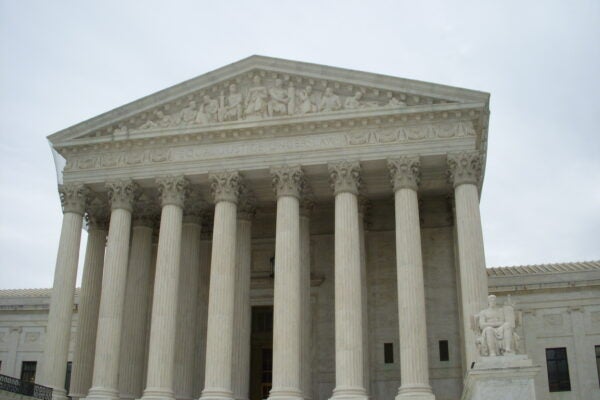
The United States Supreme Court’s shadow docket has been in the news and is a subject of continued scholarly interest. Here at HLS, for example, it was the subject of the recent Rappaport Forum, “The Docket That Shall Not Be Named: The Supreme Court’s Emergency Orders“. Harvard Law School research librarian Deanna Barmakian has turned a light on the shadow docket and the availability of filings from these important cases.
What is the shadow docket?
The term “shadow docket” is generally used to refer to controversial or politically important cases that are brought to the United States Supreme Court on an emergency basis, seeking relief from a stay or injunction. These cases, also known as “application cases,” are often decided by brief orders rather than full opinions. Many mundane cases are decided via this process, but an increasingly large subset is of research and public interest.
Where are the filings?
Because these cases lack oral arguments and full opinions, the filings that do exist may provide the best source of insight into these decisions. In 2025, Barmakian decided to figure out where and how researchers could get access to these filings. Her research led to a 2025 prize-winning paper, “The Splintered Availability of U.S. Supreme Court Shadow Docket Briefs.”
In her research, Barmakian discovered that finding materials from these cases isn’t as simple as searching a database. Post-2017 cases can be found on the U.S. Supreme Court’s website but have been inconsistently added to major legal research databases. Legal vendors are making efforts to identify cases of interest and include them in their databases, but access is not complete. Older cases are still only available in print from the National Archives (NARA). In addition, finding a complete set of documents for a case can be tricky, because the court changes the docket number if the case is later granted certiorari. Researchers will need to check multiple sources to gather a complete set of documents, particularly for cases that originate in the shadow docket but are later referred to the full court.
Sharing her knowledge
With more focus on the shadow document, law librarians need to know how to help our researchers find these documents. Barmakian shared the lessons she learned in her article in the March/April 2026 issue of AALL Spectrum at page 31, “The Librarian’s Guide to the Shadow Docket.” In the article, she discusses “what orders cases are, why they matter, and how to find the records” and gives practical tips for researchers.
Some of her takeaways for finding order docket filings
- Know the vocabulary: Shadow docket cases may also be referred to as interim orders cases, application cases, non-argument cases, or the emergency docket
- Search by docket number AND case name: Cases that move to the merit state receive a new docket number. Researchers should also search by case name when locating documents
- Check multiple databases to collect a complete set of documents for post-2017 cases
- Give yourself time: Pre-2017 filings are only available from the NARA. Ordering documents from NARA can be time-consuming.
Contact Us
phone: 617-495-3455
email: asklib@law.harvard.edu
library website: hls.harvard.edu/library
Stay Connected
Library Innovation Lab (LIL) Blog
Instagram @hlslibrary
Facebook @hlslibrary
Et Seq blog (archived)