Immigration detention is often described as “tough” or “necessary,” but the day-to-day reality experienced by individuals in custody is shaped by policies that are hard to evaluate without reliable evidence. Over the past several years, Empirical Research Services has been working across disciplines to document how detention practices affect detainees’ mental and physical health, and, in some cases can contribute to serious harm, including death in custody.
At Harvard, this work has brought together Empirical Research Services, clinicians at the Law School, and researchers at the Medical School, in collaboration with advocates, to translate government records into transparent, reproducible analyses so that debates about detention conditions can be grounded in measurable outcomes. In practice, empirical work starts long before the statistics: finding the right records, checking them for gaps and inconsistencies, and documenting every step so the results can be verified. That kind of careful documentation matters in law as much as in public health, because evidence has to be traceable, explainable, and repeatable. Working with ICE (U.S. Immigration and Customs Enforcement) records often meant working with missing fields, inconsistent definitions, errors, and disappearing data; our goal was to be transparent about those limitations while still making the strongest possible use of the available evidence. Sometimes the biggest obstacle wasn’t messy data, but delay. In one project on solitary confinement, ICE produced key records only after roughly six years, and the production still left major gaps.
Analysis finds that “2025 mortality is substantially higher than the 2012–2024 baseline, second only to 2020, the COVID-19 pandemic year.”
In 2025, ICE reported 33 deaths in custody, the highest annual number in ICE’s publicly available records since recordkeeping began in 2003. ICE, however, described detainee mortality as “the lowest in ICE history,” relying on an unadjusted proportion. Those statements can coexist because they answer different questions. A raw count tells you how many people died; a simple proportion can hide how much detention expanded or how long people were held. To compare risk over time, you have to account for the size of the detention system and the amount of time people spend in custody. When we do that, 2025 mortality is substantially higher than the 2012–2024 baseline, second only to 2020, the COVID-19 pandemic year.
Solitary confinement: making the “black box” measurable
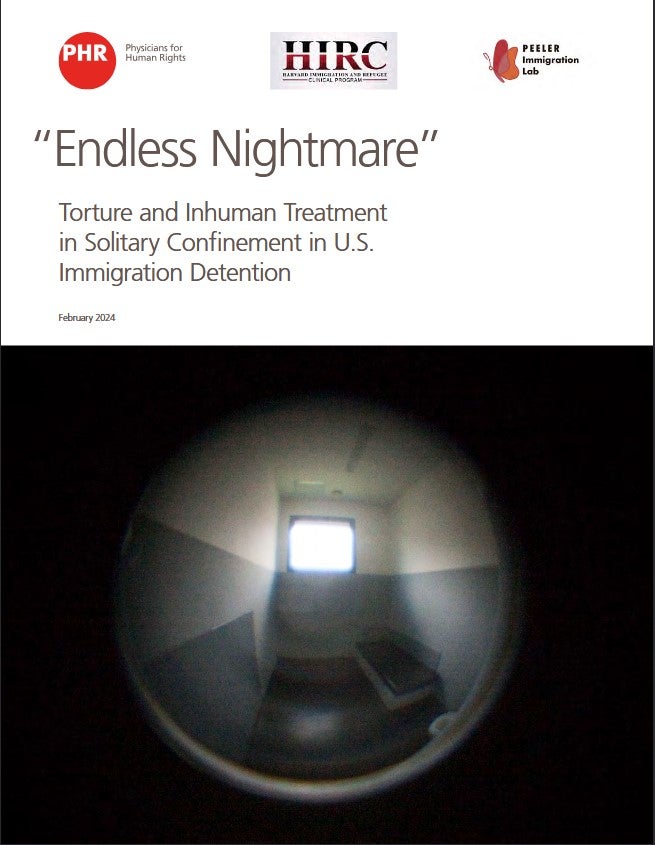
Another major focus of our work is solitary confinement in immigration detention, which ICE labels “segregation.” In February 2024, together with Harvard Law School’s Immigration and Refugee Clinical Program, Physicians for Human Rights (PHR), and collaborators, we released Endless Nightmare, documenting extensive use of solitary confinement and its well-established health harms. The report documented solitary confinement lasting weeks or months and its association with severe psychological and physical consequences, especially for people with existing vulnerabilities.
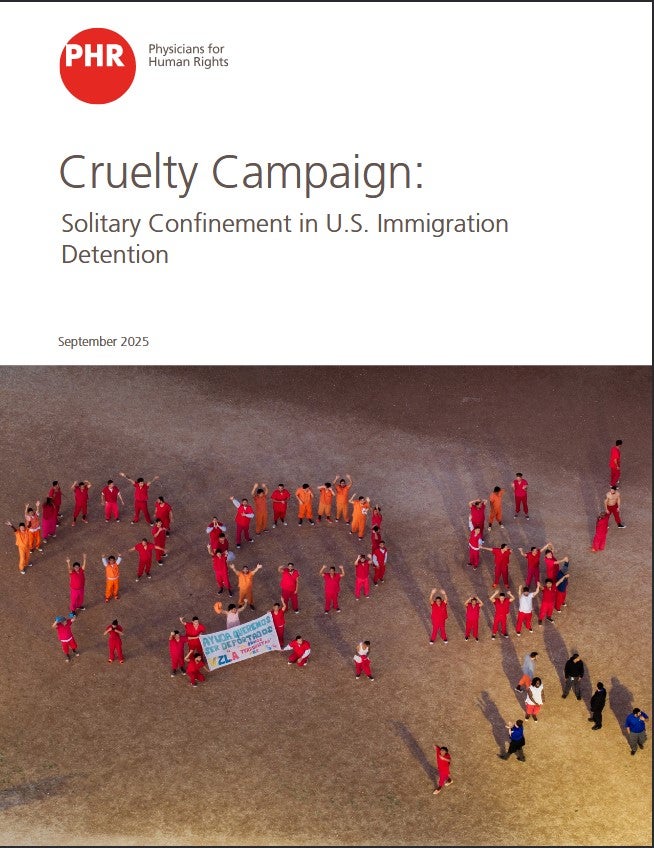
As we were writing Endless Nightmare, detention facilities were only required to report placements for non-vulnerable detainees after they lasted beyond a certain threshold. One of our key recommendations was a basic transparency fix: report every placement, not just those that crossed a time cutoff. ICE adopted this change last year, expanding its reporting so that every placement is now included, making the scale of solitary confinement easier to measure and compare over time. In September 2025, a follow-up report reflects this improved reporting and found that more than 10,000 people were placed in solitary confinement between April 2024 and May 2025, an unusually high level of use over a short period. That work combined publicly available ICE data with [Freedom of Information Act] FOIA-obtained records to make a hidden practice visible at national scale.
We also collaborated with coauthors on a law review article, The Solitary Confinement Crisis in Immigration Detention, situating these findings in the legal and policy landscape. For lawyers and legal advocates, this kind of analysis is useful because it turns scattered records into usable evidence: how often solitary is used, how long it lasts, and whether patterns appear consistent with ICE’s own stated rules. It also supports legal arguments about access to counsel and due process, because conditions of confinement can affect whether people can contact attorneys, prepare documents, and participate meaningfully in their cases.
Works like this depend on more than statistical tools; they depend on access to records, careful documentation, and quality control, especially because public agency webpages and datasets can change over time. Tables may be updated, links can break, and files can disappear or be replaced without clear version histories. We therefore document retrieval dates, preserve key source files, and use reproducible code so results remain verifiable. The data aren’t perfect, which is why transparent methods matter: they help make the evidence clearer and more usable.
Laying the groundwork for credible empirical research
If you are working on an empirical project, especially one involving public or administrative data, consider asking early:
- What question do you want to answer?
- What measures make comparisons fair (e.g., a mortality rate per admission, per time in custody, or per population)?
- How will you document sources and cleaning steps so someone else can re-run your results?
- What would it take for your findings to be credible not only to scholars, but also to courts, policymakers, journalists, and the public?
These are the kinds of questions ERS helps with across the HLS community.
Filed in: In the Community
Contact Us
phone: 617-495-3455
email: asklib@law.harvard.edu
library website: hls.harvard.edu/library
Stay Connected
Library Innovation Lab (LIL) Blog
Instagram @hlslibrary
Facebook @hlslibrary
Et Seq blog (archived)