
Effective wayfinding signage often feels invisible because it simply assists you in accomplishing your tasks. However, when signage is ineffective, we take notice. A good sign is more than typography, icons, words, and color. Just as a user interface (UI) is part of the user experience (UX) of a website, wayfinding signs in the library must be designed to enhance the user experience of using the library
What we did
In order to update our signage, we approached each sign as an object with a specific job. For this process we:
- Did an inventory of all the signs with their location
- Categorized by purpose: directional, informational, instructive, label
- Wrote out what effect each sign is supposed to cause
Next, we created prototype signage to test out. We had two main questions:
- How do patrons use existing signs to find their way around?
- Are there other methods they use to find their way?
We Invited students who had never been to the library to participate in a wayfinding activity. They would be given a series of tasks to do as they narrated what they were doing and their thought process. Two staff members would observe and take notes.
“This feels like an escape room game!”
-student participant
What we learned
This process gave us great insights into how someone who has never been to the library experiences it and where we can improve. Among the insights:
Users want a schematic map of the floor and the entire building
Several students tried to use emergency exit maps to orient themselves in the space
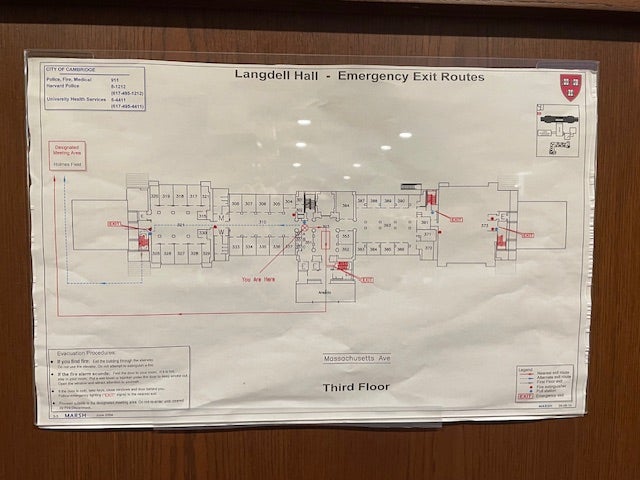
Multiple names for a classroom
Langdell North is also called Vorenberg Classroom and Langdell 225. The same for Langdell South/Kirkland and Ellis/ Langdell 272.
Elevator signs
- Signs should display points of interest for each floor
- Signs should be both inside and outside of the elevator
Sound zone confusion
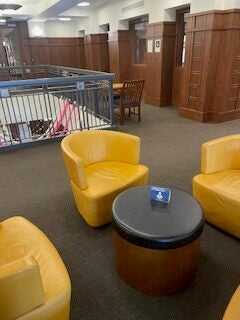
The area with soft seating and chess tables is designated as a “Quiet Zone” but multiple participants thought it was a space for talking despite signs that say, “Quiet Zone”. They noted that chess tables, conversational seating, and location above the circulation desk as their guide for using the space.
We will continue to update and improve the wayfinding experience in the library based on these insights and continued experimentation.
Contact Us
phone: 617-495-3455
email: asklib@law.harvard.edu
library website: hls.harvard.edu/library
Stay Connected
Library Innovation Lab (LIL) Blog
Instagram @hlslibrary
Facebook @hlslibrary
Et Seq blog (archived)