How to Tell an AI What to Do: Rules, Cases, and Interpretation
November 3, 2026
12:20 pm - 1:20 pm
Lewis Hall, 5th floor at the Berkman Klein Center's Multi-Purpose Room 515
1557 Massachusetts Avenue
Cambridge, MA 02138
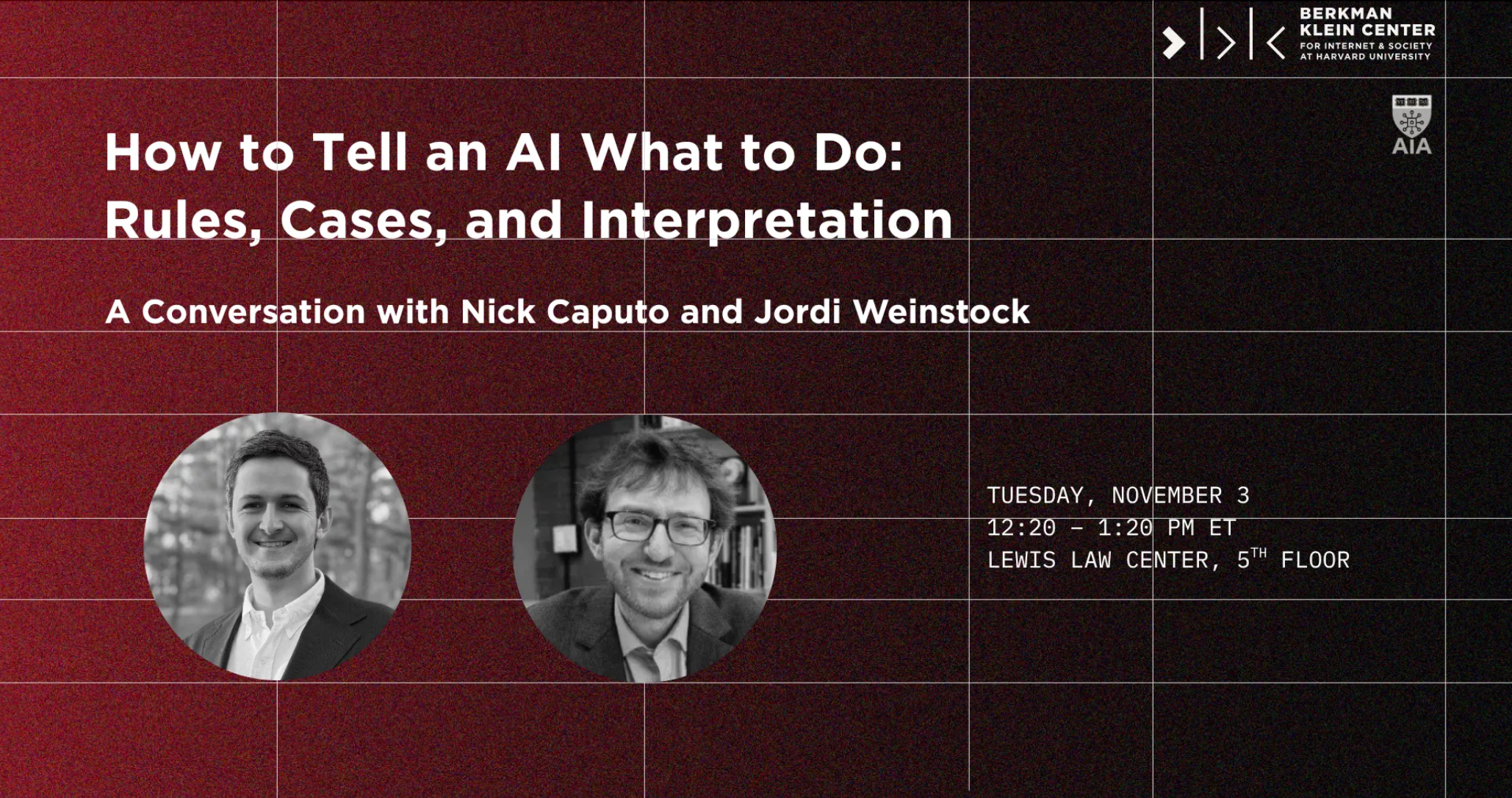
The OpenAI Model Spec and Claude’s Constitution lay out rich targets for AI alignment. But, like the law, these texts cannot settle every novel case in advance. When rules leave questions open, who should decide what they mean, and on what grounds? Nicholas Caputo and Jordi Weinstock will explore these questions through a comparative reading of the AI constitutions. Both documents combine rules, principles, and judgment, but place different emphases on interpretive discretion. The discussion will examine the tension between operating within a human-specified normative order and exercising judgment beyond what humans have specified. As we enter the multiagent era, in which we may soon see self-sovereign AI systems operating outside of human control and in superhuman ways, the law’s lessons for alignment have only become more relevant.
Nicholas Caputo (HLS ‘ 24; Johns Hopkins School of Government and Policy; Oxford Martin AI Governance Initiative) and Jordi Weinstock (Harvard Law School; Berkman Klein Center) will discuss what legal theory can and can’t tell us about AI constitutions. Caputo’s research treats AI alignment as a problem of jurisprudence, and his work in progress asks whether Claude can consent to its own constitution. Weinstock teaches at Harvard Law School about the confluence of AI and traditional law and served as an external reviewer of Claude’s constitution.