HLSL Faculty Book Talk: Redefining Comparative Constitutional Law: Essays for Mark Tushnet
April 8, 2026
12:30 pm - 1:30 pm
This event has passed
Milstein East B
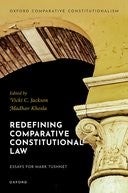
Join the HLS Library on April 8th at 12:30 for an HLS Library Book Talk in Milstein East B. This event features a discussion on Redefining Comparative Constitutional Law: Essays for Mark Tushnet with HLS Professor Emeritus Mark Tushnet and volume editors HLS Professor, Vicki Jackson and Columbia Law School Professor, Madhav Khosla. This event is free and will be recorded, open to all Harvard ID holders in person, and open to the public on Zoom Webinars.
Register to attend in person, Harvard ID required. Register by April 1st for a complimentary lunch.
Register for the livestream via Zoom Webinars, open to the public. Livestream does not include lunch.
If you, or an event participant, require disability-related accommodations, please contact Accessibility Services at accessibility@law.harvard.edu.
More about the book from the publisher Oxford University Press:
Redefining Comparative Constitutional Law: Essays for Mark Tushnet reflects upon the field of comparative constitutional law, which has emerged in recent decades as a major domain of scholarship and judicial practice. Among the most prominent figures in the ongoing renaissance of this field has been Mark Tushnet. This book uses the occasion of Professor Tushnet’s recent retirement from Harvard Law School to think critically about the field. Each chapter takes up one of Professor Tushnet’s major recent themes. To begin with, the book both takes off from and ends with reflections on Tushnet’s curiosity about the world; it considers different questions of methodology, canon, empiricism, and language. Another set of essays then consider the relationships among constitutionalism, liberal democracy, and international law, including reflections on debates over constitutional design, global values, and constituent power. A third focus of the next set of chapters is the relationship of rights to courts and legislatures, in liberal democracies, the countries of the Global South, and First World autocracies. Fourth, reflecting Tushnet’s work on constitutionalism outside the courts is a set of chapters exploring institutional design and the role of nonjudicial actors, such as fourth branch institutions. Fifth is a set of essays that focus on variations within liberal constitutionalism and the possibility of other forms of constitutionalism under different political regimes. An epilogue by Professor Tushnet reflects further on constituent power and constitutional theory.