Colonialism, Empire, and Race: Critical conversations on law, movements, & the university
April 8, 2026
11:50 am - 6:00 pm
This event has passed
Wasserstein Hall, 1585 Massachusetts Avenue, Milstein Conference Room, HLS campus
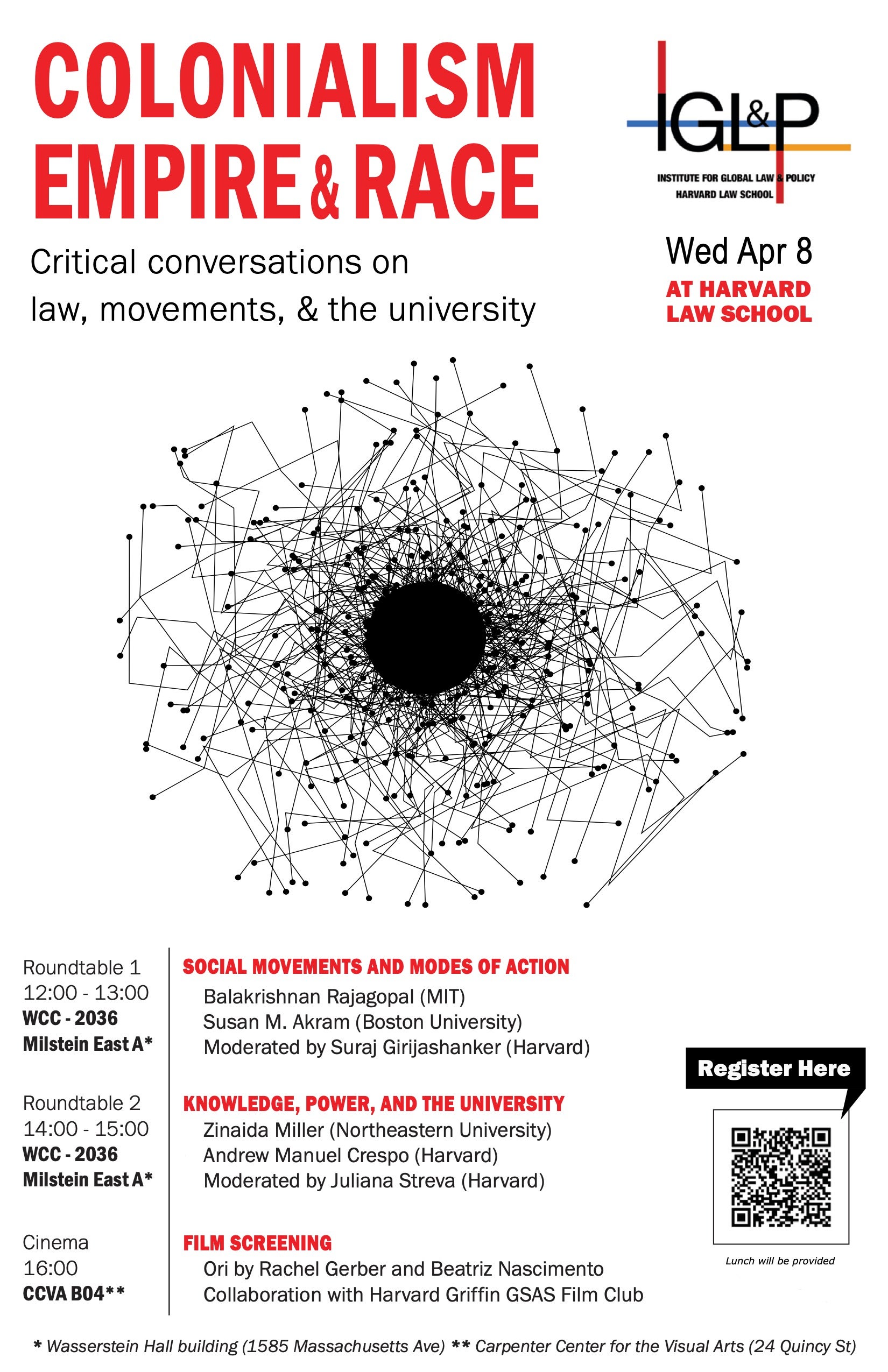
This symposium brings together two roundtables and a film screening to engage the entanglements of law, colonialism, and racialisation. It convenes scholars whose work examines the ongoing formations and afterlives of empire, exploring how legal regimes both shape and are shaped by colonial and racial hierarchies, as well as the role of the university in addressing pressing issues of the present.
Across these conversations, we reflect on the possibilities and limits of radical transformation: how law might be mobilized against the structures it has helped to constitute, and what role academia and engaged scholarship can play in such efforts.
The symposium aims to foster a critical space attentive to the intersections of race, gender, and class in the current socio-political moment.
12:00–13:00 | Roundtable 1 – Social Movements and Modes of Action *lunch will be provided
Balakrishnan Rajagopal (MIT)
Susan M. Akram (Boston University)
Moderated by Suraj Girijashanker (Harvard)
14:00–15:00 | Roundtable 2 – Knowledge, Power, and the University
Zinaida Miller (Northeastern University)
Andrew Manuel Crespo (Harvard)
Moderated by Juliana Streva (Harvard)
Location (both roundtables):
Wasserstein Hall, 1585 Massachusetts Ave, Room 2036 (Milstein East A)
16:00 | Film Screening
Ori (1989), directed by Rachel Gerber in collaboration with Beatriz Nascimento
Harvard Griffin GSAS Film Club
Location: Carpenter Center for the Visual Arts, 24 Quincy St, Room B04
The event is free and open to the public. Registration: https://docs.google.com/forms/d/e/1FAIpQLSfloqU4mDHynm7_CY7eygPB7m2x6hEH_Jtb9RO1tR3_zQqj7A/viewform?usp=sharing&ouid=110670176480283128902
Seating is limited and available on a first-come, first-served basis.
Organized by Juliana Streva and Suraj Girijashanker – Institute for Global Law & Policy (IGLP), Harvard University
In case of questions, please contact:
Juliana Streva – jmoreirastreva@law.harvard.edu
Suraj Girijashanker – gkandath@law.harvard.edu
More information about speakers and film:
Balakrishnan Rajagopal is Professor of Law and Development at the Department of Urban Studies and Planning at the Massachusetts Institute of Technology (MIT) and the Special Rapporteur on adequate housing as a component of the right to an adequate standard of living, and on the right to non-discrimination (UN). He is the founder of the Displacement Research and Action Network at MIT which leads research and engagement with communities, NGOs, and local and national authorities.
Susan Akram is Professor and Director of the Boston University Law’s International Human Rights Clinic. She is the founding director of the Immigration Project at Public Counsel in Los Angeles, and the Political Asylum/Immigration Representation (PAIR) Project in Boston. She has taught at the American University in Cairo, Egypt, at Al-Quds and Birzeit Universities in Palestine, the Oxford University Refugee Studies Center and the University of Murcia in Spain.
Zinaida Miller is Professor of Law & International Affairs at Northeastern University’s School of Law and College of Social Sciences and Humanities. She is co-director of the Northeastern School of Law Center for Global Law & Justice as well as Senior Advisor at Harvard Law School’s Institute for Global Law & Policy. She works on critical approaches to international law, transitional justice, and international human rights as well as on the role of international law and governance in the Palestinian-Israeli conflict.
Andrew Manuel Crespo is the Morris Wasserstein Public Interest Professor of Law at Harvard Law School, where he teaches criminal law and procedure and serves as the Executive Faculty Director of the Institute to End Mass Incarceration. Professor Crespo works to develop modes of legal practice that integrate lawyers effectively and responsibly into organizer-led anti-carceral campaigns and movements.
Film: ORÍ (1989) directed by Rachel Gerber in collaboration with Beatriz Nascimento
Orí means “head” in Yoruba language. A visual feast of African transmigration and its continuity and political presence in the Americas. Orí is a film that participates in the life and modern organization of Black Movements in Brazil between 1977 and 1988. After 11 years of production, and a commemorative launch in 4 capitals of the country, Orí was at the end of 1989 in 17 international events and festivals where it received several awards, such as the Paul Robeson da Diaspora (11th Pan African Festival of Ouagadougou).